Best Safety Glasses UK 2026 — Tested for Trade Use
Your eyes don’t get a second chance. One flying shard from a grinder, one splinter from a joist, one splash of mortar — that’s all it takes. And yet eye protection is still one of the most overlooked bits of PPE on site, often swapped out for something cheap, uncomfortable, or bought on a whim from the bucket by the checkout.
We’ve put together this guide to cut through the noise. Whether you’re on the tools every day or just starting out, there’s a pair here that will actually stay on your face and let you work properly — no fogging, no pressure points, no excuses for leaving them in the van.
Quick Picks at a Glance
Pick
Product
Best For
Price Range
Best Overall
Uvex Pheos Safety Glasses
All-day comfort, all trades
Around £10-12
Best Budget
DeWalt Reinforcer
Site use, occasional wear
Around £5-6
Best Anti-Fog
Bolle Tracker II
Dusty/humid environments
Around £8-10
Best for Grinding
JSP Stealth Safety Specs
Metalwork, angle grinding
Around £8-12
Best Goggles
DeWalt Concealer Goggles
Chemical splash, dusty cutting
Around £15-18
Best Premium
Uvex i-3 Safety Glasses
Comfort-focused, full-day wear
Around £18-22
Best Value Wrap
Stanley Airsoft
General building work
Around £6-9
[amazon table="2234"]
What to Look For in Safety Glasses for Trade Work
Not all safety glasses are created equal. A pair that suits a weekend DIYer might last ten minutes on a serious worksite. Here’s what actually matters when you’re buying for trade use:
EN166 certification — this is the EU/UK standard for eye protection. Any specs you wear on a commercial site should carry this mark. Look for it stamped on the lens or frame.
Impact rating — the marking ‘3’ on the lens means it’s rated for high-speed particles (grinding, routing, chiselling). ‘1’ is basic protection only — fine for dust but not much else.
Anti-fog coating — sweating on site, working in cold stores, or moving between indoors and outdoors will fog uncoated lenses immediately. Anti-fog is worth paying a couple of quid extra for.
Anti-scratch — lenses that scratch easily will compromise your vision fast on a dusty site. Look for AS (anti-scratch) or K-rated lens coatings.
Frame fit — wrap-around frames give more coverage and stay on better when you’re bent over or working overhead. Avoid anything too lightweight or flimsy.
Lens colour — clear for indoor and low-light work; tinted or amber for outdoor work in bright conditions. Some anti-fog lenses come in a slight yellow tint which boosts contrast.
Our Top Picks — Reviewed
1. Uvex Pheos Safety Glasses — Best Overall
If we had to pick one pair for daily wear across most trades, the Uvex Pheos would be it. They’re lightweight, properly comfortable over a full shift, and the lens quality is noticeably better than budget options. The Supravision Excel coating gives you anti-scratch and anti-fog in one, and it actually works — even when you’re breathing hard in cold conditions.
The integral brow guard is a nice touch, and the frame sits close to the face without gripping so hard it gives you a headache. They’re available in clear, smoke, and amber lens options. Available from Toolstation for around £10-12 — reasonable for something you’ll actually keep on all day.
Trade suitability: Electricians, joiners, general builders, plumbers. Particularly good for indoor and mixed environments.
Pros: Excellent anti-fog performance, comfortable over long periods, EN166 rated, good lens clarity
Cons: Not the most stylish look, brow guard slightly bulky under some helmets
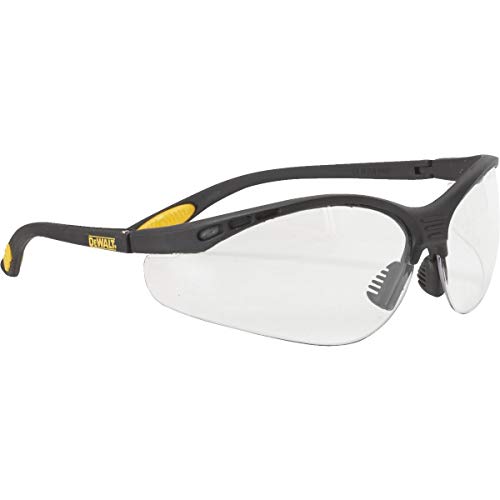
The DeWalt Reinforcer is the default choice for many tradespeople who just want something solid, cheap, and replaceable. At around £5-6 from Screwfix and Toolstation, these are genuinely worth picking up in bulk — keep a pair in the van, a pair in the toolbox, and one in the pocket.
Lens quality is adequate rather than excellent, and the anti-fog coating (where present) is basic compared to Uvex. But for site work where glasses get scratched, lost, or sat on regularly, you don’t always want to be precious about what you’re wearing. The fit is decent with a comfortable temple design that doesn’t dig in.
Trade suitability: General labourers, builders, anyone who gets through pairs quickly on dusty sites.
Pros: Very affordable, decent DeWalt build quality, EN166 rated, widely available
Cons: Anti-fog not as effective as premium options, lens can scratch faster over time
3. Bolle Tracker II Safety Glasses — Best Anti-Fog
Bolle have a solid reputation in safety eyewear and the Tracker II is one of their most trusted models for trade use. The anti-fog performance is notably good — there’s a reason these get consistently recommended on trade forums when someone asks about specs that don’t steam up.
The polycarbonate lens is rated to withstand high-speed particles and the frame has a good wraparound shape that provides proper side coverage. Comfortable for extended wear, though not quite as lightweight as the Uvex Pheos. Available from Screwfix and Toolstation for around £8-10.
Trade suitability: Plasterers, joiners working in enclosed spaces, anyone who struggles with fogging.
Pros: Excellent anti-fog, trusted brand, solid lens protection, widely available
Cons: Slightly heavier than competitors, limited style options compared to premium brands
Bolle Tracker safety glasses provides protection from all mechanical risks and also chemical risks
making it unique in the safety glasses range. This platinum permanent coating applied on both surfaces of the lens makes them highly scratch-resistant (1.4 cd/m²)
gives them a high resistance to the most aggressive chemicals and slows the appearance of fogging.
Upper protection
Interchangeable foam reinforcement with indirect ventilation
4. JSP Stealth Safety Specs — Best for Grinding
JSP is a UK-based PPE manufacturer with a strong reputation for making kit that meets professional standards without inflating the price. The Stealth model is a wraparound safety spec with a slim profile and ultra-thin lens that still offers solid impact resistance for metalwork and grinding applications.
The 99.9% UV protection is a bonus for outdoor work, and the slim frame means they fit under most face shields and welding visors. For electricians and engineers doing work near angle grinders or cutting discs, these offer a reliable option at a reasonable price — typically around £8-12 from Toolstation and Screwfix.
World's lightest - at 16 g the stealth 16g is the world's lightest safety spectacle
quality lens - dual 95 base ultra-thin and ultra-strong optically perfect lenses because they are so thin they transmit more light than other spectacles improving vision and lowering eye strain
integral nose bridge - the built in nose bridge has been designed and shaped to fit most face shapes comfortably and securely
spectacle cord anchor - the temple tips have a spectacle cord anchor point for further practicality, preventing loss or scratching from being put on rough surfaces
premier shield - stealth 16g is available in clear with our premier shield coating which gives the safety glasses anti-scratch and ant-mist properties (only available on product asa920-1a1-300)
5. DeWalt Concealer Safety Goggles — Best Goggles Option
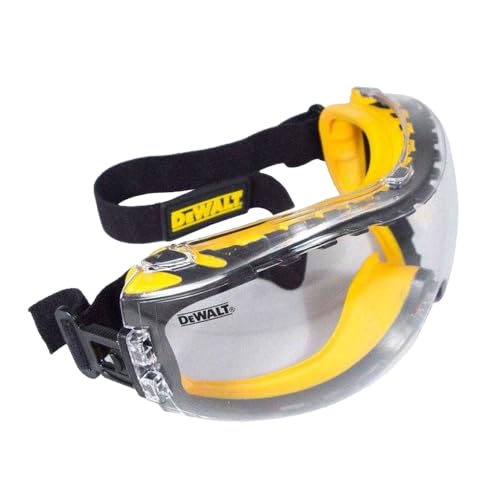
Sometimes glasses aren’t enough. If you’re cutting, routing, or working with chemicals or liquids, a proper goggle gives you the enclosed coverage that open-framed specs simply can’t. The DeWalt Concealer Goggles are the go-to at this price point — available for around £15-18 from Toolstation and Screwfix.
The indirect ventilation system significantly reduces fogging compared to cheaper enclosed goggles, and the soft frame sits comfortably over the face without gaps. They’ll fit over most prescription glasses too, which is a frequent request from tradespeople who can’t wear contacts on site. The lens can be replaced separately, which extends the product life considerably.
Trade suitability: Plumbers, roofers, floorers, anyone working with cement, chemicals, or high-dust cutting.
Pros: Full enclosed protection, fits over prescription glasses, replaceable lens, anti-fog venting
Cons: More expensive than specs, can feel warm over long periods, bulkier to carry
If you wear safety glasses every day and comfort genuinely matters to you, the Uvex i-3 is worth the extra outlay. The one-piece lens wraps around well, the temples are flexible and don’t apply pressure points at the sides of the head, and the supravision coating is among the best in class for combined anti-fog and anti-scratch performance.
Available in various lens tints, the i-3 is a popular choice with electricians and site managers who spend full days in PPE. Budget around £18-22 depending on lens type and supplier — Screwfix and Uvex UK stockists will have them.
Trade suitability: Daily wearers across all trades. Particularly popular with electricians and site supervisors.
Pros: Superior comfort for long wear, excellent lens coating, professional appearance, flexible frame
Cons: Noticeably more expensive than most options, slight overkill for occasional use
7. Stanley Airsoft Safety Glasses — Best Value Wraparound
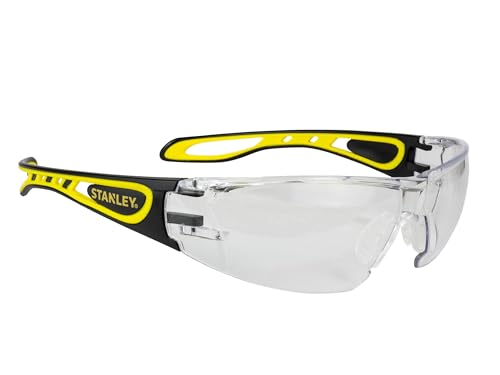
The Stanley Airsoft occupies a useful gap in the market — better than a basic pair of site specs, but not so expensive you’ll be upset when they get sat on. The wraparound lens gives decent side coverage, and the rubberised nose bridge helps them stay put when you’re sweating. Lens quality is reasonable for everyday building work.
Available from most trade counters and online retailers for around £6-9. A solid backup pair or a sensible option for apprentices just starting out who need reliable protection without spending much.
Trade suitability: General building work, groundworkers, apprentices, as backup pairs.
Pros: Good value, decent wraparound coverage, Stanley brand quality, comfortable nose bridge
Cons: Anti-fog not exceptional, not as refined as Uvex or Bolle at similar price points
Wraparound one piece lens for full coverage protection
Bi moulded rubber templates and adjustable nosepieces provide a comfortable no slip fit
Full Comparison Table
Product
Lens Coating
EN166?
Anti-Fog?
Impact Rating
Best Use
Uvex Pheos
Supravision Excel (AS+AF)
Yes
Yes — excellent
3 (high-speed)
All-day, all trades
DeWalt Reinforcer
Basic AS
Yes
Basic
3 (high-speed)
Site, everyday general use
Bolle Tracker II
K&N (scratch + fog)
Yes
Yes — very good
3 (high-speed)
Dusty/humid environments
JSP Stealth
UV400 + scratch
Yes
Moderate
3 (high-speed)
Grinding, metalwork
DeWalt Concealer Goggles
AS+AF (goggle)
Yes
Yes (vented)
3 + splash
Dust, liquids, cutting
Uvex i-3
Supravision Extreme
Yes
Yes — premium
3 (high-speed)
Daily wear, comfort priority
Stanley Airsoft
Basic
Yes
Basic
3 (high-speed)
General building, backup
Practical Tips for Wearing Safety Glasses on Site
Buying decent specs is only half the job. The rest is actually wearing them consistently and maintaining them properly.
Clean lenses with a proper lens cloth — wiping them on a dusty glove or work shirt will scratch the coating and reduce visibility. Most suppliers sell microfibre pouches cheaply.
Replace them when they’re scratched. Scratched lenses are not just annoying — they compromise optical clarity and can obscure hazards. If you can see marks across your vision, it’s time for a new pair.
Store them properly. Chucked loose in a toolbox, they’ll be scratched and frames bent within a week. Keep them in a case or a zip pocket.
Wear them correctly. Specs that sit too low on your nose or too far from your face don’t provide proper protection. A proper wraparound fit matters.
Don’t share. Safety glasses are personal PPE. Sharing fits is unhygienic and often results in ill-fitting protection.
Understanding EN166 — The UK Safety Standard for Eye Protection
All safety glasses sold in the UK for occupational use should be marked to EN ISO 16321 (the updated standard) or the legacy EN166. Look for the standard reference on the lens and frame. The markings tell you exactly what protection the product provides:
The number ‘1’ in the optical class marking means the lens meets premium optical clarity standards — important if you’re wearing them all day.
The letter ‘K’ means the lens has an anti-scratch coating. ‘N’ means anti-fog. You’ll often see ‘K&N’ on better lenses.
A ‘3’ after the impact rating means the glasses are rated for high-speed particles generated by tools like grinders and routers. This is what you need on most sites.
Don’t be put off by the technical markings — any EN166-certified glasses from a reputable supplier will be suitable for the vast majority of trade applications. If in doubt, look for the certification number and check the safety datasheet on the retailer’s product page.
Frequently Asked Questions
Do I need safety glasses or goggles?
Safety glasses are fine for most general trade work — cutting, drilling, nailing, fixing. Switch to goggles when you’re working with liquids, fine grinding dust, or in situations where particles could enter from below or the sides. Goggles also offer better protection when operating equipment that generates fine airborne particles, such as concrete saws or routers on MDF.
Can I wear safety glasses over my regular glasses?
Some models are specifically designed as ‘OTG’ (over-the-glasses) specs. The DeWalt Concealer Goggles mentioned above is a good example. Most regular wraparound specs won’t sit comfortably over prescription frames — if you wear glasses on site, either go for dedicated OTG specs or look into prescription safety glasses from specialist suppliers.
How often should I replace safety glasses?
There’s no fixed replacement schedule, but as a rule of thumb: if you can see scratches across the lens, if the anti-fog coating has worn off, or if the frame has warped or cracked, replace them. Most good-quality specs will last 12-18 months of heavy daily use with proper care.
Are tinted safety glasses allowed on site?
Tinted lenses (smoke, amber, yellow) are fine for outdoor work and can actually improve contrast and reduce eye strain in bright conditions. Don’t wear smoke-tinted lenses in low-light conditions or indoors — they’ll reduce visibility too much and create their own hazard. Clear lenses are the right default for most interior trade work.
Our Verdict
For most UK tradespeople, the Uvex Pheos hits the sweet spot — proper anti-fog performance, EN166 certified, comfortable enough to actually wear all day, and available at Toolstation and Screwfix for around £10-12. That’s not a lot of money for something that protects your eyesight.
If budget is the priority, the DeWalt Reinforcer is a solid no-nonsense option that does the job at under £6. If you work in particularly dusty or wet conditions, step up to the DeWalt Concealer Goggles for the enclosed protection you actually need.
Whatever you choose, wear them. Eye injuries are among the most common and most preventable on UK construction sites. A decent pair of safety glasses costs less than a cup of coffee and lasts months. There’s no excuse for leaving them in the van.