A random orbital sander is one of those tools that carpenters, joiners, decorators and finishing tradespeople reach for constantly — and yet it’s also one of the most overlooked purchases. Buy the wrong one and you’re fighting vibration, poor dust collection, and a sander that leaves swirl marks all over your work.
We tested seven models across a range of price points, from the affordable Erbauer at Screwfix through to the premium Festool, to find out which ones are genuinely worth your money for UK trade use. Whether you need a reliable site sander for door furniture and trim, or a precision finishing tool for joinery and fitted furniture, there’s something here.
Quick Verdict
Best overall corded: Bosch GEX 125-1 AE — well-balanced, smooth, and brilliant dust extraction for the money.
Best budget: Erbauer ERS125 from Screwfix — solid tool at under £40, surprisingly capable for general finishing work.
Best cordless: DeWalt DCW210NT — brushless motor, excellent run time on a 5Ah battery, proper trade tool.
Best premium: Festool ETS 150/5 EQ — if you’re doing high-end joinery or fitted furniture, nothing touches it.


At a Glance: Random Orbital Sander Comparison
| Sander | Power | Speed | Disc | Dust | Price (approx.) |
| Erbauer ERS125 (125mm corded) | 250W | 4,000–12,000 OPM | 125mm | Bag + port | ~£35 |
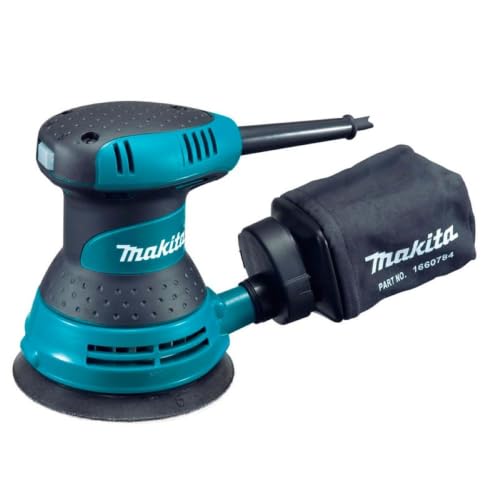
| Makita BO5030 (125mm corded) | 300W | 4,000–12,000 OPM | 125mm | Bag + port | ~£55 |
| Bosch GEX 125-1 AE (125mm corded) | 250W | 4,000–12,000 OPM | 125mm | Bag + port | ~£70 |
| DeWalt DWE6421 (125mm corded) | 280W | 8,000–12,000 OPM | 125mm | Bag + port | ~£85 |
| Makita DBO180Z (18V cordless) | 18V LXT | 7,000–11,000 OPM | 125mm | Bag + port | ~£90 bare |
| DeWalt DCW210NT (18V cordless) | 18V XR | 8,000–12,000 OPM | 125mm | Bag + port | ~£130 bare |
| Festool ETS 150/5 EQ (150mm) | 310W | 3,500–10,000 OPM | 150mm | Systainer port | ~£380 |
1. Erbauer ERS125 125mm Random Orbital Sander — Best Budget Pick
Available at: Screwfix | Price: around £35
Screwfix’s own-brand Erbauer range has improved significantly over the past few years, and the ERS125 is a solid example. It’s a 250W corded sander with a hook-and-loop pad system that makes disc changes straightforward, and the dust extraction — via the bag or a connected vacuum — works better than you’d expect at this price.
The grip is comfortable enough for an hour or two of use, and the variable speed dial lets you drop the pace for delicate work or crank it up for stripping back old finishes. For the money, it’s hard to fault.
Pros: Cheap, dust collection works well, easy disc changes, widely available
Cons: Noticeably more vibration than pricier models, not the most durable over years of heavy use
Best for: Apprentices, general tradespeople wanting a no-fuss site sander on a tight budget
2. Makita BO5030 125mm Random Orbital Sander
Available at: Toolstation, Amazon UK | Price: around £55
The Makita BO5030 has been a workhorse for tradespeople for years, and it’s easy to see why. It’s a clean, well-made corded sander with a 300W motor, soft start, and a pad-dampening mechanism that reduces swirl marks — something cheaper sanders often struggle with on fine finishes.
The dust collection via the bag is decent, though like most budget Makitas we’d recommend hooking it up to a proper vacuum for dusty environments. It’s heavier than the Erbauer but that extra mass actually helps reduce hand fatigue on longer jobs.
Pros: Reliable build quality, soft start, good for fine finishing, trusted brand
Cons: Dust bag adequate but not exceptional, heavier than budget alternatives
Best for: Joiners and carpenters who want a reliable corded workhorse without overspending
- For fast, super smooth sanding
- Pad control system for controlled pad speed upon start up
- Uses quick change 125mm hook and loop abrasive paper
- Conveniently located on/off switch for easy one handed operation
- High power motor for heavy duty applications
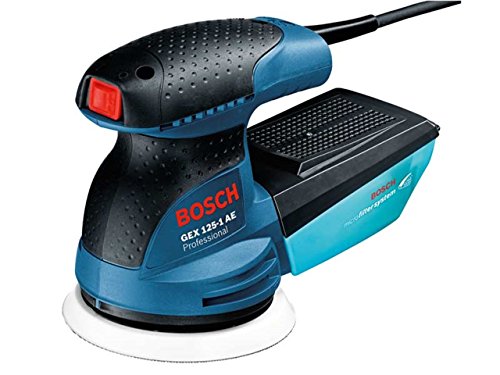
3. Bosch GEX 125-1 AE 125mm Random Orbital Sander — Best Corded Overall
Available at: Screwfix, Toolstation, B&Q, Amazon UK | Price: around £70
The Bosch GEX 125-1 AE is our top pick for corded random orbital sanders. It strikes a brilliant balance between performance, dust extraction, and ergonomics. The microfilter dust canister is noticeably more effective than a basic bag, and Bosch’s Constant Electronic feature maintains pad speed under load — which matters when you’re pushing into harder material.
The low vibration levels make it comfortable for extended use, and the pad accepts standard 8-hole 125mm Velcro discs widely available from Screwfix and Toolstation. The build feels robust without being unnecessarily heavy. For decorators and joiners doing regular finishing work, this is the sweet spot.
Pros: Excellent dust extraction, low vibration, constant speed under load, good ergonomics
Cons: Not cheap for a corded tool, microfilter cassette needs occasional cleaning
Best for: Decorators, joiners, carpenters — anyone doing regular finishing work on site or in a workshop
- Compact and ergonomic design with variable grip positions offers outstanding comfort even when working overhead
- Speed preselection option enables use in multi-material applications
- Dust box with built-in Bosch Micro Filter System for practically dust-free work
- Entry-class 125mm random orbit sander for small areas and spot repair work
- Scope of supply: Carrying case;Microfilter box (spare part number 2 609 199 133);Sanding paper K80 (2 609 170 090);Voltage 240 V

4. DeWalt DWE6421 125mm Random Orbital Sander
Available at: Screwfix, Toolstation, Amazon UK | Price: around £85
DeWalt’s corded random orbital sander is a dependable, no-nonsense tool. The 280W motor delivers a good speed range, and the rubber over-moulded grip provides solid control. The hook-and-loop pad is easy to use, and the dust bag is among the better-performing bags in this category — though we’d still recommend a vacuum connection for fine dust.
It’s heavier than the Bosch GEX and doesn’t offer quite as smooth a finish on delicate timber, but it’s built tough and handles heavier sanding tasks — stripping paint, cutting back fillers, preparing hardwoods — without complaint. It’s a workhorse sander.
Pros: Robust build, decent power, good speed range, trusted DeWalt reliability
Cons: Heavier than rivals, not as refined on delicate finishing as the Bosch
Best for: General builders and multi-traders who want a tough corded sander to handle varied tasks
- 280 W MOTOR: 8,000 - 12,000 opm, providing a superior finish
- 125 mm HOOK & LOOP PLATEN: Quick change and secure hold of Sanding Disc
- VARIABLE SPEED DIAL: Allows you to match the speed to the material
- DUAL PLANE COUNTER-BALANCE: low-vibration design reduces user fatigue
- DUST SEALED ON/OFF SWITCH: For increased durability
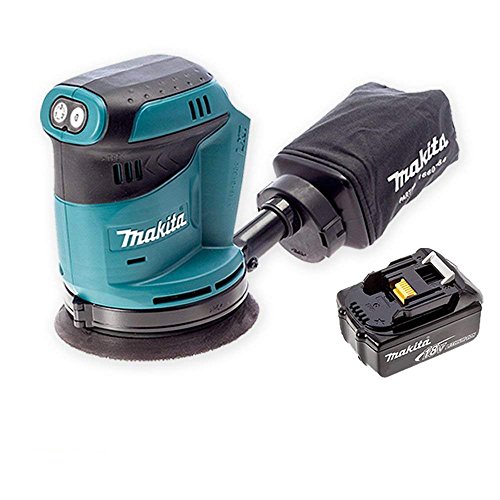
5. Makita DBO180Z 18V LXT 125mm Cordless Random Orbital Sander
Available at: Screwfix, Toolstation, Amazon UK | Price: around £90 (bare unit)
If you’re already running Makita 18V LXT batteries, the DBO180Z is an obvious first look. It’s a compact, lightweight cordless sander that handles general finishing tasks well. The 7,000–11,000 OPM range gives reasonable flexibility, and the low-profile design makes it easier to use in confined spaces than bulkier corded models.
Battery life is reasonable — expect around 45 minutes to an hour of active sanding on a 3Ah battery before you need to swap. On a 5Ah battery, you’re comfortably into a half day of light use. Dust extraction via the bag is adequate for site work; for workshops we’d always hook up a vacuum.
The trade-off is that this is a brushed motor tool. The newer DBO180RTJ with a brushless motor is worth considering if you’re sanding frequently, as it’ll be noticeably more efficient and last longer under heavy use.
Pros: Lightweight, compact, integrates with LXT system, decent cordless performance
Cons: Brushed motor, battery not included, not quite as smooth as corded at the same price
Best for: Makita LXT users who want a cordless sander for site work or jobs without easy power access
- 1 x DBO180Z Random Orbital Sander
- 1 x Makita BL1850 5.0Ah Battery
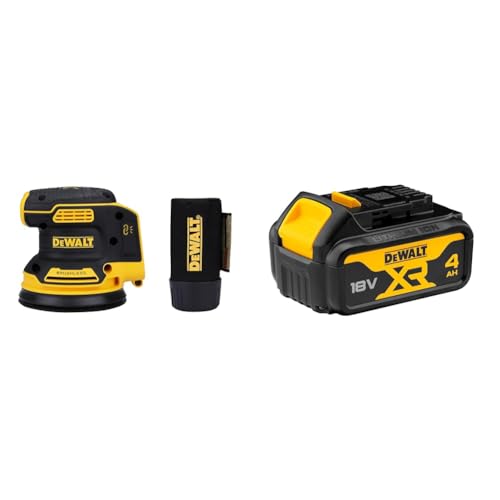
6. DeWalt DCW210NT 18V XR 125mm Cordless Random Orbital Sander — Best Cordless
Available at: Screwfix, Toolstation, Amazon UK | Price: around £130 (bare unit)
The DeWalt DCW210NT is the best cordless random orbital sander we tested for trade use. The brushless motor delivers noticeably more power and efficiency than the Makita DBO180Z, and the variable speed (8,000–12,000 OPM) gives genuine flexibility for different materials and finishes.
The two-handed design — with a rear grip in addition to the top handle — gives better control on vertical surfaces and overhead work, which makes a real difference for decorators finishing doors and wall panels. Dust collection is good, and the bag works well enough for general site use.
On a 5Ah battery, you’re looking at over an hour of continuous use. For carpenters and joiners fitting out rooms or doing detailed finishing work away from power, this is a genuinely capable tool.
Pros: Brushless motor, excellent battery life, two-handed design, smooth finish on all materials
Cons: Expensive bare, battery not included, heavier than the Makita
Best for: Carpenters, decorators, and joiners who sand frequently and want the best cordless option
- Cordless technology for more user freedom
- Low vibration allowing for extended usage without fatigue
- Built in dust extraction port allowing direct connection to dust extractor, or DEWALT AirLock system
- Lightweight design provides the user with upgraded 4.0Ah Power without increasing the size or weight over the 18V 3.0Ah battery pack
- Inbuilt Protection against overheat, overload and deep discharge, increases battery life
7. Festool ETS 150/5 EQ 150mm Random Orbital Sander — Best Premium
Available at: Festool stockists, Amazon UK | Price: around £380
The Festool ETS 150/5 EQ is the benchmark for professional finishing sanders. It uses a 150mm pad rather than 125mm, which increases the surface area by roughly 44% — you cover more ground in less time. The variable speed and Festool’s EC-TEC motor maintain consistent performance under load, and the vibration levels are genuinely low even during extended use.
Where Festool earns its price tag is in dust extraction. Connect it to a Festool CT extractor and you’ll get near-laboratory-clean air at the tool. For tradespeople fitting high-end kitchens, bespoke joinery, or expensive hardwood flooring, that level of dust control is worth paying for — both for the finish quality and health reasons.
It’s not for everyone. If you’re a general builder doing occasional sanding between other tasks, you’d be overspending significantly. But for joiners and decorators working on premium jobs where finish quality matters, the Festool justifies its cost.
Pros: Outstanding finish quality, exceptional dust extraction, 150mm pad, low vibration, built to last decades
Cons: Very expensive, overkill for general site use, proprietary accessories
Best for: Joiners, cabinet makers, and high-end decorators where surface finish and dust control are critical
- Illuminating: The first battery-powered one-handed eccentric sander with an integrated light ring.
- Designed to fit your hand: Thanks to its optimised ergonomics and low height, you can work with your hand directly at the surface – for optimal control even in narrow areas.
- Working with a Festool system: The 18V power in the Festool system enables you to seamlessly switch between batteries and machines.
- Individual lighting: There are two light modes that can be set on the machine – full lighting or dimmed light.
- More functions with the Festool app: You can use your smartphone to dim the light in a customised and infinitely adjustable manner – enabling you to check the surface again after finishing sanding.
What to Look for in a Random Orbital Sander for Trade Use
125mm vs 150mm
Most trade sanders use 125mm pads, and the discs are widely available from Screwfix and Toolstation. The 150mm format covers more surface area per pass — better for large flat surfaces like floors and panels — but the discs are less commonly stocked and more expensive. For most tradespeople, 125mm is the right starting point.
Corded vs Cordless
Corded sanders are cheaper, lighter, and run indefinitely — ideal for workshop and fixed-site use. Cordless makes sense if you’re working at height, in confined spaces, or on jobs without easy access to power. If you’re fitting out a house room by room, the DeWalt DCW210NT genuinely earns its keep. If you’re sanding in a workshop, save the money and buy corded.
Dust Extraction
The dust bag that comes with most sanders is adequate for short bursts but won’t cut it for any sustained work — especially with MDF, hardwoods, or old painted surfaces. Always look for a tool with a vacuum port, and hook it up to an M-class extractor for anything dusty. Your lungs will thank you, and it keeps your finish cleaner too.
Variable Speed
Variable speed is worth having on any sander you plan to use regularly. A lower speed setting helps with delicate surfaces — bare softwood, veneer, fine hardwood — where full speed can leave marks. Most mid-range and above tools include this as standard.
Disc Compatibility
Stick to sanders that take standard 8-hole hook-and-loop 125mm discs. These are stocked everywhere — Screwfix, Toolstation, B&Q, Amazon — and are available in every grit from 40 through to 400. Proprietary disc systems lock you into one supplier and add ongoing cost.
Which Random Orbital Sander Should You Buy?
If you’re an apprentice or occasional user who needs a capable sander without overspending, the Erbauer from Screwfix at around £35 is a genuine bargain.
If you’re a decorator, joiner, or carpenter doing regular sanding work and want the best corded tool, the Bosch GEX 125-1 AE is our top pick at around £70. It’s smooth, effective, and well-built.
If you need cordless freedom for site work, the DeWalt DCW210NT is worth the premium — the brushless motor and battery efficiency make a meaningful difference over a working day.
If you’re working on premium joinery or high-end fitted furniture, look seriously at the Festool. It’s expensive, but the finish quality and dust extraction are in a different league.
Final Verdict
For most UK tradespeople, the Bosch GEX 125-1 AE hits the sweet spot — it’s affordable, performs well on fine finishes, and extracts dust better than anything else at the price. If your work takes you to jobs without power, upgrade to the DeWalt DCW210NT cordless and you’ll have a tool that keeps up with daily demands.
Whatever you buy, pair it with a proper dust extractor for sustained use. It’ll improve your finish, protect your health, and stop you breathing in materials that are best kept off the job — particularly MDF and old paint.
Related Posts