Quick Verdict
The DeWalt DPC6MRC Mini Roll Cage is still our overall pick for site and second-fix work — light, quiet enough for indoor use, and genuinely portable. If noise matters most, the Bambi Air BB24V Super Silent is worth the extra spend, and workshops running air tools regularly should look at the Hyundai HY3050V V-Twin for sustained output.
At a Glance — Air Compressor Comparison
Product | Best For | Tank Size | Price (approx) |
Clarke Monza 6.35CFM Oil-Free | Budget workshop use | Portable, no tank | £130 |
DeWalt DPC6MRC Mini Roll Cage | Second-fix carpentry, site work | 6L | £190 |
Makita MAC610 Oil-Free | Quiet indoor trade use | 6L | £210 |
SGS Engineering 24L 9.6CFM | Small workshop, hobby trade | 24L | £150 |
Bambi Air BB24V Super Silent | Customer-facing indoor work | 24L | £420 |
Hyundai HY27550 50L Oil-Free Silent | Van-portable workshop | 50L | £240 |
Hyundai HY3050V V-Twin Direct Drive | Busy workshop, spray/air tools | 50L | £290 |
One product in the original line-up, the Clarke “Boxer 6/50”, doesn’t match any current Clarke SKU we could verify on Amazon UK — Clarke’s Boxer range runs much larger (100L+) belt-driven units, not a 6CFM/50L model. It’s been swapped below for the closest genuine budget Clarke compressor, the Monza 6.35CFM oil-free unit. The other six picks all check out as current, purchasable UK listings.
1. Clarke Monza 6.35CFM Oil-Free — Best Budget Compressor
Our original budget pick, the Clarke “Boxer 6/50”, doesn’t correspond to a real current Clarke model on Amazon — Clarke’s Boxer line is built around much larger belt-driven workshop units. For a genuine budget entry point from the same brand, the Monza 6.35CFM oil-free portable compressor fills that role: light, no oil to maintain, and cheap enough to be a sensible first compressor for occasional DIY and light trade use.
It won’t run demanding air tools continuously, but for inflation, light nailing and the odd blow-down job, it’s honest value.
- 35 CFM output
- 5HP oil-free motor
- Portable, lightweight

2. DeWalt DPC6MRC Mini Roll Cage — Best Overall
Still the compressor we’d recommend to most trades. The roll cage design protects it on a site floor, it’s genuinely light enough to carry up a ladder or between vans without a second thought, and the 6L tank is enough for second-fix nailing, stapling and general trim work without being oversized for the job.
- 6L tank
- Roll cage protection
- 240V
- Compact and portable

3. Makita MAC610 Oil-Free — Best for Quiet Indoor Work
When you’re working inside an occupied house or a customer-facing environment, noise matters as much as output. The MAC610 is one of the quieter oil-free units on the market at this size, without sacrificing enough output to be frustrating on second-fix work — a genuinely good choice for finish carpentry inside someone’s home.
- 8-bar oil-free unit
- 240V
- Lower operating noise for its class
No products found.
4. SGS Engineering 24L 9.6CFM — Best Mid-Range Workshop
For a small workshop or hobby-trade setup that needs more sustained output than a portable site compressor but doesn’t want to commit to a full 50L unit, this 24L direct-drive SGS compressor delivers a genuinely useful 9.6CFM at a price that undercuts most of the competition in this bracket.
- 24L tank
- 6 CFM, 2.5HP
- Direct drive
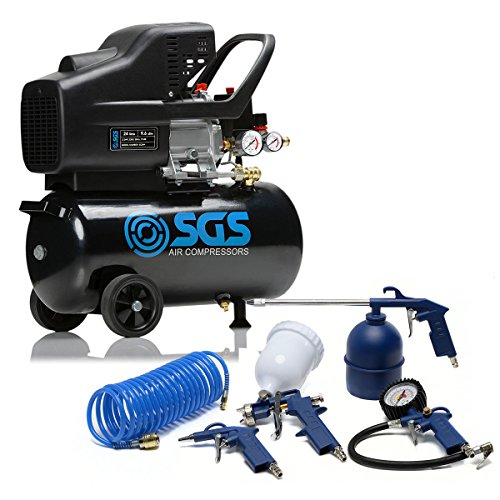
5. Bambi Air BB24V Super Silent — Best for Customer-Facing Work
Bambi’s compressors are built specifically around low noise, and the BB24V is the unit to buy if you’re working somewhere noise complaints are a genuine risk — dental practices, offices, occupied homes. It costs significantly more than a standard 24L compressor for the privilege, but for the right job, that’s the entire point of buying it.
- 24L tank
- Ultra-quiet operation
- Oil-lubricated for longevity
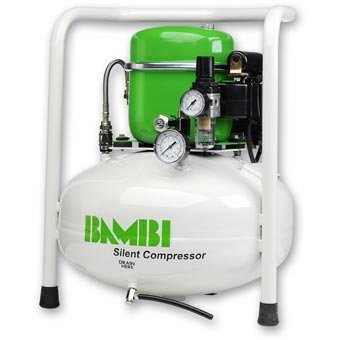
6. Hyundai HY27550 50L Oil-Free Silent — Best Portable Workshop
50 litres of tank capacity with an oil-free motor and genuinely low noise output makes the HY27550 a strong choice for a van-based tradesperson who wants workshop-level air capacity without workshop-level maintenance or noise. 11 CFM at 118psi comfortably runs most air tools.
- 50L tank
- 11 CFM, 750W/2HP
- Oil-free, low noise


7. Hyundai HY3050V V-Twin Direct Drive — Best for Heavy Workshop Use
For a busy workshop running spray guns, impact tools or anything with sustained air demand, the V-twin direct-drive HY3050V delivers noticeably better recovery time than single-cylinder units at a similar tank size. It’s louder and heavier than the portable options on this list, but that’s the trade-off for real workshop-grade output.
- 50L tank
- V-twin direct drive
- Higher sustained CFM output

What to Look for in an Air Compressor
CFM (cubic feet per minute) at a given PSI tells you whether a compressor can actually keep up with your tool, not just inflate a tyre — check your air tool’s CFM requirement against the compressor’s output at working pressure, not just its peak.
Oil-free motors need less maintenance and are usually lighter, but oil-lubricated motors generally run cooler and last longer under sustained heavy use — which is why bigger workshop units tend to be oil-lubricated.
Tank size affects recovery time and run-cycle frequency more than outright power — a bigger tank means fewer, longer motor run cycles rather than the motor working harder.
Noise output (dB) matters far more than most buyers budget for until they’re working somewhere it becomes a problem — customer-facing and residential jobs are where the quieter (and pricier) units earn their keep.
Frequently Asked Questions
Which trades need what?
Site and second-fix carpenters generally want something small and portable like the DeWalt DPC6MRC. Workshop-based mechanics and spray work benefit from a larger tank and sustained CFM like the Hyundai HY3050V. Anyone working in occupied or customer-facing spaces should prioritise noise output over raw power.
Do I need oil-free or oil-lubricated?
Oil-free is lower maintenance and fine for occasional to moderate use. If you’re running the compressor for hours at a time, several times a week, an oil-lubricated unit will generally last longer under that duty cycle.
How much CFM do I actually need?
Check the tool with the highest CFM demand you’ll be running — most brad nailers need very little, but a die grinder or sander can need considerably more. Buy for your most demanding tool, not your average one.
The Verdict
For most trades, the DeWalt DPC6MRC still earns its place as the sensible default — portable, quiet enough, and sized right for common site work. Step up to the Hyundai units if you need sustained workshop output, and reach for the Bambi if noise genuinely can’t be a problem on the job.
Related reading