Best Voltage Tester UK 2026 — 7 GS38-Compliant Picks for Sparks and Multi-Trade Use
If there’s one tool every electrician owns from day one and replaces every few years, it’s a voltage tester. It’s the kit that proves a circuit is dead before you put your screwdriver anywhere near it — and on a busy day, it’s the difference between getting home for tea and a trip to A&E. The wrong tester gets binned within a week. The right one lives in your pouch for years.
We’ve pulled together seven of the best voltage testers you can buy in the UK in 2026, covering cheap-and-cheerful non-contact pens for spot checks, GS38-compliant two-pole testers for proper proving-dead work, and premium units with built-in continuity, RCD trip and phase rotation. There’s a comparison table below, plus advice on what to look for by trade type.
Prices were checked across Amazon UK, Screwfix, Toolstation and CEF at the time of writing. Treat them as a guide — tester prices move around with seasonal trade promotions and stock availability.
Our quick verdict
Best overall: Kewtech KT1790 — 18th edition compliant, GS38 finger guards, switchable LED torch, and the right answer for most working sparks.
Best budget: Fluke 1AC-A1 II VoltAlert — around £25 and the most reliable non-contact pen tester on the market. Every spark should have one in their van as a backup.
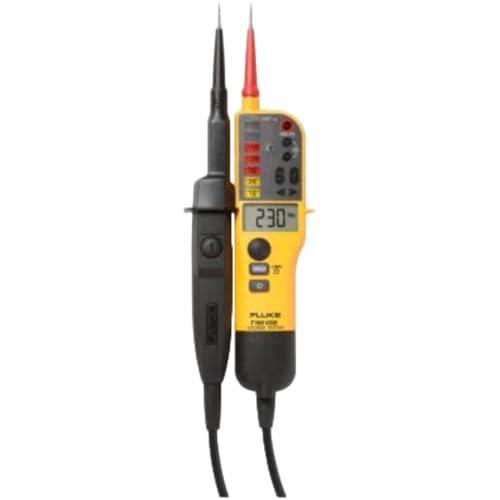
Best premium: Fluke T150 — full LCD readout, switchable load, continuity and rotation testing. The Land Rover of voltage testers — pricey, but you’ll never buy another.
At a glance — voltage tester comparison
Product
Best For
Type
Price (approx)
Where to Buy
Draper Expert 2-Pole Tester
Budget proving dead
2-pole
Around £20
Amazon UK, Toolstation
Fluke 1AC-A1 II VoltAlert
Quick non-contact spot checks
Non-contact
Around £25
Amazon UK, Screwfix
Knipex 98 25 20 NCV Tester
Backup pen with torch
Non-contact
Around £30
Amazon UK, CEF
Martindale VT25
Solid daily-use 2-pole
2-pole
Around £70
CEF, Toolstation
Kewtech KT1790
Best all-round trade tester
2-pole + RCD
Around £85
Screwfix, CEF, Amazon UK
Megger TPT320
LCD reading, low-impedance
2-pole + LCD
Around £100
CEF, RS Components
Fluke T150
Premium do-it-all tester
2-pole + LCD
Around £180
Amazon UK, RS, CEF
[amazon table="2663"]
What to look for in a voltage tester
Voltage testers look more or less the same on the shelf — two leads, a couple of LEDs and a price tag. The differences only become obvious when you’re actually using one. Before we get to the picks, here’s what should be on your checklist:
GS38 compliance — the HSE’s guidance for working with electricity. Probes must have finger guards, no more than 4mm of exposed metal at the tip, and built-in fused leads. If it’s not GS38 compliant, it’s not legal for trade use. Cheap testers from unknown brands often skip this.
Two-pole vs non-contact — non-contact pen testers are useful for a quick yes/no on whether a cable is live, but they don’t prove dead. For safe isolation under BS 7671, you need a proper two-pole tester. Most working sparks carry both.
Voltage range — for UK trade work you want at least 12V to 690V coverage. That handles single-phase domestic, three-phase commercial, and three-phase industrial in one tool. Some budget units stop at 400V, which leaves you short on commercial sites.
Low-impedance / load function — a low-Z tester deliberately loads the circuit to dissipate any phantom voltages from inductive coupling. Without this, modern PIR sensors, dimmer circuits and long parallel runs can show ‘live’ when they aren’t. Essential for fault-finding in modern installations.
Continuity and RCD trip — useful extras on mid-range and premium testers. Continuity buzzer saves you swapping to a multimeter for simple checks; RCD trip is handy for verifying safety devices on first fix.
Display — LED-only testers (volts shown by which lamp lights up) are tough and quick to read in poor light. LCD testers give exact voltages but need batteries and can be harder to see in bright sunshine. Both have their place.
Battery vs no battery — GS38-compliant two-pole testers can work without batteries (the test voltage powers the lamps), which means they’ll always work when you need them. Anything with an LCD or NCV function needs batteries — keep spares in the van.
1. Draper Expert 2-Pole Tester — best budget
Price: around £20 | Where: Amazon UK, Toolstation, Draper
Draper’s Expert range is the entry point for trade-grade voltage testers, and at twenty quid the 2-pole tester is the cheapest GS38-compliant unit worth buying. Voltage range is 12V to 690V AC/DC, you get the standard LED bar showing voltage steps, and the leads pass the finger guard / 4mm probe test. Build is plasticky compared to a Kewtech or Martindale, but for a backup tester or an apprentice tool, it does the job.
Pros: GS38 compliant, full voltage range covered, cheap enough to keep a spare in the van.
Cons: leads feel thin, no continuity buzzer, plastic body won’t survive being trodden on.
Best for: apprentices, multi-trade installers (gas, plumbing, kitchen fitters) who need an occasional tester, anyone who wants a backup.
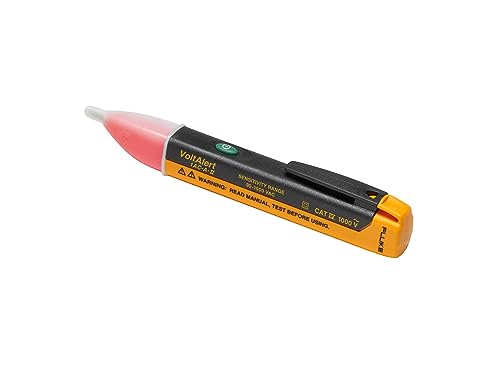
2. Fluke 1AC-A1 II VoltAlert — best non-contact pen
Price: around £25 | Where: Amazon UK, Screwfix, RS Components
The VoltAlert is the pen tester every spark we know has clipped to their breast pocket. Fluke’s non-contact tester glows red and beeps when it detects mains voltage, and it’s accurate enough that you can use it through standard PVC sheathing. Pocket clip doubles as a torch trigger. It’s not a substitute for a proper two-pole tester — it can give false negatives behind metal back boxes — but as the first thing you reach for on a board, it earns its keep daily.
Pros: famously reliable, dust and waterproof IP67, runs for years on two AAA batteries, the industry standard for a reason.
Cons: non-contact only — never use it as your sole means of proving dead; doesn’t show voltage, just presence.
Best for: every working electrician as a back-pocket tool, kitchen fitters and plumbers wanting a quick check on cables before drilling
3. Knipex 98 25 20 NCV Tester — best non-contact alternative
Price: around £30 | Where: Amazon UK, CEF, Cromwell
If you’ve ever owned a pair of Knipex pliers you know the build quality, and their non-contact voltage tester is no exception. Same idea as the Fluke — beep and red light when mains is detected — but with a noticeably brighter front LED that doubles as a proper work torch, and a slightly chunkier grip that’s easier in cold hands. It costs a fiver more than the VoltAlert, but for some sparks that’s worth it for the better torch alone.
Pros: good torch, IP54 rated, German build, two-stage sensitivity to find cables behind plaster.
Cons: slightly bigger than the Fluke, not as widely stocked in UK trade counters.
Best for: sparks who use the torch a lot, joiners and kitchen fitters wanting one tool for cable detection and lighting.
4. Martindale VT25 — best mid-range two-pole
Price: around £70 | Where: CEF, Toolstation, Martindale Direct
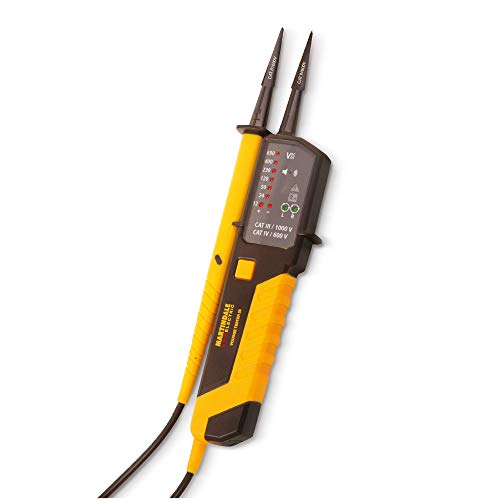
Martindale is a British brand that quietly supplies a lot of council and housing-association stock. The VT25 is their bread-and-butter two-pole tester — 12V to 690V range, GS38 leads, single-pole detection on one probe so you can identify the live conductor, and a continuity buzzer. No LCD, no RCD function, but everything you actually need for safe isolation under 18th edition. Build is solid and the leads have a magnetic clip on the back that holds them together on your belt — small thing, but you’ll appreciate it.
Pros: British support, GS38, single-pole live detection, magnetic lead clip.
Cons: no RCD trip function, no LCD voltage readout, plain LED display only.
Best for: domestic and commercial sparks who want a reliable daily-use tester without paying premium prices.
Price: around £85 | Where: Screwfix, CEF, Amazon UK, Kewtech Direct
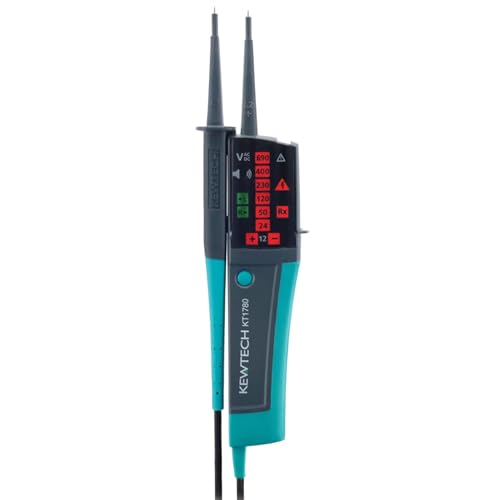
The KT1790 is the tester you see in more electricians’ pouches than any other model on this list, and there’s a reason. It’s GS38 compliant, covers 6V to 690V AC/DC, has a switchable load button for low-Z testing on phantom voltages, includes single-pole detection, continuity, RCD trip (30mA) and phase rotation indication, and has a built-in LED torch with the trigger sensibly placed on the back of the main probe. Kewtech is a UK brand with proper trade-counter support and replacement leads available from any wholesaler. For most working sparks this is the right tool, and the right price.
Pros: full feature set, GS38, low-Z load function, RCD trip, phase rotation, LED torch, UK support.
Cons: no LCD readout (LED bar only), batteries required for full functionality.
Best for: domestic and commercial electricians, EV chargepoint installers, solar engineers — anyone who wants one tester to handle everything in the pouch.
✔️ The KT1780 Voltage Tester measures AC and DC voltages up to 690, providing clear LED indication of the detected voltage level.
✔️ With GS38 compliant slender probe tips and designed to the new international standards IEC 61243-3, IEC 61010-1 and measurement category CAT IV 600V
✔️ Perform continuity, single pole phase, polarity and phase rotation testing as well as a self diagnostic test to ensure correct operation.
✔️ Slender UK specific probe tips that fit into recessed terminals such as RCBOs
✔️ The Kewtech brand has become synonymous with high quality, as we manufacture innovative, accurate and reliable test equipment specifically for the UK market.
6. Megger TPT320 — best for fault-finding
Price: around £100 | Where: CEF, RS Components, Amazon UK
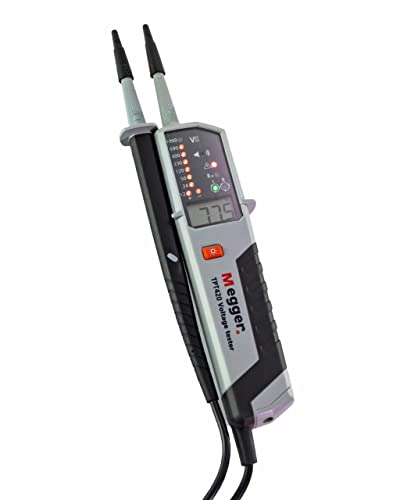
Megger’s TPT320 is a slightly different proposition. It’s still a GS38 two-pole tester, but instead of an LED bar it has a small LCD that gives you the actual voltage reading from 6V to 690V. That makes it the right pick if you spend a lot of your day fault-finding rather than just proving dead — knowing whether you’re seeing 110V, 230V or a phantom 50V actually matters when chasing intermittents. Low-Z load function as standard, RCD trip on board, and the build is the usual Megger heavy-duty plastic.
An easy-to-use and ergonomic voltage meter - Voltage detection is also indicated by an audible alert
AC voltage range: 12 to 1000V / DC voltage range: 12 to 1200V
Continues to detect voltage even after the batteries have expired
Works below the tipping thresholds of RCDs, RCBOs and safety breakers when testing circuits between phase and earth
Optimised for testing electrical installations
7. Fluke T150 — best premium tester
Price: around £180 | Where: Amazon UK, RS Components, CEF
The T150 is what you buy when you’ve stopped caring about price and just want the best two-pole on the market. Fluke’s premium tester gives you a backlit LCD with both voltage and resistance readings, selectable load function, continuity, single-pole detection, phase rotation and an audible warning above 50V. The leads are noticeably better than anything on this list — thicker, more flexible, and the probe tips have removable caps that let you switch between standard and 4mm GS38 modes for testing in confined back boxes. It’s overkill for first-fix domestic, but for commercial, industrial or anyone who lives by their tester, it’s the gold standard.
Pros: best build quality on the market, full feature set, backlit LCD, removable probe caps, lifetime warranty.
Cons: expensive, batteries needed, more features than most domestic sparks will ever use.
Best for: commercial and industrial electricians, M&E contractors, panel builders, anyone who’s broken three cheap testers and is done with it.
T150 Voltage and Continuity Tester with backlit LCD readout and additional ohms measurement gives you fast test results the way you need them.
This continuity tester has an easy to use interface with large buttons, display hold, switchable load, bright backlights and clear audible and physical indicators designed for any work situation.
T150 two-pole voltage and continuity tester measures low ohm resistances up to 1999 Ω.
This voltage tester is the best for your tool belt. Enhanced ergonomic design is easy to use (even with gloves on) and offers quick, secure probe docking.
Two-pole voltage and continuity testers measure voltage, but just as important is when a voltage tester tells you that there is NOT voltage present before working on any circuit. For you to rely on your two-pole tester, it has to be the most rugged and reliable tester you can find.
Which voltage tester by trade?
Domestic electricians
The Kewtech KT1790 is the right answer for most. GS38, low-Z, RCD trip and torch in one unit covers everything you’ll see in a domestic property. Pair it with a Fluke 1AC VoltAlert in your top pocket for quick checks before you commit to a full proving sequence.
Commercial and industrial sparks
Step up to the Megger TPT320 or Fluke T150. The actual voltage readout matters when you’re working across mixed 230V/110V/three-phase environments, and the better build quality earns its keep when you’re using a tester thirty times a day instead of three.
Maintenance and facilities engineers
Fault-finding is where an LCD tester pays off. The Megger TPT320 is the sensible pick — Megger’s reputation in the maintenance world is hard-won, and the LCD makes intermittents far easier to chase down.
Multi-trade and adjacent trades (kitchen fitters, plumbers, gas)
You don’t need a £180 Fluke. The Draper Expert 2-pole at around £20 covers your need to check that a circuit is isolated before working near it, and a Fluke VoltAlert is worth the extra £25 for the speed of a quick non-contact check.
Apprentices
Don’t waste money on a premium tester until you know how you work. The Martindale VT25 at around £70 is a proper trade-grade tester that won’t embarrass you on site, and you can step up to a Kewtech or Fluke once you’ve got a year or two under your belt.
How to use a voltage tester safely (the proving sequence)
A voltage tester is only as safe as the way you use it. The standard proving sequence under BS 7671 / 18th edition is straightforward and should be drilled into every spark from day one:
Test your tester on a known live source (a proving unit or a circuit you know is live).
Test the circuit you want to work on — between line and neutral, line and earth, neutral and earth.
Re-test your tester on the known live source to confirm it didn’t fail between the two tests.
Only then start work.
Skipping the first or third step is how people get hurt. A proving unit (Kewtech KEWPROVE3 or similar) costs around £30 and means you don’t need to find a live socket every time you isolate a circuit. Worth every penny.
Frequently asked questions
What’s the difference between a voltage tester and a multimeter?
A voltage tester is purpose-built for one job — proving a circuit live or dead — and is built to withstand site abuse, drops and short circuits. A multimeter is a more sensitive measurement tool with a wider range of functions but needs more care. Most sparks carry both: a tester in the pouch for daily isolation work, a multimeter in the toolbox for set-up and fault-finding.
Can I use a non-contact pen tester to prove dead?
No. Non-contact testers can give false negatives when there’s metal between the cable and the sensor (back boxes, conduit, screened cable), and the HSE specifically requires a two-pole contact tester for safe isolation work. Use a pen tester for quick first checks only — never as your final proof.
Do I need a GS38-compliant tester for domestic work?
Yes. GS38 is the HSE’s guidance on test probes and leads for safe working, and it applies to any electrical work in the UK regardless of voltage or environment. The 4mm exposed probe rule and finger guards exist because they prevent accidental short-circuits and shocks. Cheap testers from generic Amazon sellers often don’t meet GS38 — check before you buy.
How often should I replace my voltage tester?
Every two to three years for daily use, sooner if you’ve had a major short-circuit through it or the leads show wear. Calibration drifts over time, and the leads are the weak point — replace them if the insulation cracks or the probe tips bend. Many wholesalers offer free annual checks of trade-brand testers.
Do voltage testers need calibrating?
Strictly, no — they’re indicators, not measurement instruments, and don’t appear on the BS 7671 calibration list. That said, most decent testers should be sense-checked annually against a known reference (a multimeter on a live circuit will do). Replace anything that’s reading wildly off.
Final verdict
For most UK electricians reading this, the Kewtech KT1790 is the right answer. It’s GS38 compliant, covers every feature you’ll realistically use, and at around £85 it’s the sweet spot between Draper-grade plastic and Fluke-grade premium pricing. Add a Fluke 1AC VoltAlert in your top pocket for £25 and you’ve got the kit to handle 95% of proving-dead and live-tracing jobs you’ll see this year.
If you’re spending all day fault-finding rather than installing, step up to the Megger TPT320 — the LCD readout earns its keep within a fortnight. And if you’re a commercial or industrial spark who’s already broken two cheap testers this year, just buy the Fluke T150 and stop thinking about it. There’s a reason every panel-builder and M&E contractor we know is carrying one.
Whatever you end up with, do the proving sequence every single time — known live, dead circuit, known live again. A £30 proving unit lives in the van for a reason. Every electrician who’s been doing this for a decade has at least one story about why that habit saved them.