A good nail gun is one of those tools that completely changes the way you work. What used to take half a morning with a hammer — fixing skirting boards, fitting door casings, nailing off floor decking — suddenly takes minutes. Once you’ve used one, you won’t go back.
The UK market is packed with options though, and the choice isn’t always obvious. Gas-powered or cordless battery? First fix or second fix? Paslode or DeWalt? There’s a lot to think about, especially when decent nailers start at £150 and pro-grade kit can push £600 or more. Getting it wrong is an expensive mistake.
We’ve pulled together the best nail guns available in the UK right now — covering brad nailers for 2nd fix joinery, framing nailers for structural work, and budget-friendly options for DIYers. Whether you’re a chippy, a builder, or a keen weekend warrior, there’s something here for you.
Quick Picks
| Product | Best For | Price Range |
| Paslode IM65 F16 | Best overall 2nd fix | ~£490 |
| Paslode IM350+ | Best framing / 1st fix | ~£550 |
| DeWalt DCN680N | Best 18V battery brad nailer | ~£300 (body only) |
| Makita DFN350ZJ | Best Makita LXT option | ~£460 (body only) |
| Milwaukee M18FN16GS | Best for Milwaukee users | ~£200 (body only) |
| Ryobi ONE+ RFN18-0 | Best budget / DIY cordless | ~£180–£210 |
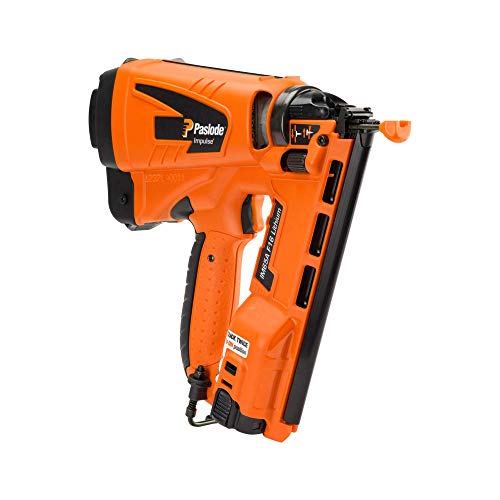

1. Paslode IM65 F16 — Best Overall 2nd Fix Nailer
- Excellent weight and balance ratio
- Consistent excellent finishing
- Quick charge Lithium battery
- Up to 10,000 shots per charge
- Distinctive angled magazine
The Paslode IM65 F16 is the benchmark for 2nd fix work in the UK. It’s been the go-to for carpenters and joiners for years, and there’s a reason it stays at the top: it’s incredibly reliable, fast to use, and purpose-built for the kind of work British tradespeople actually do. Architrave, skirting, door linings, stair spindles — this gun handles all of it without blinking.
What makes the IM65 different from battery nailers is its fuel-and-battery system. A small gas canister provides the driving force, with the lithium battery just handling ignition. The result is a gun that drives nails with real consistency — typically 16g brads from 25mm to 63mm — and delivers around 1,000 shots per canister. It’s one of the more expensive options to run because of the fuel canisters, but for professional use the reliability and speed more than justifies it.
Build quality is excellent, and the tool-free jam clearing is a genuinely useful feature on a busy site. The balanced weight and good grip mean you can nail off a full room’s worth of skirting without your arm falling off. If you’re a tradesperson doing 2nd fix day in, day out, this is the one to get.
Pros
- Proven reliability on site over many years
- Consistent nail driving thanks to the gas-powered system
- Tool-free jam clearing, easy to maintain
- Balanced, comfortable to use all day
Cons
- Ongoing fuel canister cost adds up
- Can be temperamental in very cold weather
- Pricier upfront than battery rivals
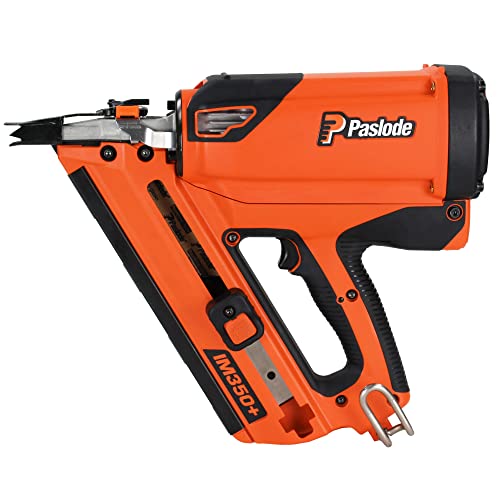
2. Paslode IM350+ — Best 1st Fix / Framing Nailer
- Powerful Paslode framing nailer: 82 Joules
- Suitable for versatile framing applications
- Added comfort and control for improved ergonomics and maneuverability
- Delivers up to 9,000 shots per charge, equates to over 4 nail fuel packs
- Fast charging, high performing Lithium battery (200 shots with just 2 minutes of charge)
If the IM65 is the king of 2nd fix, the Paslode IM350+ is the workhorse for 1st fix and structural nailing. This is the framing nailer you’ll spot on every major UK construction site — whether it’s nailing off roof timbers, fixing studwork, or laying floor decking at speed. It fires 51–90mm nails and gets through the heavy stuff without the need for a compressor.
Like the IM65, it runs on a fuel-and-battery system, and that’s a big deal for site work. No trailing hoses, no waiting for a compressor to build pressure — just pick it up and drive nails. The depth-of-drive adjustment is simple and effective, and the magazine takes 34-degree paper collated nails which are widely available across UK merchants and builders’ merchants.
The IM350+ weighs a bit more than a brad nailer, which is fair enough given what it does. It’s not a tool you’d use for fine joinery, but for structural timber work it’s arguably the most practical 1st fix nailer you can buy in the UK. Pair it with the IM65 and you’ve got a seriously capable nailing setup for any trade.
Pros
- No compressor required — proper cordless freedom on site
- Fast cycle time — keep up with the fastest carpenters
- Widely available nails at UK merchants
- Robust build that takes site abuse
Cons
- Fuel canister running costs
- Heavier than a brad nailer — feels it by end of day on overhead work
- Not suitable for delicate 2nd fix
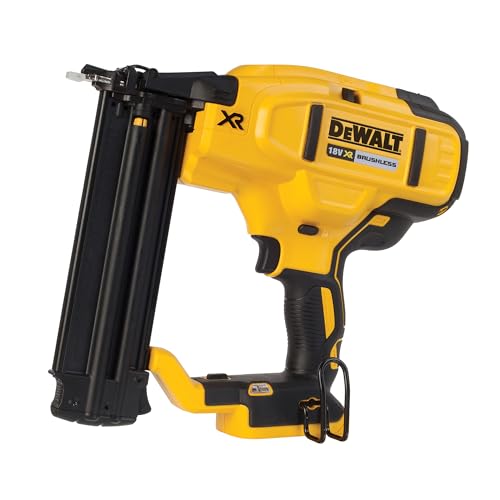
3. DeWalt DCN680N — Best 18V Cordless Battery Brad Nailer
- BRUSHLESS MOTOR: The advanced brushless motor technology delivers exceptional performance by maximising power output while minimising energy loss. This design not only extends the overall lifespan of the tool but also allows for a more compact and ergonomic build, making it easier to handle in tight spaces and reducing fatigue during prolonged use.
- ADJUSTABLE DRIVE DEPTH: The depth of drive can be conveniently adjusted using the thumb wheel depth adjuster. This facillitates precise nail placement and ensures optimal performance for various materials and applications.
- SEQUENTIAL MODE: Ideal for precision placement, this mode ensures accurate and controlled nailing for detailed work.
- BUMPING MODE: Designed for high-speed production, this mode enables a rapid firing rate of up to 4 nails per second, making it suitable for larger projects requiring efficiency.
- ERGONOMIC AND LIGHTWEIGHT: Engineered for user comfort and maneurability, this nail fixer was designed for extended use and demanding working conditions, ensuring continous performance and reduced fatigue.
The DeWalt DCN680N is the best pure battery brad nailer for UK tradespeople who are already in the DeWalt ecosystem. Running off standard 18V XR batteries, it drives 18g brads from 15–54mm and delivers a consistent performance across the nail range. If you’ve already got a few DeWalt batteries on the go, adding this to the arsenal makes a lot of sense financially.
One of the standout features is the tool-free depth adjustment — a proper dial rather than a fiddly screw-driver-required affair — and the anti-dry-fire mechanism means you won’t mark your timber when the magazine runs empty. The magazine holds 110 nails and the LED light is genuinely useful in dark corners. In testing, it fired cleanly and consistently without any misfires across a variety of softwood and hardwood materials.
It’s available body-only for around £180, which is solid value if you’ve got the batteries. With a kit (battery and charger) you’re looking at £250–280. The only real criticism is it doesn’t fire quite as fast as the Paslode gas guns, but for most 2nd fix jobs that won’t matter in the slightest.
Pros
- Great if you’re in the DeWalt 18V XR ecosystem
- No fuel canisters — just batteries you already own
- Tool-free depth adjustment and anti-dry-fire mechanism
- LED job light for working in dark spaces
Cons
- Slightly slower cycle time than gas alternatives
- Body-only pricing assumes you have batteries already
- Not the best option if you’re not in the DeWalt ecosystem
4. Makita DFN350ZJ — Best for Makita LXT Users
- Quick fire response
- Cordless for convenience of not having the need for a compressor and air hose
- Contact trip
- Depth dial
Makita’s DFN350ZJ is the equivalent weapon of choice for tradespeople in the Makita camp. It drives 15–35mm nails (F-type brad nails) and is a solid performer for finer 2nd fix work like beading, decorative trim, and furniture fixing. It’s lighter and more compact than the DeWalt, which makes it nice to work with overhead or in tight spots.
The spring-powered drive mechanism — common to many battery nailers — means it relies purely on the battery for power rather than any gas assist. Makita have engineered this well; the tool drives consistently and the contact firing mode makes quick repetitive nailing efficient. Magazine capacity is 100 nails.
One thing to note is the nail size range — up to 35mm is shorter than the DeWalt’s 54mm maximum, so if you regularly need longer brads (for thicker skirting or MDF panels) you might want to look elsewhere. But for beadings, architraves, and trim work, it’s an excellent choice and widely available at Screwfix and Toolstation for around £160 body only.
Pros
- Compact and lightweight — great for overhead and tight work
- Uses standard 18V LXT batteries
- Works well for fine trim and beadings
- Good availability from UK trade merchants
Cons
- Maximum 35mm nail length limits versatility
- Not suited for heavier 2nd fix or structural work
- Only worth it if you’re a Makita LXT user
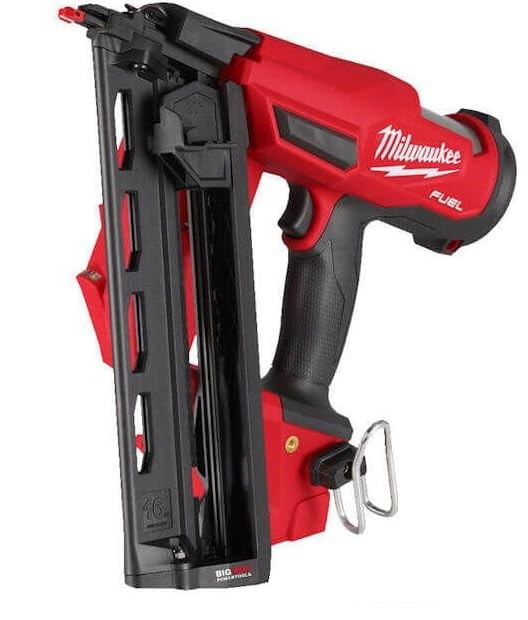
5. Milwaukee M18 FUEL 16G Finish Nailer — Best for Milwaukee Users
- LED work light
- Tool-free jam clearing latch
- Reversible belt clip
- Tool-free depth adjustment
- Bumper & overmold to protect surfaces
Milwaukee’s M18 FUEL Finish Nailer steps it up a notch from a standard brad nailer. It fires 16-gauge straight finish nails from 32–63mm, making it suited to heavier 2nd fix tasks — think chunky skirting boards, solid wood door casings, or stair nosings — where a standard 18g brad might not have quite enough holding power. Milwaukee’s FUEL motor drives consistently and the sequential/contact fire mode toggle is right where your thumb can reach it.
The depth-of-drive adjustment is among the best we’ve tested — precise and tool-free — and the dry-fire lockout prevents damage to your work surface when the magazine runs empty. Milwaukee tools are well-known for their build quality, and this is no exception. It’s heavy-duty in the best possible sense.
The downside is cost. At around £220 body-only, it’s the priciest battery nailer in our roundup. But if you’re already running Milwaukee M18 FUEL gear on site, adding this to your line-up makes complete sense. It’s a step up in calibre from the DeWalt and Makita options.
Pros
- 16g nails for heavier 2nd fix tasks
- Outstanding build quality and FUEL motor reliability
- Excellent depth-of-drive control
- Great for M18 users with existing batteries
Cons
- Most expensive battery nailer in this roundup
- Heavier than 18g alternatives
- Finish nails may be overkill for lighter trim work
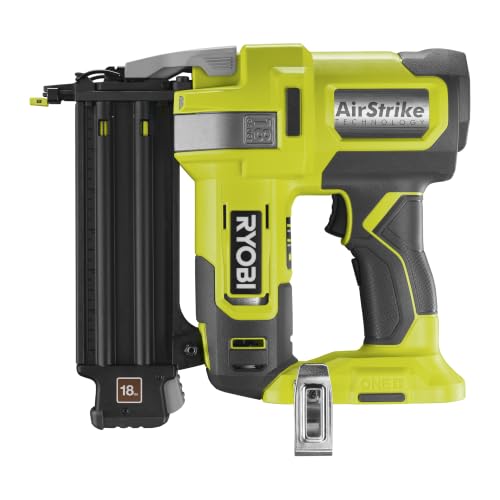
6. Ryobi ONE+ RFN18-0 — Best Budget Cordless Nail Gun
- Air Strike Technology provides cordless convenience, eliminating the need for a noisy compressor, bulky air hose or expensive gas cartridges
- Fires 18 G nails 1.2 mm from 15 to 50 mm long
- Tool less depth of drive adjustment helps protect the work surface and allows proper setting of nails and tool - less jam release for easy removal of accidentally jammed nails
- Grip-light technology engages LED by grasping the handle
- Belt hook mounts left or right for added convenience
Not everyone needs a professional-grade nailer. If you’re a confident DIYer tackling a kitchen fit-out, fitting new skirting, or building some outdoor furniture — the Ryobi ONE+ RFN18-0 is a fantastic entry point that won’t break the bank. It runs off Ryobi’s very popular ONE+ 18V battery system (shared with drills, jigsaws, sanders and over 100 other tools) and fires 18g brads from 15–50mm.
The AirStrike technology is what sets Ryobi’s nailers apart at this price point. There’s no compressor, no gas canisters, and no complicated setup — just a battery and you’re away. The depth adjustment wheel is intuitive, and the tool-free jam clearing nose is a sensible inclusion. It drives nails cleanly into softwood and MDF without issue, and most users report no misfires during normal use.
At around £80–110 body only (frequently on offer at B&Q and screwfix), it’s remarkable value. It won’t keep pace with a Paslode on a busy site, and it might struggle with very hard hardwoods, but for casual trade use or serious DIY it’s genuinely impressive. A great starter nail gun.
Pros
- Extremely good value for money
- No gas, no compressor — simple setup
- Works with the wide Ryobi ONE+ battery range
- Good for DIY and occasional trade use
Cons
- Not up to professional all-day use
- Can struggle with very dense hardwoods
- Ryobi ecosystem isn’t widely used in professional trades
Buyer’s Guide — Choosing the Right Nail Gun
First Fix vs Second Fix: What’s the Difference?
First fix nailing is structural — fixing timber frames, floor joists, roof timbers, decking. You need a framing nailer that handles nails from around 50–90mm. Second fix is finishing work — fitting skirting, architrave, door casings, and trim. Here you want a brad or finish nailer firing smaller gauge nails (15–63mm typically). Most tradespeople end up with one of each.
Gas-Powered vs Battery Cordless
Gas-powered nailers (like Paslode) use a fuel canister plus a small battery for ignition. They offer faster cycle times and are the preferred choice on busy sites where speed matters. Battery-only nailers are simpler — no canister costs, less maintenance — and have improved significantly in recent years. For professional use, gas is still the gold standard; for DIY or lighter trade work, battery-only is perfectly capable.
What Gauge Nail Do You Need?
Gauge refers to the thickness of the nail. 18g brads are thin and fine — ideal for lightweight trim, beadings, and furniture. 16g finish nails are thicker with more holding power — better for heavier skirting and door frames. Framing nailers typically fire 28 or 34-degree collated nails for structural work. Always check your nailer’s gauge compatibility before buying nails.
Features to Look For
A tool-free depth-of-drive adjustment lets you dial in exactly how deep the nail sits — essential for different timber thicknesses. An anti-dry-fire or dry-fire lockout stops the gun firing when empty (and stops you marking your work). A tool-free jam clearing nose saves time when things go wrong. LED job lights, contact vs sequential firing modes, and a magazine capacity of 100+ nails all add up to a more efficient day’s work.
Running Costs: Nails and Fuel
Battery nailers just need nails — widely available in bulk from Screwfix, Toolstation, and builders’ merchants. Gas nailers need both nails and Paslode fuel canisters (around £7–10 each), which give approximately 1,000 shots. On a busy site this adds up. Factor this into your cost calculation, especially if you’re buying a Paslode as a business tool.
FAQ
What’s the best nail gun for 2nd fix joinery in the UK?
The Paslode IM65 F16 is the most widely used 2nd fix nailer by professional carpenters and joiners in the UK. For those who prefer battery-only tools, the DeWalt DCN680N and Milwaukee M18FN16GS are excellent alternatives.
Do I need a separate nail gun for first fix and second fix?
Yes, ideally. Framing nailers (like the Paslode IM350+) are designed for structural nailing with larger, heavier nails. Brad and finish nailers are for lighter 2nd fix work. Using the wrong gun risks either not driving the nail deep enough, or splitting finer timber. Most professional tradespeople own both.
Are gas nail guns worth the running costs?
For professional use, yes. The speed and consistency of gas nailers like the Paslode range makes them faster and more reliable than battery alternatives for heavy day-to-day site use. The fuel cost is a genuine consideration but it’s a relatively small part of the overall cost of professional tools.
Can I use a nail gun for skirting boards and architrave?
Absolutely — that’s exactly what 2nd fix brad nailers are designed for. An 18g nailer firing 45–50mm brads is the standard setup for skirting on timber, and around 30–38mm for architrave and door casings. You’ll achieve a neater finish than hand nailing, and far faster.
Final Verdict
The best nail gun for most UK tradespeople is still the Paslode IM65 F16 for 2nd fix and the Paslode IM350+ for 1st fix. They’ve earned that reputation through years of performance on site, and they remain the benchmark everything else is measured against. If you’re in the DeWalt, Makita or Milwaukee ecosystem and already have batteries, the branded battery nailers are excellent value and eliminate the fuel canister cost.
For DIYers, the Ryobi ONE+ RFN18-0 is an outstanding entry point — if you’re already in the ONE+ system, it’s a no-brainer. Whatever you buy, you’ll wonder how you managed without one. A nail gun is one of those tool purchases that pays back its cost in the very first job.