Quick Verdict
If you only buy one thermal camera this year, make it the FLIR C5 — it’s the best balance of resolution, usability and price for general building, damp and electrical diagnostic work. Surveyors producing formal reports should look at the Bosch GTC 600 C, and if you just want to know whether a wall is actually worth opening up before you commit to a full camera, the InfiRay P2 Pro phone plug-in gets you most of the way there for under £150.
Quick Comparison — Thermal Imaging Cameras
Model | Sensor | Temp Range | Type | Best For | Approx. Price |
FLIR C5 | 160 x 120 (MSX) | -20°C to +400°C | Standalone | All-round building, damp and electrical work | £450 |
Bosch GTC 600 C | 256 x 192 | -20°C to +600°C | Standalone (12V) | Surveyors and client reporting | £600 |
Bosch GTC 400 C | 160 x 120 | -10°C to +400°C | Standalone (12V) | Bosch 12V users wanting a rugged handheld | £330 |
Milwaukee M12 TI-201C | 160 x 120 | -20°C to +350°C | Standalone (M12) | Sparks already on M12 batteries | £450 |
TOPDON TC004 Mini | 320 x 240 (TISR) | -20°C to +350°C | Standalone, Wi-Fi | Best resolution per pound | £280 |
FLIR ONE Pro | 160 x 120 (MSX) | -20°C to +400°C | Phone plug-in | Occasional use, no extra tool to carry | £380 |
InfiRay P2 Pro | 256 x 192 | -20°C to +550°C | Phone plug-in | Cheapest genuinely useful thermal imaging | £140 |
All seven of these are current UK listings we’d actually recommend spending money on. Prices move around with stock and bundles, so treat the figures above as a guide rather than gospel — check the box below each pick for the live price.
1. FLIR C5 — Best All-Rounder
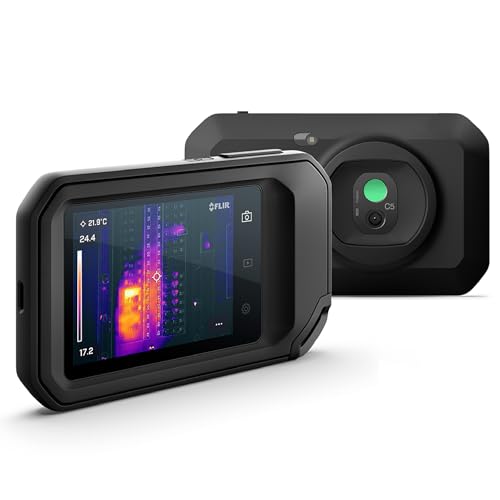
The FLIR C5 remains the sensible default for anyone doing a mix of damp surveys, heat-loss checks and the odd electrical fault-find. The 160×120 sensor sounds modest next to the newer 256×192 units on this list, but FLIR’s MSX image-blending sharpens edges using the built-in visual camera, so you can actually tell which stud or joist you’re looking at rather than a fuzzy hotspot.
Wi-Fi means images go straight to your phone for a WhatsApp to the customer or a quick line in a report, and the battery genuinely lasts a working day. If you want one camera that does 80% of jobs well without a huge outlay, this is still it.
- 160 x 120 MSX sensor
- -20°C to +400°C range
- Wi-Fi image transfer
- Full working-day battery

2. Bosch GTC 600 C — Best for Reports and Surveys
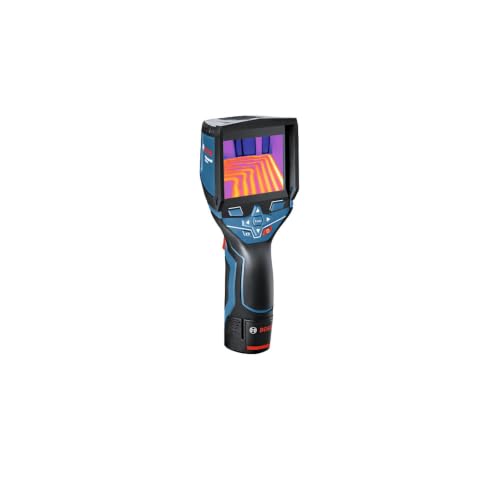
Step up to the GTC 600 C and you get a proper 256×192 sensor and a temperature range that stretches to 600°C, which matters if you’re chasing overheating electrical connections as well as damp and insulation gaps. The image quality is genuinely a step above the C5, and Bosch’s app lets you generate a basic PDF report on site — handy if a client wants something in writing before you’ve even left the van.
It runs on Bosch’s 12V platform, so if you’re already carrying GTC or GLM batteries this slots straight in. It’s the pick for anyone whose thermal camera output actually needs to go in a survey document rather than just confirm a hunch.
- 256 x 192 sensor
- -20°C to +600°C range
- Bosch 12V battery platform
- On-device app reporting

3. Bosch GTC 400 C — The Rugged Middle Ground
The GTC 400 C sits between the C5 and the 600 C on spec and price, and it’s the one to pick if you’re already invested in Bosch’s 12V system and want a handheld that will survive being dropped off a step ladder. Resolution matches the C5 at 160×120, but the housing feels noticeably more site-tough, and the connected app support is the same as the 600 C.
It won’t out-resolve the pricier options here, but for Bosch 12V users who want one rugged tool rather than the sharpest possible image, it’s a sensible middle ground.
- 160 x 120 sensor
- -10°C to +400°C range
- Bosch 12V battery platform
- Rugged site housing
4. Milwaukee M12 TI-201C — Best for M12 Users
If you’re already carrying an M12 battery for your drill, impact driver or inspection camera, the M12 TI-201C means one less charger and one less battery format cluttering the van. It’s not the newest sensor on this list, but it’s a proven, no-nonsense thermal imager that’s been a trade staple for years — good enough resolution to spot missing insulation, damp tracking and hot electrical joints without a learning curve.
Availability and pricing on this one has moved around more than most, so it’s worth double-checking current stock and price before you commit — but for M12 loyalists it’s still the obvious box to tick.
- 160 x 120 sensor
- -20°C to +350°C range
- Runs on M12 batteries
- Simple, trade-proven interface
No products found.
5. TOPDON TC004 Mini — Best Resolution Per Pound
TOPDON has pushed the TC004 line on hard since it first appeared on this list, and the current TC004 Mini actually out-resolves several cameras here at 320×240 with Wi-Fi transfer built in. As a standalone unit (not a phone plug-in) it’s genuinely usable one-handed on a ladder, with a claimed 14-hour runtime that holds up in practice for a full day’s surveying.
It won’t have the brand recognition of FLIR or Bosch on a client-facing report, but for a second camera to keep in the van — or a first camera for someone starting out — the resolution-to-price ratio is hard to beat.
- 320 x 240 TISR resolution
- -20°C to +350°C range
- Wi-Fi image transfer
- Up to 14-hour battery life
No products found.
6. FLIR ONE Pro — Best Phone Plug-In
For anyone who only needs a thermal camera occasionally, the FLIR ONE Pro plugs straight into your phone and uses FLIR’s same MSX processing as the C5, just without the standalone body and battery. It’s the choice if you don’t want another device rattling round the toolbox — the phone does the screen, storage and reporting, the FLIR ONE just adds the sensor.
The trade-off is you’re tethered to your phone and its case compatibility, and battery drain on the phone itself is real during extended use. But for the occasional damp check or insulation spot-check, it’s a sensible, lower-outlay way in.
- 160 x 120 MSX sensor
- -20°C to +400°C range
- USB-C phone plug-in
- Uses FLIR Ignite app

7. InfiRay P2 Pro — Cheapest Camera Worth Owning
The InfiRay P2 Pro is the camera we’d point a genuinely budget-conscious trade at. At under £150 it undercuts every other camera on this list by a wide margin, yet the 256×192 sensor and 550°C upper range are both better on paper than several pricier standalone units here — the trade-off is a smaller, plastic-bodied unit and app software that’s less polished than FLIR’s.
It’s a USB-C phone plug-in, so no separate battery to charge, and it’s genuinely good enough to catch missing insulation, a leaking pipe run or a warm consumer unit connection. Not what you’d hand a client a survey report from, but an easy first thermal camera to own.
- 256 x 192 resolution
- -20°C to +550°C range
- USB-C, 9g body
- Android version shown; iOS variant also available

Buyer’s Guide: What Actually Matters
Sensor resolution is the real spec
Forget megapixels — thermal sensor resolution is measured in pixels like 160×120 or 256×192, and it’s the single biggest factor in how usable your images are. A 160×120 camera will show you a hotspot; a 256×192 camera will show you the shape of that hotspot clearly enough to trace a pipe run or a stud.
Thermal sensitivity (NETD)
This is how small a temperature difference the camera can actually detect and display, usually quoted in millikelvin. Lower is better. It matters more than most buyers realise for subtle damp gradients, where the difference between wet and dry plaster might only be a degree or two.
Standalone or phone plug-in
A standalone camera is faster to get working, survives being dropped, and doesn’t drain your phone battery. A phone plug-in is cheaper and takes up no extra space in the van, but you’re tied to phone compatibility and battery life. Most trades end up wanting a standalone once they’re using it weekly.
Emissivity and reflected temperature
Shiny surfaces lie to thermal cameras. Reflective materials like glass, polished metal and some plastics reflect ambient heat rather than showing their own true temperature, which is why a thermal camera alone should never be your only evidence for a damp report — pair it with a moisture meter.
Reporting and image handoff
If you need to hand a client something in writing, check the camera has an app that exports images with a temperature scale and, ideally, basic annotation. FLIR’s Ignite cloud and Bosch’s app both do this well; the cheaper standalone cameras generally don’t.
Frequently Asked Questions
Can I find a water leak with a thermal camera?
Often, yes — a fresh leak shows up as a cooler patch as water evaporates, or a warmer patch if it’s a hot water pipe. But thermal cameras show temperature difference, not moisture directly, so always confirm with a moisture meter before you start opening up walls.
Do I need certification to use one?
No certification is required to buy or use a thermal camera. If you’re producing formal reports for insurance or legal purposes, a recognised thermography course (Level 1 or above) will carry more weight with clients, but for routine trade diagnostic use it isn’t a legal requirement.
What resolution do I actually need?
160×120 is fine for spotting obvious problems — missing insulation, a cold bridge, a hot electrical joint. If you’re regularly tracing pipework or producing client-facing images, step up to 256×192 or higher.
Are the cheap phone cameras any good?
The InfiRay P2 Pro and FLIR ONE Pro are both genuinely useful, not toys. They won’t match a dedicated £500+ standalone camera for image quality, but for spotting problems before deciding whether a fuller survey is needed, they punch well above their price.
Will it work in a cold, unheated shell?
Yes, but be aware that a building with no heating on and no temperature differential inside vs outside will give you very little to see. Thermal imaging works best with at least a few degrees of difference between inside and outside, or between the target and its surroundings.
The Verdict
For most trades doing a mix of damp, insulation and electrical checks, the FLIR C5 remains the safest all-round buy. If reporting matters to your business, step up to the Bosch GTC 600 C. And if you just want to know whether a job is worth quoting for before committing to a full camera, the InfiRay P2 Pro or FLIR ONE Pro will get you there for a fraction of the price.