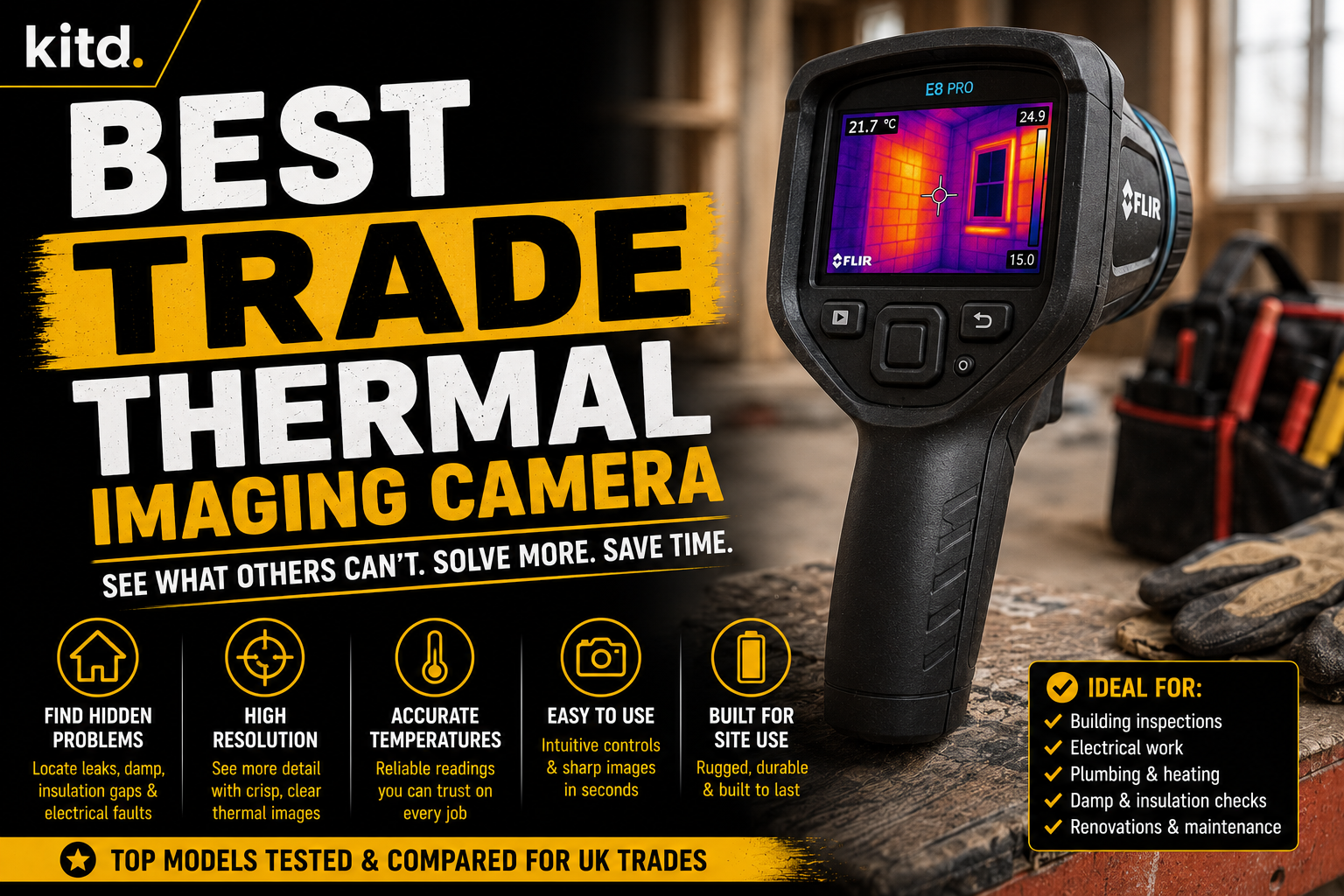
A good inspection camera is one of those tools that does nothing for months and then saves you half a day in one go. Tracing a cable through a stud wall, checking a void before you cut, finding why a fish tape keeps snagging behind plasterboard, confirming there is nothing nasty in a duct before you pull through — a borescope turns guesswork into a quick look. For electricians working in occupied properties where you cannot just rip things open, it is the difference between a tidy job and a hole you have to make good.
This guide is for UK electricians and maintenance sparks choosing a camera in 2026, split by how they get used: a do-everything cordless camera for the van, a premium tool for daily fault-finding, and a budget flexible borescope for occasional looks. Everything here is available from UK suppliers — wholesalers, Screwfix, Toolstation and Amazon UK. Prices are approximate UK street prices and move with stock and promotions, so treat them as a guide rather than a quote.
Our quick verdict
If you want a one-line answer: for most electricians already on the Milwaukee platform, an M12 inspection camera is the easiest call — it runs on the M12 batteries you already own, the image quality is genuinely useful, and it is built like a site tool rather than a gadget. If you do a lot of fault-finding and want the most refined dedicated unit, a RIDGID micro CA-series gives you a sharper screen and a properly rugged handset. And if you only need an occasional look and you want to spend twenty-odd quid, a Teslong or similar flexible USB borescope that runs off your phone does the job for a fraction of the money.
How to choose an inspection camera
Probe diameter and length
The probe is what gets you into the wall, so size it to your work. A 5.5 to 9mm head fits down standard back boxes, conduit and most drilled holes, while a slimmer head reaches tighter spots at the cost of a smaller, dimmer image. Length matters too: a metre is fine for back boxes and shallow voids, but for tracing runs down a cavity or up a riser you want three metres or more. Buy for the longest run you realistically inspect, because a probe that is too short turns a quick look into a no.
Screen vs phone
Cameras split into two camps. A dedicated unit with its own screen — Milwaukee, RIDGID — is faster to deploy, works in bright light, and does not tie up your phone, which matters when you are up a ladder one-handed. A phone or USB borescope is far cheaper and the screen is bigger, but you are fiddling with an app, the connection can drop, and you would not want to drop your phone down a riser. For daily trade use the self-contained screen wins; for occasional use the phone type saves real money.
Image quality, lighting and articulation
Resolution sells cameras but lighting and the head matter just as much in a dark void. Adjustable LED brightness around the lens lets you see without washing out shiny cable and pipe, and a camera that records photos and video is worth having for evidence and for showing a customer the problem without them climbing into the loft. Articulating heads that you can steer are excellent for following a run round a bend, though they cost more and are an extra thing to break — most trades manage fine with a fixed head and a bit of probe-twisting technique.
The best inspection cameras at a glance
Prices are approximate UK street prices for 2026 and vary by retailer, kit and promotion.
| Model | Type | Best for | Approx. price |
| Milwaukee M12 inspection camera | Cordless, own screen | Platform users wanting a rugged daily tool | £200–360 |
| RIDGID micro CA-series | Handheld, own screen | Refined dedicated fault-finding | £170–300 |
| Bosch / DeWalt cordless scope | Cordless, own screen / phone | Existing platform users | £120–250 |
| Teslong USB / WiFi borescope | Phone-connected | Occasional looks on a budget | £20–60 |
The picks in detail
Best overall — Milwaukee M12 inspection camera
For the many electricians already running M12, the Milwaukee camera is the obvious pick. It shares the batteries and chargers you already carry, the image is clear and well lit, and the build is proper site-grade rather than fragile. The rotatable screen and decent cable options make it quick to use one-handed up a ladder, and the photo and video capture is handy for records and for showing customers what is going on inside a wall without them having to take your word for it. It is not the cheapest, but on the M12 platform it is the lowest-hassle route to a camera you will actually keep using.
Best dedicated unit — RIDGID micro CA-series
RIDGID built their name on inspection gear and it shows. The micro CA-series handsets are rugged, sensibly laid out, and the better models give you a sharp screen and strong LED lighting that make reading cable markings and spotting damage easier in a dark void. As a standalone tool not tied to a battery platform, it suits sparks who are not invested in one cordless system, or who want a dedicated camera that lives in the diagnostics bag rather than sharing batteries with the drill. Pay a bit more for the larger screen if you do a lot of fault-finding — your eyes will thank you.
Best platform alternative — Bosch or DeWalt cordless scope
If your kit is Bosch Professional or DeWalt rather than Milwaukee, both offer capable inspection scopes that run on their respective batteries, and the platform fit is the main reason to choose them. Performance is broadly comparable for general electrical work — back boxes, voids, short cable traces — and staying on one battery system keeps the van simpler. Check probe length and head size against your typical jobs before buying, as the kits vary, but for an existing platform user these are a sensible, no-fuss choice.
Best budget — Teslong USB or WiFi borescope
If you only need an occasional look and cannot justify a trade unit, a Teslong-style flexible borescope that plugs into your phone or connects over WiFi does a remarkable amount for the money. The image is perfectly good in a lit space, the slim semi-rigid probes feed into tight spots, and you can record straight to your phone. The trade-offs are the app faff, the occasional dropped connection and a build that will not take the same abuse as a Milwaukee or RIDGID. As a cheap second camera or an entry point for an apprentice, it is hard to argue with.
Getting the most from your camera
A camera is only as good as your technique. Feed the probe gently and let it find the path rather than forcing it round bends, where you can kink the cable. Use the LED brightness control — too much light bounces off shiny cable and conduit and blinds the lens, so dim it down to read markings. Keep the lens clean and a spare set of the magnetic and hook accessories in the case for retrieving dropped screws and fish tapes, which is a job the camera quietly does brilliantly. And save photos of anything you find inside a wall or void; it makes your reports and your customer conversations far easier, and covers you if a fault turns out to be pre-existing.
Frequently asked questions
What probe diameter do electricians need?
A head of around 5.5 to 9mm suits most electrical work, fitting down standard back boxes, conduit and drilled holes while still giving a usable image. Slimmer probes reach tighter spaces but show a smaller, dimmer picture. If you mainly check back boxes and voids, a 8 to 9mm head is a good all-rounder; go slimmer only if you regularly inspect narrow conduit.
Is a phone borescope good enough for trade use?
For occasional looks, yes — a phone or USB borescope is cheap and the image is fine in a lit space. For daily fault-finding, a dedicated unit with its own screen is faster, more reliable and does not tie up your phone up a ladder. Many sparks own a cheap phone scope as a backup and a proper trade camera as their main tool.
Do I need an articulating head?
Not usually. An articulating head you can steer is excellent for following a cable round a bend, but it costs more and is another mechanism to damage. Most electrical inspection — back boxes, voids and short runs — is handled fine with a fixed head and a bit of probe-twisting technique, so reserve articulation for those who regularly trace long, awkward runs.
Can an inspection camera retrieve dropped screws or fish tapes?
Yes, and it is one of the most useful party tricks. Most trade cameras come with magnetic, hook and mirror accessories that clip to the head for retrieving dropped fixings or guiding a fish tape, turning the camera into a recovery tool as well as a viewer. Keep those accessories in the case — they save a lot of swearing.
The bottom line
For most UK electricians the call comes down to your platform: on Milwaukee M12, the M12 camera is the easy, rugged daily choice; off it, a RIDGID micro is the best dedicated unit, with Bosch and DeWalt scopes covering their own platforms. Keep a cheap Teslong-type borescope as a backup and you are covered for everything from a quick look behind a board to a proper cable trace. Buy for the probe length and head size your work actually needs, learn to use the lighting, and a camera will earn its place in the van many times over.