This will annoy some of you, so let me say it plainly: if you’re a carpenter buying your first proper saw for cutting boards, buy a track saw before a circular saw. Not instead of — eventually you want both — but first. I know that goes against how most of us were taught, when a corded circular saw was the rite of passage, so let me make the case.
What changed my mind
For years I did what everyone did. Circular saw, a straight edge clamped to the sheet, a pencil line, and a cut that was near enough. Near enough meant a fraction out over 2.4 metres, a bit of splintering on the veneer, and a straight edge that walked if I didn’t clamp it perfectly. I got fast at hiding rough edges with trim and scribing to cover my sins.
Then I borrowed a track saw on a kitchen job and cut a full sheet of 18mm oak-veneered ply in one pass — dead straight, no tear-out, glue-ready off the saw. That was the moment. The circular saw didn’t get slower overnight, but it suddenly looked like the compromise it always was for sheet work.
The case for the track saw first
Accuracy you don’t have to fight for
A track saw rides a rail that sits exactly on your cut line, with an anti-splinter strip right at the blade. You line the rubber edge up to your marks and cut. No clamped straight edge to measure off, no offset to calculate, no drift. For a first-year chippy especially, it removes a whole category of mistakes — and mistakes on expensive sheet material are what hurt.
A finish you’d otherwise pay for
The cut off a track saw is clean enough to glue or leave on show. That means less filling, less sanding, less scribing trim to hide a ragged edge. On kitchens, wardrobes, panelling — anything where the edge is visible — it turns a two-step job into one step, and it makes your work look like a joiner’s rather than a hacker’s.
It’s safer
The blade on a plunge-style track saw is guarded until you push it into the cut, and it retracts when you lift. It runs down a rail, not freehand across a wobbling sheet on trestles. Kickback is far less likely, and the blade’s covered the rest of the time. For someone still building confidence, that matters.
It keeps the dust down
Hook a track saw to an extractor and most of the dust goes in the bag instead of your lungs and the customer’s carpet. A bare circular saw fires chip and dust everywhere. If you work in occupied homes, that difference is the reason you get asked back.
The excuses I used to make
“Too expensive.” A budget track-compatible saw runs to around £130–150 — about the same as a decent circular saw once you’ve bought a good blade and a clamp. “I can get a straight cut with a clamped rail.” You can, on a good day, if the rail doesn’t shift and the offset’s spot on — but you’re doing three steps to the track saw’s one, and the finish still isn’t as clean. “It’s a workshop tool.” It isn’t: a rail and a plunge saw pack down smaller than a circular saw plus a length of clamped straight edge, and they set up faster on site. Every excuse I made held up right until I actually used one.
What to look for in a first track saw
You don’t need to spend big money to start. Look for a saw with a riving knife, a proper depth stop, a bevel that locks positively, and a rail with a fresh anti-splinter strip. Buy at least a 1.4m rail so you can cross-cut a sheet, and a couple of rail clamps so it doesn’t creep. A fine-tooth blade — around 48 teeth — is what gives the clean edge; a coarse blade on the best saw in the world still tears veneer. Get those basics right and even a mid-price saw will out-cut a circular saw every time.
When the circular saw still wins
I’m not telling you to bin the circular saw — there are jobs where it’s still the right tool. For ripping structural timber, cutting joists and studs, notching, and rough first-fix work, a circular saw is faster, lighter, and you don’t care about a factory edge. It’s also cheaper, so a budget corded circular saw is a fine second saw once the track saw has earned its place.
And there’s the price gap to think about. A decent circular saw sits around £80–150; a track saw with a rail starts around £150 at the budget end and runs to £500-plus for the premium cordless options. If cash is tight, a budget track-compatible saw like the Evolution R185CCSX below splits the difference — a circular saw that comes with a rail — and gets you most of the benefit for the money.
No products found.
It makes you money, not just cleaner cuts
This is the part that gets overlooked. A track saw isn’t just about pride in a clean edge — it’s about the jobs it opens up and the time it saves. Once you can cut sheet accurately and quickly on site, you can take on flooring, panelling, fitted wardrobes, alcove units and kitchen work with confidence, and do them in the customer’s home without a workshop. Faster, cleaner, less waste from botched cuts on expensive board — it all lands on the right side of your day rate. The saw pays for itself in a job or two.
There’s a reputation angle too. Clients don’t see your framing, but they absolutely see the edge of a fitted unit and the join on a worktop. Work that looks factory-finished is what gets you recommended, and recommendations are the cheapest marketing a chippy will ever get. A track saw is one of the few tools that visibly lifts the standard of the work the customer actually looks at.
A year on — what it actually changed
A year after I made the switch, the circular saw still lives in the van, but it comes out for framing, first fix and the rough stuff, not for anything that shows. The track saw does the sheet work, the door trimming, the worktop cuts and most of the second fix. My offcut pile shrank because I stopped ruining boards with a wandering cut, my sanding time dropped because the edges came off clean, and I stopped apologising to customers for a rough join I’d then hide with beading.
The other thing that changed was speed. People assume the rail slows you down — lining it up, plunging, sliding the saw. In practice, setting a rail on your marks is quicker than clamping a straight edge, working out the offset and hoping it doesn’t shift, and you get it right first time. Over a day of sheet cutting the track saw is genuinely faster, not slower, once you’re used to it.
The order I would buy in today
If I were kitting out again as a chippy, I’d buy a track saw first — even a budget track-compatible one — because accurate sheet cutting is where the money and the reputation are. Then I’d add a circular saw for the rough stuff, a jigsaw for curves, and build from there. The track saw is the tool that makes your work look professional; the circular saw is the tool that makes the rough work fast. Get the one that lifts your standard first.
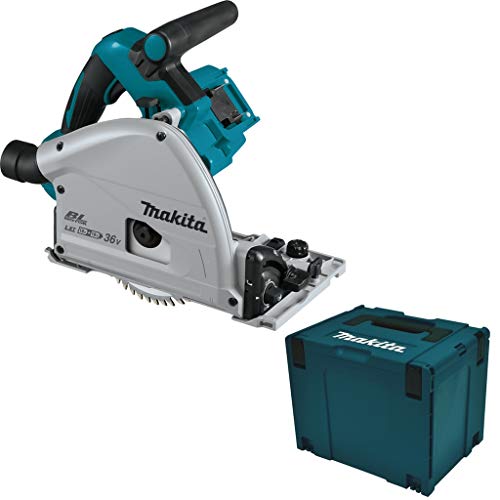
Buy the best track saw you can afford — something with a brushless motor and a genuinely rigid rail, like the Makita plunge saw below, holds its accuracy job after job in a way budget saws start to lose — put a sharp blade in it, hook it to an extractor, and I promise the first clean sheet you cut will make the case better than I can. That’s why, for me, every chippy should own a track saw before a circular saw.
Related reading