Kitd is reader-supported. If you buy through links on this page we may earn a commission from Amazon, at no extra cost to you.
A clamp meter does one thing a standard multimeter cannot do safely: it measures current without you breaking the circuit. You close the jaws around a single conductor, read the amps and move on. For fault finding, checking motor loads, balancing circuits and spotting an overloaded cable, it is the quickest tool in the bag.
The market runs from sub-£40 Kaiweets units with thousands of reviews up to Fluke models costing several times as much. We checked what is on sale on Amazon UK, looked at the specs on the listings and picked the clamp meters worth considering for UK trade work. Prices and review counts were checked at the time of writing.
Quick Verdict
For most tradespeople the Kaiweets HT206D is the best value pick: more than 11,700 reviews, AC and DC current to 600A, and a price of £42.49. If you want the Fluke name without the Fluke price, the Fluke 302+ at £81.00 is the entry route, though stock was down to one at the time of checking. For electricians who want a full-featured true RMS clamp with a trade reputation, the Fluke 323 is the one to aim for.
Best Clamp Meters at a Glance
| Clamp meter | Price | Key features | Best for |
| Kaiweets HT206D | £42.49 | 6000 counts, 600A AC/DC, backlit LCD, capacitance | Best value all-rounder |
| Kaiweets D-jaw clamp | £35.99 | Auto-ranging, DC/AC current, flashlight and backlight | Cheapest useful option |
| UNI-T UT210D | £62.90 | True RMS, auto range, capacitance, temperature | Mid-price true RMS |
| Fluke 302+ | £81.00 | Fluke build and brand, AC/DC clamp | Fluke on a budget |
| Kewtech KT203 | £95.00 | Digital AC/DC clamp, 33mm jaw, 400/600V | Trade brand, simple use |
| Fluke 323 | £145.00 | 400A AC, true RMS | Serious daily use |
What to Look for in a Clamp Meter
AC Only or AC/DC
Plenty of clamp meters only measure AC current. That is fine for fixed wiring and most electrical work. If you work on vans, solar, EV charging or battery systems, you will want a clamp that also reads DC current, as the Kaiweets and Kewtech models here do.
True RMS
A true RMS meter gives accurate readings on non-sinusoidal loads such as LED drivers, variable speed drives and electronic equipment. An average-responding meter can read low on these loads. If you test modern installations, true RMS is worth having.
Jaw Size
Jaw capacity decides what cables you can clamp. A 33mm jaw like the Kewtech KT203 copes with most domestic and light commercial cable. Larger cables and busbars need a wider jaw, so check the listing before you buy.
Safety Rating
Check the CAT rating and voltage on the meter itself, and use a CAT-rated clamp for the environment you work in. A cheap clamp for checking a socket circuit is not the same as a meter for working on a distribution board. Always follow safe working practice.
Display and Extras
A backlight is useful in a dark cupboard, and a flashlight is a bonus. Features like capacitance, temperature and continuity turn a clamp into a general-purpose meter, which saves carrying a second tool.
The Best Clamp Meters
Kaiweets HT206D
The HT206D is the standout value pick. It has 6000 counts, auto-ranging, 600A AC/DC current and 600V AC/DC voltage, plus a backlit LCD, capacitance, continuity and resistance. At £42.49 it has more than 11,700 reviews on Amazon UK, which is a very strong record for any electrical tool.
It is not a Fluke, and you should not treat a budget meter as the final word on safety-critical readings. But for fault finding and general load checks, it does a lot for the money.
Pros: Huge review count, AC/DC current, backlit display, low price.
Cons: Not a recognised trade brand for formal work.
Best for: Best value all-rounder for sparks, HVAC and maintenance.

- The KAIWEETS smart clamp multimeter designed for accurate and efficient electrical testing in both residential and industrial environments. With intelligent auto-ranging technology, it automatically identifies measurement modes, eliminating the need for manual selection and improving workflow efficiency.
- 【LowZ & LPF】: Low input impedance helps prevent false readings due to ghost voltage. Low Pass Filter (LPF) for accurate measurement of variable frequency drive signals when measuring motors and transformer. To measure the current you need to clamp the meter around one of the wires instead of the whole power cord.
- 【NCV Function】: Non-contact voltage detection effectively check electrical status through measuring EM field intensity without touching any wires; The NCV button lies on the right side. Simply place your thumb on it and push. Safety standard IEC 61010-1, CAT III 600V. Double insulation.
- 【Multi-Function】: Two-color backlit display - When the voltage > 80V or the current > 3A, the LCD backlit turns orange to warn you of high voltage, addition function: LED Flashlight / Temperature Testing for liquids and air condition/ Low Battery Indication / Auto power off after 15 minutes inactivity.
- 【What You Get】: 1* Digital Clamp Meter, 1* Test Leads, 1 * Thermocouples, 2 * AAA batteries, 1* Storage Bag, 1 * User Manual. 3-Year after-sale service and lifetime technical support. Please contact with us if you have any concerns
Kaiweets D-Shaped Jaw Clamp Meter
This Kaiweets model costs £35.99 and has nearly 2,000 reviews. The listing highlights auto-ranging, DC and AC current, a D-shaped jaw, a flashlight and a backlight. It is the cheapest clamp here and a sensible glovebox spare.
Pros: Cheapest option, flashlight and backlight, nearly 2,000 reviews.
Cons: Fewer measurement extras than the HT206D.
Best for: A low-cost spare for the van.

- [AC DC CLAMP METER] This clamp meter can accurately measure AC/DC current, AC/DC voltage, temperature (thermocouple included), NCV, capacitance, frequency, resistance, continuity and diode. Good help for troubleshooting the household solar system, automotive and industrial electrical issues, perfect for electricians, DIY, professionals, etc.
- [LowZ & LPF] Low input impedance(LowZ) prevents false measurements caused by phantom voltage. Low Pass Filter (LPF) for accurate measurement of frequency signals when measuring motors and transformers.
- [True-RMS CLAMP METER] This multimeter can measure 400 A AC / DC current, 600 V AC / DC voltage.
- [Other Features] 1. D-shape jaws that open to a maximum of 2.8cm. 2. Backlit screen and torch for clear readings and ease of operation. 3. Auto shut-off after 15 minutes of inactivity to conserve battery power. 4. Low battery alert to remind battery replacement.
- [Service and Safety] Passed IEC61010-1 and CAT III 600V certification. The screen turns orange to warn when the voltage >80V, the current >1A. Comes with a nice carry case, manual and two sets of leads for electrical and temp. KAIWEETS provides 36 months of high-quality service and lifetime technical support.
UNI-T UT210D
The UT210D is a compact true RMS clamp with auto-ranging, capacitance and temperature measurement. At £62.90 it has more than 3,800 reviews. It sits between the budget Kaiweets and the Fluke models, and the true RMS reading is useful on electronic loads.
Pros: True RMS, compact, strong review record.
Cons: Brand is less familiar on site than Fluke.
Best for: Mid-price true RMS in a small body.
No products found.
Fluke 302+
The Fluke 302+ is the entry point to the Fluke range. At £81.00 it has more than 2,500 reviews on Amazon UK, and you get Fluke’s reputation for build quality and trusted readings. Stock was down to one unit at the time of checking, so availability may change.
Pros: Fluke build and reputation, thousands of reviews.
Cons: Limited stock when we checked and a higher price than the Kaiweets.
Best for: Electricians who want a Fluke at a lower price.
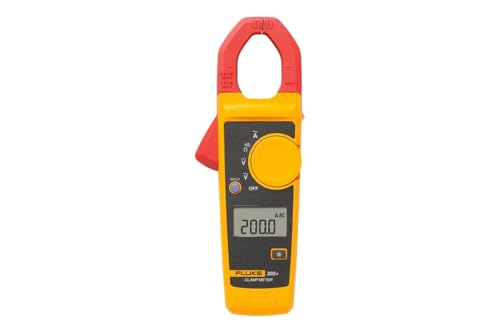
- AC current measurements up to 400 A, handling your everyday electrical maintenance needs
- Comes with the TL75 Hard Point Test Lead Set offering the convenience of a test lead and probe in one unit with a variety of connections
- Rugged, easy-to-use digital clamp meter with CAT IV 300 V/CAT III 600 V safety rating
- Small enough to carry in your work bag, flexible enough for tight spaces.
- Built for daily use — durable construction and simple operation
Kewtech KT203
Kewtech is better known for installation test kit, but the KT203 is a digital AC/DC clamp meter with a 33mm jaw and a 400/600V rating. At £95.00 it only has 31 reviews, so the evidence is thin, but it appeals to people who like to buy Kewtech across the kit bag.
Pros: Trade brand, AC/DC, 33mm jaw.
Cons: Few reviews and a higher price than better-reviewed rivals.
Best for: Electricians who want the Kewtech badge across their kit.
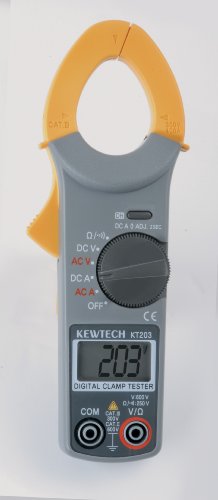
- Popular contractor orientated clamp meter - strong and robust
- 0.01A accuracy be 40A means it measures down to 10mA
- Measures DC current with a DC adjust - ideal for Solar Installations and automotive applications
- It is used for solar instalations not solar powered
Fluke 323
The Fluke 323 is a 400A AC true RMS clamp meter and the most serious tool in this list. At £145.00 it costs more than three times the HT206D, but it is built for daily trade use and the readings are trusted on site. It had 48 reviews at the time of checking.
Pros: True RMS, trade-grade build, trusted brand.
Cons: Most expensive here, AC only.
Best for: Electricians who use a clamp every day.
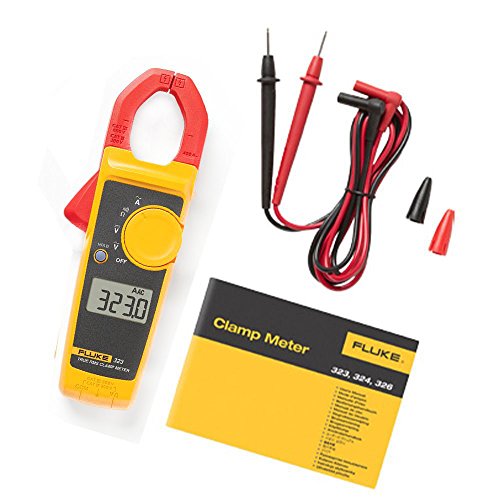
- Two year Fluke Warranty
- True-rms measurements and optimized ergonomics make the 323 series clamp meters the best general troubleshooting tools for commercial and residential Electricians
- The Fluke 323 model is ideally suited for current measurements up to 400 a in tight cable compartments
- 400 amp AC current measurement, 600 Volt AC/DC Voltage measurement
- Cat IV 300V/CAT III 600 V safety rating
Which Clamp Meter Should You Buy?
If you use a clamp a few times a month, the Kaiweets HT206D covers you for a fraction of the Fluke price. If you work with electronic loads and want true RMS without paying Fluke prices, the UNI-T UT210D is a good middle option. If a clamp is a daily tool on commercial or industrial work, spend the money on a Fluke and treat it as a long-term investment.
Using a Clamp Meter Properly
Clamp One Conductor
The jaws must close around a single conductor. Clamping a whole twin and earth cable or a flex gives you near-zero because the opposing currents cancel. Use a line splitter or isolate a single core where you can.
Centre the Cable
Keep the conductor in the middle of the jaw and keep other live cables away from the clamp. Nearby cables can add stray magnetic fields and change the reading, especially in a crowded distribution board.
Check Zero on DC
On DC ranges, press the zero button with the jaws closed and no conductor inside before you measure. This takes out the small offset from magnetism in the surrounding area.
Look After the Jaws
Keep the jaw faces clean and closing fully. Dirt or damage on the contact faces affects accuracy. Store the clamp in a case rather than loose in the bag.
Where a Clamp Meter Earns Its Keep
A clamp meter is the quickest way to check the load on a circuit without opening anything up. Check a cooker circuit, confirm a heater is drawing what it should, find an unbalanced three-phase load, or see whether an immersion heater is actually working. On motors and pumps it shows start-up current and running current, which is useful for diagnosing a failing load.
FAQs
What is the difference between a clamp meter and a multimeter?
A multimeter measures current by breaking the circuit and putting the meter in series. A clamp meter measures current by clamping around a single conductor, so you do not need to disconnect anything. Many clamp meters also measure voltage and resistance.
Can I measure current on a twin and earth cable?
No. You need to clamp a single conductor. If you clamp around the whole cable, the currents in live and neutral cancel and the reading will be close to zero.
Do I need a true RMS clamp meter?
It is worth having if you test electronic loads such as LED lighting, drives and computer equipment. For simple resistive loads an average-responding meter is fine.
Can a clamp meter measure DC current?
Only if it is an AC/DC clamp. Check the listing. The Kaiweets and Kewtech meters here measure DC, while the Fluke 323 is AC only.
Is a cheap clamp meter safe?
It can be, provided it carries a proper CAT rating for the job and you use it within its limits. For safety-critical work on distribution boards, a recognised trade brand is the sensible choice.
Final Thoughts
A clamp meter earns its place quickly. Start with the Kaiweets HT206D if you want value, step up to the UNI-T UT210D for true RMS, and buy the Fluke 323 when a clamp becomes a daily tool. Whichever you pick, check the CAT rating before you use it.