A cordless planer is one of those second-fix tools that doesn’t get the attention of a drill or impact driver but earns its place in the van the moment you have to hang a sticking door at three o’clock on a Friday afternoon. Plug-in planers are still the right answer for the workshop bench and for repetitive joinery work, but for site work, door hanging and trim — the jobs where you actually use a planer — the cordless options have caught up to the corded ones in the last two years.
We’ve worked through the cordless planers UK trades are reaching for in 2026 — the 18V and 36V tools from DeWalt, Makita, Milwaukee, Bosch and the rest, the workshop-grade Festool, and the budget Ryobi for the trade who already runs the One+ platform. Everything below is sized for site and second-fix work; if you need a stationary planer for through-thicknessing, that’s a different tool.
All prices are approximate at the time of writing and based on UK retail at Screwfix, Toolstation, Amazon UK and the trade direct sites. Bare-tool pricing assumes you’re already on the relevant battery platform; kit pricing includes battery and charger.
Our quick verdict
If you want the one-line answer: the Makita DKP181 36V brushless planer is still the best all-round cordless planer for UK tradespeople in 2026. It’s powerful enough to take a proper 2mm cut on a hardwood door without bogging down, the 82mm planing width matches the corded version, and Screwfix and Toolstation both stock it in kit and bare-tool form. For 18V single-platform users, the DeWalt DCP580 is a strong choice. For the trade who’s already on Milwaukee, the M18 Fuel cordless planer earns its keep.
The 6 best cordless planers for UK tradespeople in 2026
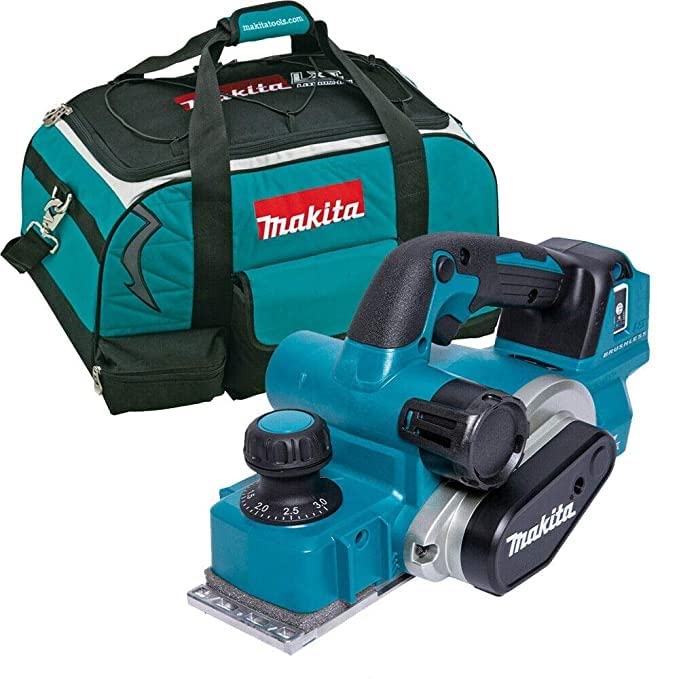


Makita DKP181 36V LXT Brushless Planer (82mm) — Best all-round
Price: Around £230–£270 bare tool; £380–£450 kit with batteries and charger
The Makita DKP181 takes two 18V LXT batteries and runs them at 36V combined for the kind of grunt you need to take a real 2mm cut on a hardwood front door without the motor bogging down. Brushless motor, 82mm planing width matching the corded KP0810, three-blade cutter head for a smoother finish than two-blade competitors, and a properly thought-through dust port that fits both 32mm Makita hose and standard workshop dust extractors.
The 0-2mm depth-of-cut adjustment is calibrated and repeatable — important when you’re shaving 1mm off the bottom of a door rather than guessing — and the rebate depth runs to 9mm which covers most door hanging rebates. Stocked at Screwfix, Toolstation, Powertool World and most UK trade direct sites in bare-tool form (DKP181Z) and as a kit with two 5.0Ah batteries (DKP181RTJ).
The right pick for the chippy who’s already on the LXT platform with a couple of 5.0Ah batteries, hangs doors regularly, and wants the cut quality of a corded planer in a cordless package.
Pros: 36V grunt takes a full 2mm cut without bogging, three-blade cutter head leaves a fine finish, proper dust port that actually works with extraction, calibrated depth scale, widely stocked at UK trade chains.
Cons: Eats two batteries at once which catches you out if you’re not paying attention, 36V tools are heavier than 18V single-battery competitors, blade replacement is fiddlier than the DeWalt.
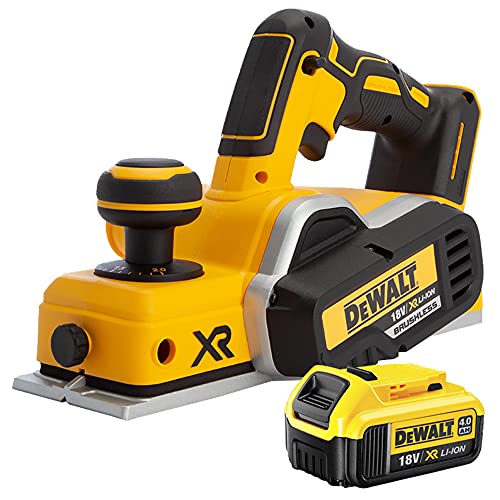
DeWalt DCP580 18V XR Brushless Planer (82mm) — Best 18V single-platform
Price: Around £190–£230 bare tool; £320–£400 kit with battery and charger
The DCP580 is DeWalt’s answer for the trade who wants an 82mm planer running on a single XR battery rather than the dual-battery 36V approach. Brushless motor, full 82mm width, 0-2mm depth of cut, and the build quality is up to DeWalt’s usual XR standard. With a 5.0Ah XR battery it’ll take six-to-eight passes on a hardwood door before needing a swap, which is more than most door-hanging jobs need.
Where the DeWalt loses to the Makita is raw grunt on hardwood — at 18V you can feel the motor working harder on full-depth cuts in oak and meranti, and the recovery from a stalled cut is slower. On softwood, MDF and the typical pre-hung door it’s indistinguishable. Stocked everywhere DeWalt is — Screwfix, Toolstation, Amazon UK and the rest. Pairs neatly with the existing DCD/DCF 18V XR drill and impact driver kit most UK chippies already own.
The right pick for the single-platform DeWalt user who hangs doors a few times a week rather than as a primary income stream.
Pros: Single 18V battery rather than dual, full 82mm width, brushless motor, properly stocked with replacement blades at every UK chain, integrates with the rest of the DeWalt XR ecosystem, lighter than the 36V Makita.
Cons: Less grunt than the 36V Makita on hardwood, the cutter head is two-blade not three, the dust port is smaller than the Makita’s and clogs more on damp timber.
- Brushless Motor - Increased power and runtime. Large twin blade drum with TCT blades for high quality surface finish. On board blade storage and torx key - for quick and easy blade changes.
- 2.0mm Depth of Cut - For large material removal. O.1mm increment depth adjustment - For fine adjustment. Front and rear shoe milled in situ - For increased accuracy.
- Air lock port - compatible with air-lock or dust bag. Foot lock off - stands the tool above the work surface.
- Part of the intelligent XR Lithium Ion Series designed for efficiency and making applications faster.
- Comes with: Tungsten carbide tipped reversible blades, Hex wrench, Torx key, Guide fence, Blade alignment plate & 1 x 4.0Ah DCB182 Battery
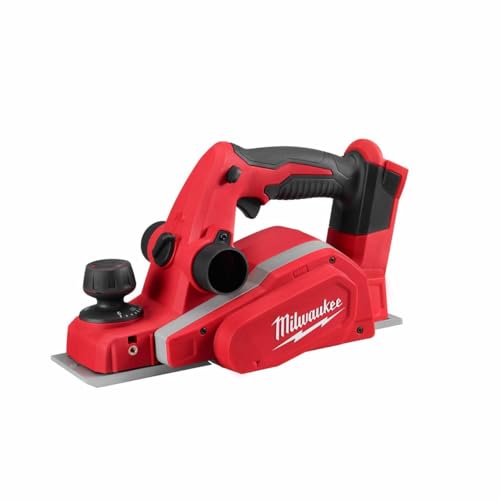
Milwaukee M18 Fuel Cordless Planer (2623-20 / equivalent) — Best for the Milwaukee user
Price: Around £230–£280 bare tool
Milwaukee’s M18 Fuel planer arrived in the UK comparatively late but it’s earned its place for the trade who’s all-in on the Red Lithium platform. Brushless POWERSTATE motor, 82mm planing width, 0-2mm depth of cut, and the build quality is up to the M18 Fuel standard you’d expect — the chassis is genuinely better fitted than the DeWalt, the depth knob has a positive click at every stop rather than a sliding scale, and the rebate fence is properly engineered rather than bolted on as an afterthought.
Power-wise it sits between the DeWalt 18V and the Makita 36V — not quite as much grunt as the Makita on heavy cuts, but noticeably more than the DeWalt on hardwood. With an 8.0Ah High Output battery it runs all day on door hanging without complaint. Stocked at UK Milwaukee specialists and the bigger trade direct sites; less commonly found at Screwfix than the DeWalt or Makita.
The right pick for the trade who’s already on the Milwaukee M18 platform with a couple of 8.0Ah High Output batteries and wants a planer that slots into the rest of the kit.
Pros: Best build quality of the 18V planers in this list, positive-click depth adjustment, properly engineered rebate fence, runs comfortably on M18 High Output batteries, brushless POWERSTATE motor.
Cons: Only really makes sense if you’re already on M18, harder to find at the high-street UK chains, replacement blades cost more than DeWalt or Makita equivalents.
- M18 3-1/4" Planer - tool Only
- The product is easy to use and easy to handle
- The product is highly durable
Bosch Professional GHO 18V-26 Cordless Planer (82mm) — Best for the Bosch user
Price: Around £200–£250 bare tool; £340–£420 kit
The Bosch Professional GHO 18V-26 is the planer of choice for the trade who’s on the Bosch 18V Professional platform and wants something better than the corded GHO 26-82. Brushless motor, 82mm planing width, 0-2.6mm depth of cut (a fractionally bigger bite than competitors), and the typical Bosch Professional fit and finish — magnesium base for flatness, dust extraction port that fits the Bosch L-Boxx workshop vac directly, and a rebate depth that runs deeper than most.
On hardwood it’s roughly equivalent to the DeWalt 18V — not as muscular as the 36V Makita but plenty for normal door hanging and trim work. The advantage of the GHO 18V-26 is the depth-of-cut range; the extra 0.6mm matters when you’re rebating a door for a heavy security letterbox or chasing out an oversized strike plate. Stocked at Screwfix, Toolstation, Powertool World and the Bosch Professional dealer network.
The right pick for the trade on the Bosch Professional 18V platform who values cut depth flexibility and Bosch’s L-Boxx case integration.
Pros: Deeper maximum cut than competitors at 2.6mm, magnesium base stays flat, L-Boxx integration with the rest of the Bosch system, magnesium handle assembly is genuinely lighter.
Cons: Slightly more expensive than the DeWalt for similar real-world performance, the deeper cut tempts overcuts on softwood, only worth it if you’re on the Bosch Professional ecosystem.
- Planes perfectly flat surfaces thanks to exact alignment of aluminium base and depth adjustment plate
- Comfortable handling with left- or right-side chip ejection
- One-blade head for longer battery run time and easy blade change with the new Wood Razor blade for 3 times more cuts than previous blade
- AMPShare: Batteries and chargers are fully compatible with the Bosch Professional 18V System and with many other tools of the multi-brand AMPShare battery alliance
- Items Included: GHO 18V-26, 1x dust bag, 1x parallel guide, 1x extra wood razor blue

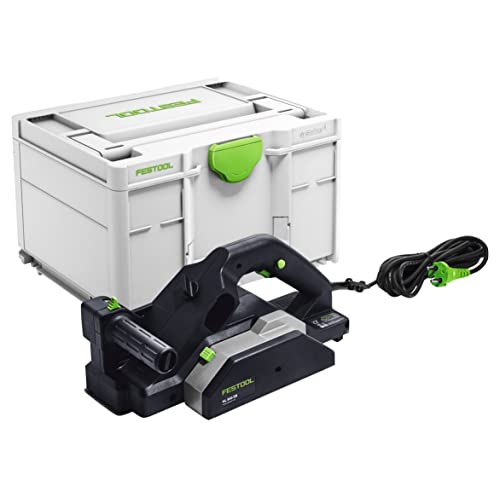
Festool HL 850 Planer — Best for joinery shop work (corded option included)
Price: Around £600–£750 corded HL 850; cordless HLC 18 around £550–£650 bare tool
The Festool HL 850 is the planer the joinery shop and the high-end finishing carpenter buys when the cut quality matters more than the platform compatibility. Spiral-bladed cutter head rather than the straight blades on every other planer here — the spiral pattern leaves a noticeably smoother surface that needs less sanding before finish. The HLC 18 cordless version uses the same head on Festool’s 18V battery platform.
The cut quality is the headline; the secondary feature is the optional rebate kit that turns the HL 850 into a full rebating tool with depth stops, edge guides and a proper dust extraction setup that fits Festool’s CT vacs natively. Available in the UK through Axminster, Workshop Heaven, Festool UK direct and the bigger trade specialists.
Not the right pick for the chippy who hangs doors three days a week — overkill, expensive, and the spiral head needs different sharpening kit. The right pick for the bench joiner, the staircase fitter, and the high-end finish carpenter where every minute saved on sanding is worth the price premium.
Pros: Spiral cutter head leaves a finish other planers can’t match, full Festool dust extraction integration, optional rebate kit makes it a serious workshop tool, build quality is workshop-grade.
Cons: Most expensive option in this list by a clear margin, spiral blades cost more to replace and need specialist sharpening, only really makes sense if you’re on the Festool ecosystem.
- Cepillado cerca de los bordes, renvalsar sin límites de profundidad gracias al alojamiento del cabezal de cepillo
- Biselado preciso: gracias a la ranura en V de 90° en la base del cepillo
- Precisión: ajuste continuo de la sección de corte
- Mayor precisión al renvalsar y rectificar
- Velocidad constante de corte incluso con la máxima sección de corte gracias a la electrónica
Ryobi R18PL-0 ONE+ 18V Planer (82mm) — Best budget for the Ryobi user
Price: Around £80–£110 bare tool; £140–£180 kit with battery and charger
The Ryobi R18PL is the cheap-and-cheerful answer for the trade who runs the ONE+ platform for occasional power tool work and wants a planer that earns its keep without spending Makita money. 82mm planing width, 0-2mm depth of cut, brushed motor (not brushless like the premium options) and a build quality that reflects the price.
On softwood it’s fine — door hanging on a pre-hung internal pine door is well within its comfort zone, and the run-time on a 4.0Ah ONE+ HP battery is reasonable. On hardwood it bogs noticeably and you have to take lighter cuts to avoid stalling the motor. The cut quality is acceptable rather than fine — there’s more tear-out than the brushless competitors and you’ll spend more time sanding. Stocked at Screwfix, Toolstation, Argos and Amazon UK.
The right pick for the apprentice, the DIYer-who’s-now-doing-it-for-money, or the multi-trade builder who needs a planer occasionally and wants it on the same battery as the Ryobi drill, jigsaw and circular saw.
Pros: Cheapest cordless 82mm planer worth buying, runs on the ONE+ platform alongside hundreds of other Ryobi tools, full 82mm width, widely stocked at UK trade chains, sensible price for occasional use.
Cons: Brushed motor lacks grunt on hardwood, more tear-out on the cut surface than brushless competitors, build quality is hobbyist-grade rather than trade-grade, depth scale is less precise than premium options.
- Chamfering groove in die-cast front shoe for added precision
- Positive depth adjustment 0-0.4mm
- Additional front handle for greater control and micro-depth adjustment
- integrated technology for maximum dust pick-up
- Includes side Fence, dust bag, wrench, 2 x reversible TCT blades
UK cordless planers compared at a glance
Planer | Width / Depth | Approx Price | Best for |
Makita DKP181 36V | 82mm / 2.0mm | £230–£270 bare | All-round trade-grade |
DeWalt DCP580 18V | 82mm / 2.0mm | £190–£230 bare | DeWalt single-platform |
Milwaukee M18 Fuel | 82mm / 2.0mm | £230–£280 bare | Milwaukee user |
Bosch GHO 18V-26 | 82mm / 2.6mm | £200–£250 bare | Bosch Pro user |
Festool HL/HLC 18 | 82mm / 1.5mm spiral | £550–£750 | Joinery / high-end finish |
Ryobi R18PL ONE+ | 82mm / 2.0mm | £80–£110 bare | ONE+ user / occasional use |
What to look for in a UK cordless planer
Battery platform — match your existing kit
A cordless planer is the wrong tool to buy on a different battery platform from the rest of your kit. The price of the planer itself is half the cost; the batteries and charger you have to buy alongside double it. Make a list of every cordless tool you use weekly and stay on the same platform — Makita LXT, DeWalt XR, Milwaukee M18, Bosch Professional 18V or Festool. The one exception is Festool, where the cut quality genuinely justifies a second platform if you’re a finish carpenter.
18V vs 36V — power vs weight
Single-battery 18V planers are lighter and cheaper to feed (one battery, not two) but bog noticeably on heavy cuts in hardwood. Dual-battery 36V (Makita DKP181) takes the heaviest cuts without complaint but weighs more and eats two batteries simultaneously. For occasional door hanging on softwood, 18V is fine. For daily door hanging on hardwood, 36V is the smarter buy.
Width and depth of cut
82mm is the trade standard — it matches a corded planer and covers door edges, trim and most second-fix work. Some hobbyist-grade cordless planers only manage 60mm or 75mm, which limits what you can do. Depth of cut should be at least 2mm — anything less and you’re taking too many passes per job. The Bosch GHO 18V-26 at 2.6mm is the deepest cut in this list.
Brushless vs brushed motor
Brushless motors run cooler, last longer, and deliver more usable power per amp-hour of battery. For a planer that pulls real load, brushless is worth the price premium. The Ryobi R18PL is the only brushed option in this list and it shows in real-world cut performance against the brushless competitors. Buy brushless unless your budget genuinely won’t stretch.
Dust extraction — actually use it
Planer chips are a pig to clean up off a customer’s hallway carpet. Every planer in this list has a dust port; the Makita, Bosch and Festool ones genuinely fit standard 32mm extractor hoses without leaking. The DeWalt port is smaller and clogs on damp timber. Carry a 5L workshop vac on the van and connect it for indoor work — the customer notices and the apprentice cleans up faster.
Frequently asked questions
Is a cordless planer powerful enough to replace a corded one?
For site and second-fix work — door hanging, trim, edge dressing — yes, the brushless 18V and 36V tools in this list are now genuinely as capable as a 750W corded planer. For workshop work where you’re taking 1mm cuts off rough-sawn oak for hours at a time, a corded planer is still less hassle (no battery swaps) and slightly cheaper to feed. Most UK chippies have moved cordless on site and kept a corded planer on the bench.
Do I need spare blades on the van?
Yes. Cordless planer blades dull faster than you think — one nail head you missed in a reclaimed door and you’ve lost the edge. Carry at least one set of replacement blades for whichever planer you run. Tungsten carbide blades last longer than HSS but don’t tolerate nails any better; treat both as consumables. Bahco, Trend and the OEM blades from each brand are all stocked at Screwfix and Toolstation.
Can I rebate with a cordless planer?
Yes, every planer in this list does rebates — the depth varies from 9mm (Makita, DeWalt) to a deeper rebate on the Bosch and Festool. Use the rebate fence and take the rebate in two or three passes rather than trying for full depth in one — cleaner cut, less tear-out, and less stress on the motor. For deep rebates beyond the planer’s capacity, finish with a router or chisel.
What’s the difference between a planer and a power planer?
On UK trade sites the terms are used interchangeably — both refer to a hand-held electric or cordless planer with a rotating cutter head. A ‘thicknesser’ or ‘planer-thicknesser’ is a different (stationary) workshop machine that takes timber to a consistent thickness through repeated passes. None of the tools in this list are thicknessers.
How long do batteries last on continuous planer use?
On a 5.0Ah 18V battery, expect 10-15 minutes of continuous full-depth cutting on softwood, less on hardwood. In real-world door hanging that’s 3-5 doors per battery. On a 36V dual-battery setup with two 5.0Ah cells, you’ll get longer runtime but you’re using two batteries simultaneously. For all-day planing work, carry at least three batteries on rotation (one in tool, one charging, one ready).
Final verdict — which cordless planer should you buy?
For the UK chippy who hangs doors regularly and wants a cordless planer that genuinely matches a corded one for cut quality and grunt, the Makita DKP181 36V LXT is still the right answer in 2026 — provided you’re on the LXT platform with batteries to feed it. The 36V power, the three-blade cutter head and the proper dust extraction port together earn the price premium over the 18V competitors.
If you’re on DeWalt XR rather than LXT, the DCP580 is the equivalent on the DeWalt side and a strong second choice. If you’re on Milwaukee M18, buy the Fuel planer — it’s the best-built 18V planer in this list. If you’re on Bosch Professional, the GHO 18V-26 is the right answer with the deeper-than-average cut depth.
If you’re already on Ryobi ONE+ and you only plane occasionally, the R18PL is fine for what it is. If cut quality matters more than platform — bench joinery, high-end finish work — the Festool HL or HLC 18 is the only planer with a spiral cutter head and the cut surface speaks for itself.