The Quick Verdict
Buy DeWalt if you want the widest tool range on UK trade counters and the easiest parts and battery supply anywhere in the country. Buy Milwaukee if you want the strongest performance ceiling in heavy-use categories — SDS drilling, impact wrenching, metalworking — and don’t mind paying a bit more to get it. Most multi-trade outfits end up with at least some of both; the question below is which one earns the first battery investment.
Brand Overviews
DeWalt — The Trade Default
DeWalt is the tool you’ll find in the widest range of UK merchants and hire shops, and that ubiquity is itself a reason to buy in — batteries, chargers and spares are never more than a branch visit away. The 18V XR range covers everything from compact drill-drivers to full SDS-max breakers, and DeWalt’s own FlexVolt system extends the same batteries up to 54V for saws and breakers that need more than 18V can give.
A genuine current entry point into the platform is the DCK266P2T-GB — a brushless combi drill and impact driver twin pack in a TSTAK case, with 2×5.0Ah batteries and charger included.


Milwaukee — The Pro Specialist
Milwaukee has built its UK reputation on the M18 FUEL range’s raw performance — brushless motors, RedLithium battery chemistry and a One-Key ecosystem for tool tracking and torque control that DeWalt doesn’t match. It costs more than the DeWalt equivalent tool for tool, but the ceiling on power and runtime is genuinely higher in the categories where it matters — heavy SDS work, impact wrenching, and metalworking.
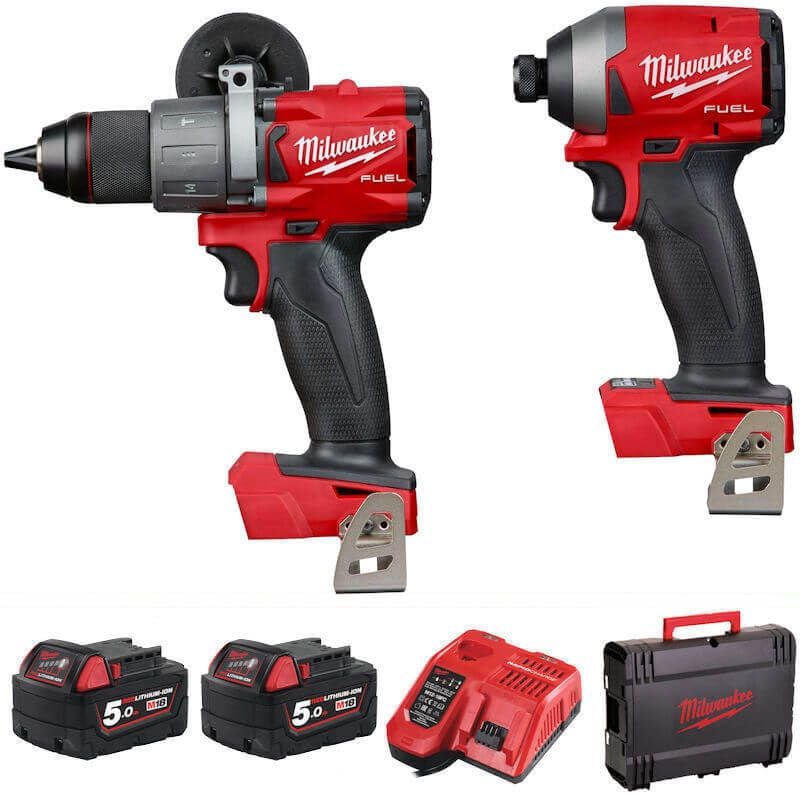
A representative current pick is the M18FPP2A2-502X — the FUEL Gen 3 combi drill and impact driver twin pack with 2×5.0Ah batteries.
Battery Platforms Compared
Both platforms run 18V lithium-ion packs with charge times, capacities and runtimes that are close enough in practice that battery chemistry alone won’t decide this for you. DeWalt’s XR packs and Milwaukee’s RedLithium packs are both available from 1.5Ah compact packs up to 12Ah high-capacity ones, and both brands’ fast chargers will top up a 5.0Ah pack in around an hour. The real difference is FlexVolt: DeWalt’s 18V/54V dual-voltage batteries step up automatically when slotted into a 54V tool, which Milwaukee’s M18 range doesn’t offer — Milwaukee’s answer to bigger jobs is the separate MX FUEL system instead, which doesn’t share batteries with M18 at all.
Tool Range and Availability
DeWalt’s Strengths
DeWalt’s 18V XR range is the single widest cordless tool range sold in the UK — several hundred tools deep, covering trades from groundworks to fine joinery, and every one of them is stocked by the major merchants (Screwfix, Toolstation, City Plumbing) as well as independent trade counters. If you need a specific niche tool in a hurry, DeWalt is the platform most likely to have it on a shelf near you.
Milwaukee’s Strengths
Milwaukee’s range is smaller but skews harder towards genuinely purpose-built trade tools — dedicated press tools for plumbers, ProPEX expansion tools, threaded rod cutters and a One-Key inventory system that larger contractors use to track tools across a fleet of vans. Where DeWalt wins on breadth, Milwaukee wins on depth in the trades it targets specifically.
Durability and Build Quality
Both brands build to a genuine trade standard rather than a DIY one, and failure rates on either platform are low enough in day-to-day site use that build quality alone rarely decides a purchase. Milwaukee’s FUEL motors and RedLink Plus electronics add overload and overheat protection that’s slightly more sophisticated than DeWalt’s equivalent XR electronics, which shows up as marginally longer tool life under sustained heavy use — SDS drilling all day, for example — but for the average combi-drill-and-impact-driver user the practical difference is small.
Price and Value
DeWalt is consistently the cheaper platform to buy into, tool for tool and kit for kit — the DCK266P2T-GB combi/impact twin pack above typically undercuts Milwaukee’s FUEL equivalent by £150–£250 depending on the retailer and any bundle offers running. Milwaukee’s premium buys you the FUEL motor and RedLink Plus electronics, plus (where it matters) One-Key connectivity — whether that’s worth the extra spend depends on how hard you’re actually running the tools, not just how often.
Platform Specs Summary
Both platforms run standard 18V lithium-ion batteries from around 1.5Ah up to 12Ah, with fast chargers topping up a 5.0Ah pack in roughly an hour on either brand. DeWalt’s entry combi/impact kits typically deliver around 60-65Nm of torque against Milwaukee FUEL’s 65-70Nm on the equivalent tier, and both brands back their tools with a standard 3-year warranty on free registration.
Which Should You Buy? By Trade
Electricians
Either platform covers the basics — combi drill, impact driver, SDS for chasing — but Milwaukee’s compact M12 sub-platform (a separate 12V system, covered in our M18 vs M12 comparison) gives electricians a genuinely one-handed option for cramped consumer units and loft spaces that DeWalt’s 18V-only compacts can’t quite match.
Plumbers and heating engineers
Milwaukee’s press-fit and ProPEX tooling is purpose-built for plumbing and heating work in a way DeWalt doesn’t directly compete with — if you’re doing any volume of pipe joining, that alone can tip the decision towards Milwaukee regardless of what you think of the rest of the range.
Carpenters and joiners
DeWalt’s breadth wins here — track saws, planers, biscuit joiners and a genuinely deep range of specialist woodworking accessories that Milwaukee doesn’t fully match tool-for-tool.
General builders and groundworkers
Either platform copes fine with general site use; DeWalt’s wider merchant availability matters more here than any performance gap, since a lost or broken tool needs replacing fast and DeWalt is more likely to be on the shelf.
Fabricators and metalworkers
Milwaukee’s FUEL grinders, band saws and metal-cutting nibblers consistently outperform DeWalt’s equivalents on runtime and cut speed under sustained metalworking loads — this is one of the clearest wins for Milwaukee in the whole comparison.
Mobile maintenance and multi-trade
DeWalt’s range breadth and lower buy-in cost make it the more practical choice for a maintenance operative who needs one platform to cover a genuinely wide spread of odd jobs without specialising in any one of them.
Final Verdict
There’s no wrong answer here for most trades — both platforms are genuinely capable, well-supported in the UK and backed by proper manufacturer warranties. DeWalt is the safer, cheaper, more available default; Milwaukee is the platform to reach for if your work leans hard into heavy drilling, impact wrenching or metalwork, or if you specifically need Milwaukee’s plumbing and electrical specialist tooling. If you’re still undecided, buy the DeWalt combi/impact twin pack above to get started cheaply, and add Milwaukee tools individually for the specific jobs where its extra performance actually earns its keep.
Frequently Asked Questions
Can I use DeWalt batteries in Milwaukee tools, or vice versa?
No — the two platforms use entirely different battery mounts and communication protocols, so batteries and chargers are not interchangeable between them.
Which platform has the better warranty?
Both offer a standard 3-year warranty on tools when registered, and both sell extended cover — check current terms on each brand’s UK site before buying, as offers change periodically.
Is Milwaukee actually worth the extra money over DeWalt?
For light-to-medium use, often not — the practical difference is small. For sustained heavy use (all-day SDS drilling, metalworking, impact wrenching), the FUEL motor and RedLink Plus electronics genuinely earn their premium.
Can I mix DeWalt XR and FlexVolt tools on the same batteries?
Yes — FlexVolt batteries work in both 18V XR tools and 54V FlexVolt tools, which is one of DeWalt’s genuine advantages over a platform split like Milwaukee’s M18/MX FUEL divide.
Does Milwaukee’s One-Key system cost extra?
The One-Key app itself is free; the cost is in buying One-Key-enabled tools, which typically carry a modest premium over the non-connected equivalent.
Related reading