Our quick verdict
Makita LXT remains the safer default for most UK trades on tool range and availability alone. Metabo is a genuinely well-engineered platform that’s worth a serious look if you value raw power density and German build quality, and don’t mind a smaller UK dealer network than Makita’s. It’s the underdog by market share, not by engineering.
At a glance: Metabo vs Makita
Metabo’s 18V range runs on its own LiHD or standard Li-Ion battery lines and is smaller than Makita’s LXT range but covers the trades Metabo targets — metalworking, general building, angle grinders in particular — to a genuinely high standard. Makita LXT is the far larger, more widely available platform, with 250+ tools and the deepest second-hand and merchant network of any 18V system covered on this site.
Battery technology — LiHD vs LXT
Metabo’s LiHD batteries pack more power cells into the same physical size as a standard lithium-ion pack, giving genuinely higher peak power output — useful for heavy-load tools like large angle grinders. Makita’s LXT batteries are conventional lithium-ion across a wide spread of capacities, prioritising breadth of options over peak power density. Neither battery technology is interchangeable with the other brand.
Tool range and ecosystem
This is Makita’s clearest advantage — LXT’s 250+ tool range dwarfs Metabo’s UK-available line-up, and Makita batteries, chargers and tools are stocked by every major UK merchant. Metabo’s range, while smaller, is strong specifically in angle grinders and metalworking tools, an area where its German engineering pedigree genuinely shows.
Build quality and ergonomics
Both brands build to a genuine trade standard. Metabo’s tools have a distinctive heft and solidity that metalworkers in particular tend to rate highly; Makita’s LXT range is more consistently refined across its much larger catalogue, since it’s had more product generations to iterate on ergonomics for any given tool category.
Price and value
A genuine current Metabo entry point is the BS 18 L drill/driver set with 2×2.0Ah batteries, charger and case.

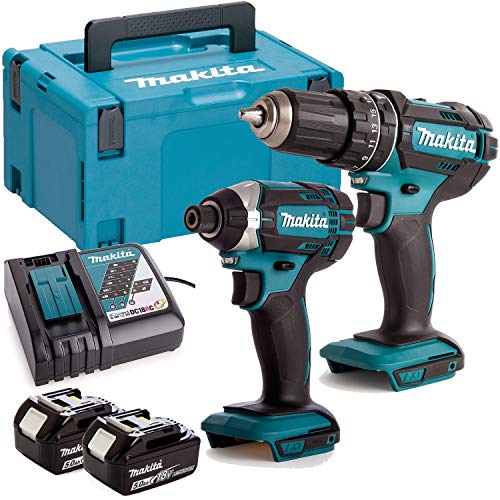
Makita’s DLX2131TJ combi drill and impact driver twin kit, with 2×5.0Ah batteries, remains one of the best-reviewed and most competitively priced entry points into LXT on Amazon UK.
Warranty and support
Both brands offer a standard warranty extendable through registration, and both maintain UK service and spares networks — Makita’s is simply larger and more widely distributed, reflecting its bigger UK market share, while Metabo’s smaller network is still genuinely functional for anyone who buys in.
Who runs each on UK sites?
Makita LXT is the platform you’ll see most often across general building, electrical, plumbing and joinery work — it’s the closest thing to a default on many UK sites. Metabo shows up more often in metalworking, fabrication and workshop settings, where its grinder range and power density have a loyal following.
Which should you buy?
If you want the widest tool range, the deepest merchant support and the platform most likely to already be running on the next van over, buy Makita LXT. If your work leans towards metalworking and grinding and you value raw power density and build heft over sheer range, Metabo is a genuinely strong alternative worth pricing up before you default to the bigger name.
FAQs
Is Metabo better than Makita?
Neither is objectively better — Metabo has an edge in power density and metalworking tools; Makita has a much wider range and UK availability. The right choice depends on your trade.
Are Metabo and Makita batteries interchangeable?
No — the two brands use entirely different battery mounts and are not cross-compatible.
Is Metabo worth the extra money?
Metabo’s pricing is broadly comparable to Makita’s at matched specifications, rather than consistently more expensive — check current listings for the specific tools you need.
Which has the bigger tool range?
Makita, by a wide margin — LXT covers 250+ tools against Metabo’s smaller UK-available range.
Which is easier to get parts and batteries for in the UK?
Makita, thanks to its much larger UK merchant and service network — Metabo parts and batteries are available but through a smaller number of stockists.
The bottom line
Makita LXT is the right call for most general trade use simply because of its scale — range, availability, second-hand market. Metabo earns its place on this list because it’s genuinely well-engineered, not because it’s a budget alternative, and it deserves real consideration from anyone whose work leans towards metalworking or grinding rather than general site tasks.
Related reading