Best SDS Drill UK 2026
When your combi drill starts smoking trying to get through a brick wall, it’s time for an SDS. These rotary hammers are built specifically for drilling into concrete, masonry, and stone — jobs that would destroy a standard drill in minutes.
Whether you’re running cables through solid walls, fixing to concrete, or doing light demolition work, an SDS drill makes the job faster and easier. Here are the best options available in the UK right now.
Quick Picks
Best Overall: Makita DHR242Z — brilliant all-rounder, great balance of power and weight, excellent build quality
Best for DeWalt Users: DeWalt DCH273N — compact, lightweight, strong performer on the XR platform
Best for Power: Bosch GBH 18V-26 — highest impact energy in the 18V class at 2.6J
Best Budget: Bosch GBH 2-26 (Corded) — under £150, proven reliability, serious power


Best SDS Drills Reviewed
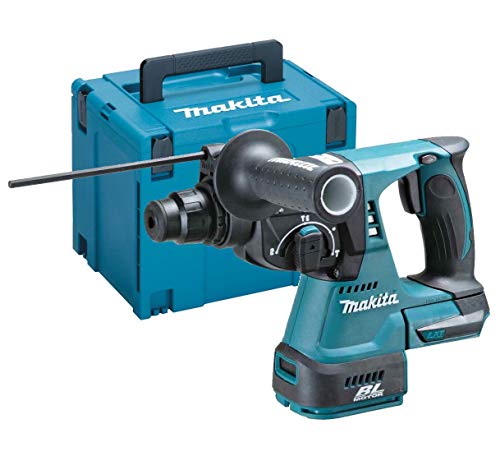
1. Makita DHR242Z
Best Overall
Price: £190-225 (body only)
The DHR242Z is the most popular cordless SDS drill among UK tradespeople for good reason. It hits the sweet spot between power, weight, and usability that makes it genuinely pleasant to use all day.
At 3.3kg (without battery), it’s light enough for overhead work and ladder use without killing your arms. The brushless motor delivers 2.0J of impact energy — not the most powerful on paper, but more than adequate for typical trade work like drilling fixings into brick and concrete up to 24mm diameter.
Three modes cover everything: rotation only (wood/metal), hammer plus rotation (masonry), and hammer only (light chiselling). The one-touch chuck makes bit changes fast, and the vibration-absorbing handle design genuinely reduces fatigue during extended use.
Build quality is typical Makita — solid, reliable, and likely to survive years of site abuse. It runs on the 18V LXT platform, so if you’re already invested in Makita batteries, this slots straight into your kit.
The downsides: 2.0J impact energy is lower than some competitors. For heavy-duty demolition or drilling large-diameter holes in reinforced concrete, you might want something beefier. Also sold body-only, so factor in battery costs if you’re new to the platform.
Verdict: The go-to choice for electricians, plumbers, and general trades who need a reliable SDS for everyday work. Not the most powerful, but the best all-round package.
- Includes:
- DHR242Z 18v SDS Hammer Drill
- Makpac Case
- Inlay
- No Batteries or Charger Included
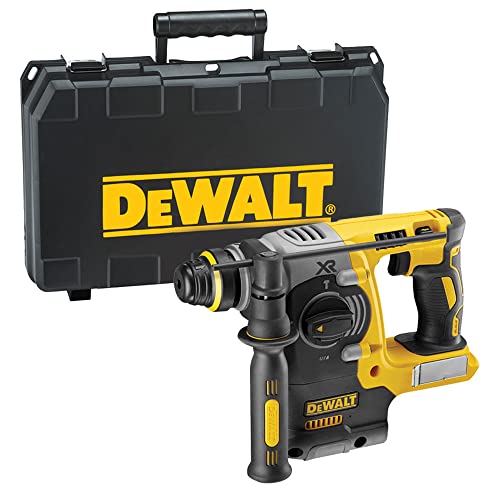
2. DeWalt DCH273N
Best for DeWalt Users
Price: £200-225 (body only)
DeWalt’s answer to the Makita, and a strong contender in its own right. The DCH273N delivers 2.1J of impact energy with an impressive 4,600 BPM — slightly more punch than the Makita on paper.
At 3.1kg body weight, it’s marginally lighter than the DHR242Z, which adds up over a full day’s work. The ergonomics are excellent, with a compact design that handles well in tight spaces. An LED work light with delay feature helps when you’re drilling in dark corners.
The electronic clutch provides consistent torque and protects the gears if the bit binds — a genuine safety feature when drilling into unknown walls. Vibration control is effective, and DeWalt claims it can drill over 90 holes (10mm x 80mm) per charge with a 5.0Ah battery.
Runs on the 18V XR platform with over 250 compatible tools.
The downsides: Chiselling performance is adequate but not exceptional — if demolition is a major part of your work, look elsewhere. Some users report the chuck can be stiff when cold.
Verdict: If you’re on the DeWalt platform, this is your SDS. Excellent build quality, solid performance, competitive with the Makita in every meaningful way.
- Category-leading high speed drilling performance at more than 90 holes (10mm x 80mm) per charge
- Rotation stop mode for light chiselling in plaster, tiles and render and impact stop mode for rotary only drilling in wood and metal
- Brushless motor with high capacity XR 4.0Ah 18V Lithium-ion battery platform for extreme runtime and reduced maintenance Electronic clutch for consistently-high torque and improved durability
- Perform & Protect: best-in-class vibration at 6.6m/s², minimising user fatigue Bright white LED with delay feature improves visibility
- Ideal for drilling anchors and fixing holes into concrete, brick and masonry from 4mm to 24mm Compact, lightweight and ergonomic design for improved comfort and support during extended operating periods
3. Bosch GBH 18V-26
Best for Power
Price: £250-300 (body only)
When you need maximum cordless power, the Bosch delivers. At 2.6J of impact energy, it hits harder than both the Makita and DeWalt — making light work of tougher materials and larger diameter holes.
The GBH 18V-26 features Bosch’s Kickback Control, which automatically shuts down the motor if the bit binds. This is a genuine safety advancement that other manufacturers are still catching up with. Electronic Precision Control provides smooth bit starts for accurate positioning.
Drilling capacity matches the impact energy: up to 26mm in concrete, 13mm in steel, and 30mm in wood. The vibration control is excellent, and the brushless motor is maintenance-free.
The trade-off is weight — at 3.5kg (body only), it’s noticeably heavier than the Makita or DeWalt. For occasional use, that’s fine. For all-day overhead drilling, you’ll feel it.
The downsides: Heavier than competitors. Bosch’s 18V platform has fewer tools than Makita or DeWalt, so platform lock-in is a bigger commitment. Higher price point.
Verdict: The most powerful 18V SDS available. Choose this when raw drilling performance matters more than weight or price.
- Delivers 2.6 J of impact energy for fast drilling and high chisel removal performance
- KickBack Control and Electronic Precision Control for better tool handling and increased user protection
- Optional GDE 18V-16 Professional dust extraction unit integrates with the hammer for a self-contained HEPA dust solution
- Universal rotary hammer in the SDS plus cordless category
- Scope of supply: Auxiliary handle (2 602 025 141);Depth stop 210 mm (1 613 001 010);L-BOXX 136 (1 600 A01 2G0);1/1 L-BOXX inlay for tool (1 600 A00 HP1);Machine cloth
4. Bosch GBH 2-26 (Corded)
Best Budget Option
Price: £130-150
If you don’t need cordless freedom, a corded SDS delivers more power for less money. The GBH 2-26 has been a trade staple for years — proven, reliable, and seriously capable.
With 2.7J of impact energy (more than any 18V cordless), it’ll punch through concrete faster than anything battery-powered. The 830W motor doesn’t fade during extended drilling sessions like batteries can. At around £140, it’s roughly a third of the price of a cordless setup with batteries.
Three-mode operation covers drilling, hammer drilling, and chiselling. The SDS-Plus chuck is the industry standard, so bits are cheap and widely available. Build quality is typical Bosch Professional — this will last years of hard use.
The downsides: You need mains power, which limits mobility and creates trip hazards. Heavier than cordless equivalents at around 2.7kg. Not ideal for ladder work or tight spaces where a cord gets in the way.
Verdict: Best value if you’re working near power outlets. More power than any cordless for a fraction of the price. The sensible choice for occasional users or as a workshop SDS.
- Delivers 2.7 J of impact energy for fast drilling and high chisel removal performance
- High-quality components ensure robustness, reliability, and long lifetime
- Optional chisel mode and quick-change chuck enable use in wide range of applications
- All-round performance rotary hammer with quick-change chuck in the SDS plus category
- Scope of supply: Auxiliary handle (2 602 025 141);Carrying case;Depth stop 210 mm (1 613 001 010);Machine cloth;Quick change chuck 13 mm (2 608 572 212);SDS plus quick-change chuck (2 608 572 213);Voltage 240 V
Comparison Table
| Model | Type | Impact Energy | Weight | Price (Body) | Best For |
|---|---|---|---|---|---|
| Makita DHR242Z | 18V Cordless | 2.0J | 3.3kg | £165-190 | All-round trade use |
| DeWalt DCH273N | 18V Cordless | 2.1J | 3.1kg | £175-195 | DeWalt platform users |
| Bosch GBH 18V-26 | 18V Cordless | 2.6J | 3.5kg | £220-250 | Maximum cordless power |
| Bosch GBH 2-26 | Corded | 2.7J | 2.7kg | £130-150 | Best value/budget |
SDS vs SDS-Plus vs SDS-Max: What’s the Difference?
SDS and SDS-Plus are effectively the same thing — both use a 10mm shank and are interchangeable. SDS-Plus is the current standard; original SDS is largely obsolete. All the drills reviewed here use SDS-Plus.
SDS-Max uses an 18mm shank and is designed for heavy breakers and large rotary hammers. It’s a completely different system — SDS-Max bits won’t fit in SDS-Plus drills and vice versa. Unless you’re doing serious demolition work, you don’t need SDS-Max.
For typical trade work — drilling fixings, running cables, light chiselling — SDS-Plus is the right choice.
What to Look For
Impact Energy (Joules): Higher means more drilling power. 2.0-2.6J handles most trade applications. For heavy-duty work, consider 3.0J+ or a corded model.
Weight: Matters more than you’d think. A few hundred grams makes a real difference during overhead drilling or ladder work. Under 3.5kg is manageable for most people.
Modes: Three-mode operation (rotation only, hammer + rotation, hammer only) gives you maximum flexibility. Some cheaper models skip the rotation-only mode.
Vibration Control: Extended SDS use can cause hand-arm vibration syndrome. Better drills have dampening systems that reduce transmitted vibration. Check the vibration rating (m/s²) — lower is better.
Platform Compatibility: If you’re already invested in a battery platform (Makita LXT, DeWalt XR, Bosch 18V), stick with it. Buying new batteries is expensive.
Cordless vs Corded
Go cordless if:
-
- You work across multiple sites or locations
-
- You frequently work on ladders or in tight spaces
-
- You’re already invested in an 18V battery platform
-
- Convenience matters more than raw power
Go corded if:
-
- You work primarily in one location (workshop, fixed site)
-
- You need maximum sustained power
-
- Budget is a primary concern
-
- You’re drilling large diameters or working in reinforced concrete regularly
For most UK tradespeople doing typical installation work, cordless makes sense. The freedom and convenience outweigh the slight power disadvantage. But if you’re doing heavy structural work or demolition, corded still wins on pure capability.
Frequently Asked Questions
Can I use an SDS drill for normal drilling?
Yes, in rotation-only mode. However, SDS drills are heavier and more powerful than necessary for general drilling. A combi drill is better for everyday use — keep the SDS for masonry work.
How long do SDS drill bits last?
Depends on what you’re drilling. In brick and standard concrete, a quality bit should handle hundreds of holes. In reinforced concrete or engineering brick, they wear much faster. Buy decent bits (Bosch, Makita, Hilti) rather than cheap sets.
Is more impact energy always better?
Not necessarily. Higher impact energy drills are typically heavier and more expensive. For drilling standard fixings in brick and concrete, 2.0J is plenty. You only need more for large diameter holes, reinforced concrete, or heavy chiselling.
What’s the difference between an SDS drill and a breaker?
SDS drills are designed primarily for drilling, with chiselling as a secondary function. Breakers (demolition hammers) are designed for chiselling and breaking — they have no rotation function. For light demolition, an SDS in hammer-only mode works fine. For serious demolition, you need a dedicated breaker.
Bottom Line
For most UK tradespeople, the Makita DHR242Z offers the best balance of performance, weight, build quality, and value. It handles everyday trade work brilliantly and will last for years.
If you’re already on DeWalt, the DCH273N is equally capable and keeps you on one battery platform.
If you need maximum cordless power and don’t mind the extra weight and cost, the Bosch GBH 18V-26 delivers the hardest hits.
And if you’re on a budget or work near power outlets, the corded Bosch GBH 2-26 gives you more power than any cordless for under £150.