Our quick verdict
M18 is your main platform for anything that needs real power — drilling, driving, cutting, grinding. M12 exists for the jobs where size matters more than raw torque — tight consumer units, loft hatches, cupboards under sinks. Most electricians and plumbers end up running both rather than picking one; this guide is about which to buy first.
At a glance: M18 vs M12
M18 and M12 are two entirely separate Milwaukee battery platforms — an M18 battery will not fit an M12 tool and vice versa. M18 covers the vast majority of Milwaukee’s range, from combi drills up through SDS-max breakers and site radios; M12 is the compact system, built around a genuinely smaller tool body for access-limited work rather than raw output.
What M18 is for
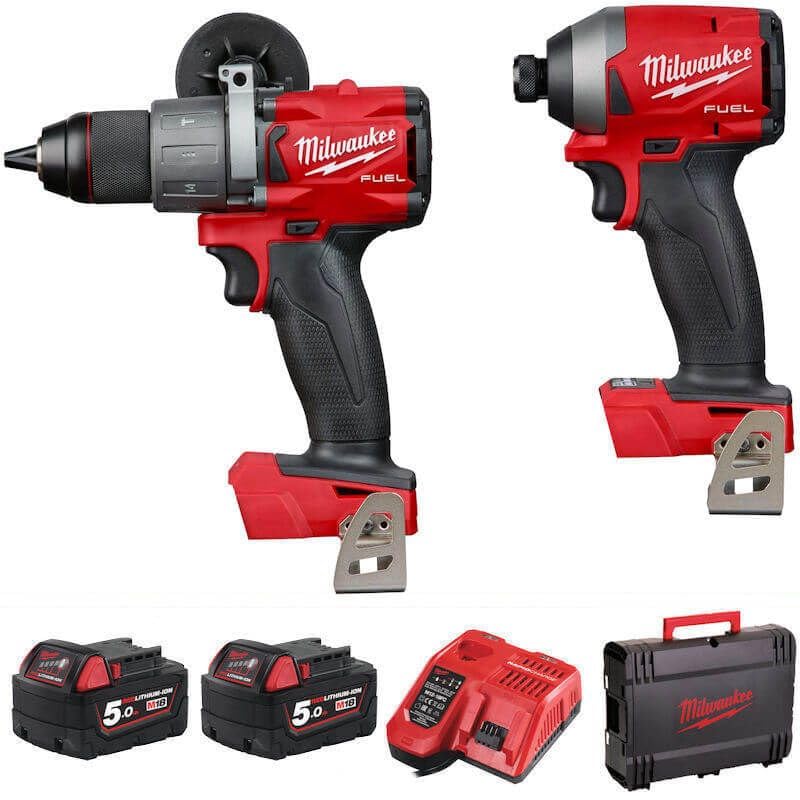
M18, and specifically the FUEL line within it, is Milwaukee’s main trade platform and the one to buy first if you’re only buying one. It covers everything from combi drills and impact drivers through to SDS rotary hammers, grinders, saws and site lighting. A genuine current FUEL combi/impact twin pack is the M18FPP2A2-502X, with 2×5.0Ah batteries included.
What M12 is for
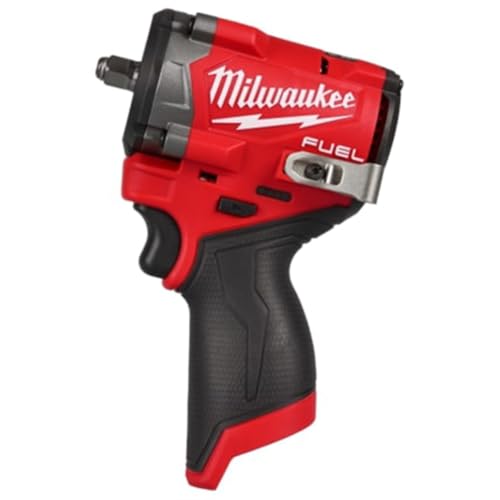
M12 is Milwaukee’s compact 12V system, purpose-built for jobs where an 18V tool’s size and weight get in the way — first and second fix electrical work in tight consumer units, plumbing in cupboards and lofts, and any one-handed job where a full-size tool simply won’t fit. The M12 FUEL Stubby impact wrench is the standout tool in the range: a genuinely compact impact wrench that still delivers real torque, and it’s named specifically because Milwaukee shortened the head length so it fits into spaces a standard impact wrench can’t reach.

Beyond the stubby impact wrench, M12 also covers inspection cameras, press tools and PEX expansion tools aimed squarely at plumbers and electricians working in confined spaces.
Head to head
Power and run-time
M18 wins comfortably on raw power and sustained runtime — it’s built for the jobs that need it. M12 isn’t trying to compete on power; its tools are tuned for enough torque to do the job in hand while staying genuinely pocket-sized, and runtime on the smaller M12 batteries is correspondingly shorter.
Size and access
This is M12’s entire reason to exist. An M12 tool body is noticeably smaller and lighter than the M18 equivalent, which matters enormously when you’re working one-handed above your head in a loft, or reaching into a consumer unit where an M18 impact driver simply won’t physically fit.
Tool range
M18 is the far larger range — several hundred tools against M12’s smaller but genuinely well-targeted selection. If you need something unusual, M18 is more likely to have it; M12 covers the specific access-limited use cases well but doesn’t try to be a complete platform on its own.
Cost
M12 tools and batteries are generally cheaper individually than their M18 equivalents, reflecting the smaller motors and battery packs, but most trades end up buying into both platforms over time rather than choosing M12 as a cost-saving measure — the two solve different problems, not the same problem at different price points.
Do you need both?
If your work regularly takes you into tight spaces — consumer units, lofts, under-sink cupboards — then yes, M12 earns its keep alongside M18 rather than instead of it. If your work is mostly open-access site or workshop tasks, M18 alone covers the vast majority of what you need and M12 can wait until a specific job demands it.
Which should you buy?
Buy into M18 first if you’re starting from nothing — it’s the platform that does the most jobs on its own. Add M12 tools individually as specific access-limited jobs demand them, starting with the FUEL Stubby impact wrench if consumer units or tight electrical work are a regular part of your day.
FAQs
Are M18 and M12 batteries interchangeable?
No — the two platforms use physically different battery mounts and are not cross-compatible in either direction.
Is M12 just a cheaper, weaker version of M18?
No — M12 is purpose-built for access-limited work, not as a budget alternative. Buy M12 for the jobs where size matters, not to save money on tools M18 already does well.
Can I charge M12 and M18 batteries on the same charger?
Only with Milwaukee’s dual-voltage chargers, which are designed to accept both platforms’ batteries — a standard M18-only or M12-only charger won’t accept the other.
Which platform should a first-year apprentice buy into?
M18 first, for the widest tool coverage — M12 tools are worth adding once you know which access-limited jobs actually come up regularly in your specific trade.
Does M12 cover SDS drilling?
Yes, in a compact form — the M12 range includes a sub-compact SDS-plus rotary hammer, though it won’t match an M18 or full-size SDS tool’s sustained drilling perfor
Related reading