Our quick verdict
Both brands make genuinely excellent 18th Edition multifunction testers, and most UK electricians end up choosing on familiarity and budget as much as spec sheet. The Fluke 1664 FC is the pick if you want auto test sequences, Bluetooth logging to Fluke’s own app, and a tester that shaves real time off a full EICR. The Megger MFT1721 is the pick if you want the tester that’s been the default on UK sites for years, with a lower buy-in price and a service network that every test-equipment repairer in the country already knows. Neither is the wrong answer — this is closer to picking a van than picking a screwdriver.
At a glance: Fluke 1664 FC vs Megger MFT1721
On paper the two testers cover the same ground — loop impedance, RCD, insulation resistance, PSC, continuity — and both meet the 18th Edition requirements out of the box. The real differences show up in workflow: the Fluke logs results to its FC app over Bluetooth and runs a guided auto test sequence that steps you through a full circuit test with fewer manual re-connections, while the Megger keeps a simpler, menu-driven interface that most UK electricians who trained on earlier Megger MFTs can pick up without a manual. On price, the Megger typically undercuts the Fluke by several hundred pounds, and Megger’s UK calibration and repair network is arguably the more established of the two for anyone who wants a local option rather than posting a tester away.
The Fluke range
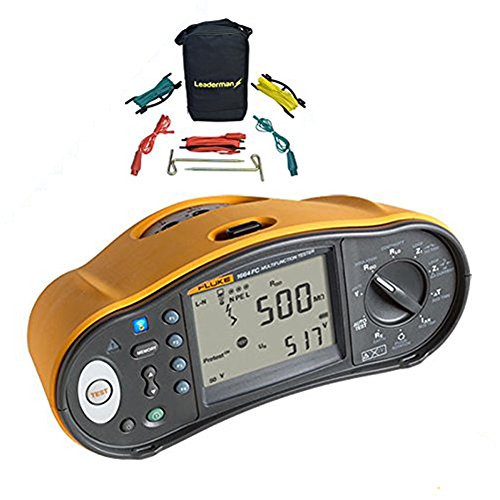
Fluke 1664 FC — the connected flagship
The 1664 FC is Fluke’s top-tier UK multifunction tester: full 18th Edition test set, an auto test sequence that runs loop, RCD and insulation checks in one guided pass, and Bluetooth logging straight into Fluke’s Connect app so results land on your phone or laptop without typing them up from a paper pad later. For anyone doing volume EICR work, the time saved on logging alone is the real selling point, not just the test speed.
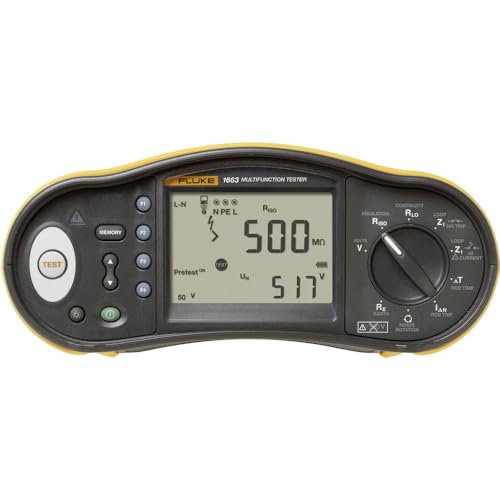
Fluke 1663 — the same tester without the connectivity
The 1663 runs the same core test functions as the 1664 FC but drops the Bluetooth logging and app integration, which brings the price down for anyone who’s happy filling in a certificate by hand or already has their own logging workflow. It’s the sensible choice if you want Fluke’s build quality and accuracy without paying for a feature you won’t use.
The Megger range
Megger MFT1721 — the UK standard
Megger’s MFT range has been the default multifunction tester on UK sites for decades, and the current MFT1721 keeps that reputation — a full 17th/18th Edition test set in a rugged case, a menu system that hasn’t strayed far from the one a generation of electricians already knows, and a buy-in price that typically sits below the equivalent Fluke. It doesn’t offer Bluetooth logging, but for anyone who’s not chasing a paperless workflow, that’s not a feature you’ll miss.

Megger MFT-X1 and MFT1845 — stepping up
Megger’s higher-tier MFT-X1 and MFT1845 testers add touchscreen interfaces, onboard job storage and Bluetooth data transfer, aimed at contractors doing high-volume commercial testing. Neither turns up as a genuine listing on Amazon UK — these are typically bought through electrical wholesalers and Megger’s own trade accounts rather than online marketplaces, so budget for a wholesaler quote if this is the tier you need.
Head to head
Speed and workflow
The Fluke 1664 FC’s auto test sequence is the bigger workflow advantage of the two — it guides you through a full circuit test in one pass and logs every result automatically, which adds up over a day of EICR work. The Megger MFT1721 is quicker to just pick up and start testing on a single circuit if you’re not running the full sequence, but it doesn’t save you the same admin time afterwards.
Display and data
Fluke’s app-based logging is the standout feature for anyone doing volume testing — results sync to your phone and export straight into a certificate template. Megger’s MFT1721 has a clear, no-nonsense display but no app connectivity, so you’re still transcribing results by hand or from the tester’s own limited internal memory.
Build and ergonomics
Both testers are built to survive daily site use and IP54-rated cases are standard across both ranges at this tier. The Fluke feels marginally more refined in the hand; the Megger’s simpler control layout means less to think about mid-test, which some electricians genuinely prefer under time pressure.
Price and kit
The Megger MFT1721 is consistently the cheaper way into a genuine 18th Edition multifunction tester, often by several hundred pounds against the Fluke 1664 FC. If budget is the deciding factor and you don’t need Bluetooth logging, that gap is hard to ignore.
Calibration and support
Both brands are well served by UK calibration labs, but Megger’s decades-long presence on UK sites means slightly wider availability of local repair and calibration options, particularly outside major cities. Fluke’s support network has caught up significantly in recent years and is no longer a real disadvantage for most users.
Which should you buy?
Buy the Fluke 1664 FC if you’re doing volume EICR or periodic testing work and the time saved by app logging and auto test sequences will pay for the price difference within a year or two. Buy the Megger MFT1721 if you want the lower buy-in cost, you’re happy logging results manually or with your own system, or you simply trained on Megger and don’t want to relearn a new interface. If you need the higher-tier touchscreen features of the MFT-X1 or MFT1845, go through an electrical wholesaler rather than Amazon.
FAQs
Do I need Bluetooth logging on a multifunction tester?
Not strictly — plenty of electricians still fill in paper or software certificates from a tester with no connectivity at all. It’s a genuine time-saver on high-volume work, but not a functional requirement for passing 18th Edition tests.
Is the Megger MFT1721 still 18th Edition compliant?
Yes — the MFT1721 covers the full 18th Edition test set (loop impedance, RCD, insulation resistance, PSC and continuity), the same as the Fluke 1664 FC.
Can I buy Megger’s higher-tier MFT-X1 or MFT1845 on Amazon?
Not currently — those models are sold mainly through electrical wholesalers and Megger’s trade accounts rather than online marketplaces, so you’ll need a wholesaler quote rather than an Amazon order.
How often does a multifunction tester need calibrating?
Most manufacturers, Fluke and Megger included, recommend annual calibration to keep results legally defensible on certificates — factor that ongoing cost into whichever tester you buy.
The bottom line
Both the Fluke 1664 FC and the Megger MFT1721 are genuinely capable 18th Edition testers that will see you through years of EICR and periodic inspection work. Choose Fluke if the auto test sequence and app logging will save you real admin time; choose Megger if you want the lower price and the interface that’s been the UK trade standard for a generation. Either is a safe investment — the wrong choice here is buying a tester that isn’t 18th Edition compliant at all, not picking between these two.
Related reading