I’ll be straight about this from the off: I don’t hate Ryobi. I ran ONE+ as my main carpentry platform for the best part of two years, I still own a fair bit of it, and I’d recommend it to plenty of people. But somewhere around April this year, mid-way through a run of first-fix and kitchen jobs, I quietly stopped reaching for it. By the end of the month most of it was sat in the van as backup, and the day-to-day work had moved onto a different platform. Here’s the honest version of why.
If you’re weighing up Ryobi against DeWalt, Makita or Milwaukee, I’m not here to tell you it’s rubbish, because it isn’t. I’m here to tell you where it stopped keeping up with how I actually work, so you can decide whether that applies to you before you sink a few hundred quid into batteries.
Where Ryobi actually earned its place
Let’s give it its due, because the reasons I bought into ONE+ in the first place are all still true. The range is enormous — over 280 tools run off the same 18V battery, so once you’re in the system you can pick up a glue gun, an inflator, a site fan, a brad nailer and a caulking gun without ever changing platform. For a chippy that breadth is genuinely useful; there are ONE+ tools the premium brands simply don’t bother making, or charge silly money for.
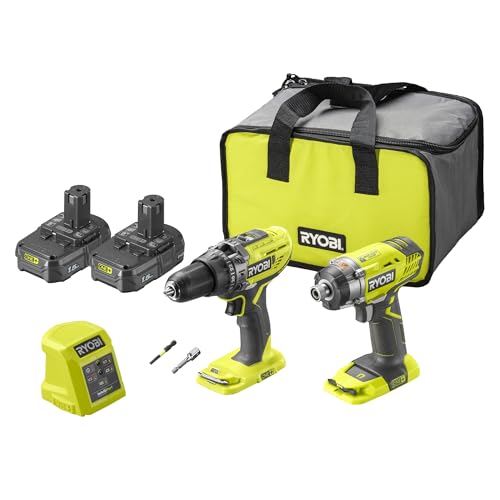
Price of entry is the other big one. A combi and impact driver twin kit with two batteries and a charger, like the one below, lands well under what you’d pay for the equivalent DeWalt or Makita set, and the bare tools are cheap enough that you can build out your kit slowly without flinching. For a first-year apprentice or someone doing weekend graft, that maths is hard to argue with, and I’d still point them straight at it.
The batteries last, too. I never had a Ryobi pack die on me prematurely, and the newer high-capacity and HP cells are a real step up on the early stuff. So this isn’t a reliability horror story. It’s something more boring, and I think more useful — a story about where a value platform quietly runs out of road when the work gets relentless.
The job that changed my mind
It was a run of three back-to-back kitchen fits. Nothing exotic — hanging doors, scribing worktops, a lot of driving long screws into engineered timber and the odd bit of joist work where the access was tight. By the second day I noticed I was babysitting the tools. The combi was bogging down driving 100mm screws into anything dense, so I was pre-drilling things I shouldn’t have needed to. The impact was fine on the small stuff and gutless on the big stuff. And I was through batteries faster than I wanted, because the brushed motors on my older tools were pulling current to make up for the lack of torque.
None of that is a disaster on a single job. But strung across a full week it adds up to a tax on your time, and time’s the one thing on site you can’t buy more of. That was the week I borrowed a mate’s brushless combi from a premium platform, used it for an afternoon, and felt the difference in my wrist and in the clock. I wasn’t fighting the tool any more. That’s the moment it clicked I’d been working around my kit instead of with it.
Where ONE+ falls down for daily graft
Three things, mainly. First, the brushless gap. Ryobi does make brushless ONE+ tools and the HP line is properly good — something like the compact HP brushless drill/driver below closes a lot of that gap on its own — but a lot of the cheaper kit most people actually buy into is still brushed. Brushed motors run hotter, give less torque per amp, and wear faster under constant load. If you’re driving big fixings all day, you feel it.

Second, build feel under pressure. The chucks on the budget drills don’t grip large bits as confidently, the clutches feel coarser, and the housings flex a touch more than I’d like when you’re really leaning on a tool. For light and medium work it’s a non-issue. For heavy, repetitive driving it becomes a low-level annoyance you stop noticing only because you’ve adapted to it.
Third, and this is the subtle one — resale and trade credibility. On a busy site, kit gets judged. That shouldn’t matter and it does. More practically, premium platforms hold their value far better second-hand, so when you do upgrade, you claw back more of your money. Ryobi is cheap to buy and cheap to sell.
The cost argument doesn’t hold up the way people think
The pitch for Ryobi is always value, and on the sticker it’s true. But the way the maths plays out over a working year is more complicated. If a cheaper tool makes a long driving job take fifteen minutes longer, and you do that kind of job a few times a week, you’ve quietly handed back hours over a year. Put a sole trader’s hourly rate against those hours and the gap between a budget combi and a premium one disappears fast.
Then there’s the upgrade trap. Plenty of trades buy Ryobi to start, outgrow it, and end up buying a second platform anyway, which means paying for batteries and chargers twice. If you already suspect you’ll want a premium platform within a couple of years, buying value first can cost you more in total than just starting where you’re going to end up. I’m not saying that’s everyone. I’m saying it was me, and I didn’t see it coming.
What I switched to — and why I didn’t go all-in
I moved my core driving and cutting tools to a brushless premium 18V platform, because that’s where my heavy daily work lives and where the time savings actually land. The combi has the torque to drive long fixings without complaint, the impact has the grunt for coach screws, and the circular and recip saws hold their speed under load in a way my old kit didn’t.
But — and this matters — I kept a chunk of Ryobi. The niche tools, the occasional-use stuff, the things that sit in the van for that one job a month. There’s no sense paying premium prices for a cordless inflator or a site fan. So I’m not anti-Ryobi; I’m anti-using-it-for-the-wrong-job. The mistake was making a value platform carry my heaviest, most repetitive work. Once I stopped asking it to do that, it went back to being genuinely useful.
Who should still buy Ryobi
If you’re an apprentice or first-year, buy it without guilt. It’ll get you a full kit for the money you have, the breadth means you’ll always have the right tool, and you’ll learn what you actually need before you spend big. If you’re a DIYer or weekend grafter, it’s arguably the best-value cordless system in the UK and I wouldn’t look past it. And if your trade work is light or occasional — second fix, small repairs, snagging — ONE+ will carry you fine for years.
It’s specifically the heavy, daily, repetitive-load tradesperson I’d steer toward a brushless premium platform for the core tools. That’s the use case where I personally hit the ceiling. If that’s not you, none of this applies, and you should ignore the bloke who quit Ryobi mid-season.
Frequently asked questions
Is Ryobi good enough for professional carpentry?
For light and medium carpentry, yes — particularly the brushless HP tools. Where it struggles is heavy, all-day driving into dense timber, where the cheaper brushed tools run out of torque and chew through batteries. Buy HP if you’re going to lean on it.
Why did you switch away from Ryobi?
Time, mainly. On heavy driving work the cheaper tools slowed me down and I was babysitting batteries. A brushless premium platform let me work faster on the jobs I do most, and over a year that paid for the difference in price.
Should I sell my Ryobi if I upgrade?
Not necessarily. Keep the niche and occasional-use tools — inflators, fans, glue guns, lights — because there’s no value in paying premium prices for those. Move only your core driving and cutting tools to the better platform.
Is it worth running two battery platforms?
It can be. Run a premium platform for your heavy daily tools and keep a value platform for the odd-job tools the premium brands either don’t make or overprice. You just don’t want your most-used tools split across two systems.
Is Ryobi HP as good as DeWalt or Makita?
It’s much closer than the older brushed range. For most trades the HP line is genuinely capable. The premium brands still edge it on sustained heavy load, build feel and resale value, but the gap is far smaller than the price difference suggests.
Final word
Quitting Ryobi mid-season sounds dramatic, but it really wasn’t. I just stopped asking a value platform to do my heaviest work, moved my core tools to something with more grunt, and kept the Ryobi for what it’s always been brilliant at — cheap breadth. If your daily work is heavy and repetitive, that’s the move I’d make again tomorrow. If it isn’t, Ryobi remains one of the smartest-value systems you can buy, and there’s no shame in staying put.