Your tool belt is basically your office. Everything you need should be within arm’s reach, with no running back to the van and no fumbling through a bag. When it works, you barely notice it. When it doesn’t, it ruins your day — a bad belt digs into your hips, dumps your pencil at the worst moment, and has you swearing at it by lunchtime.
There’s a huge range of carpenter’s tool belts on sale in the UK, from basic nylon rigs at under £30 to serious leather setups costing over £200. The right one depends on what you’re doing: a first-fix carpenter has very different needs from a finishing joiner or a general site worker, and weight distribution, pocket layout and material quality all matter more than you’d think.
Below are six of the best carpenter’s tool belts available in the UK right now, covering every budget and work style.
Quick Picks at a Glance
Product | Best For | Price Range |
OX Pro Oil-Tanned Leather 4-Piece Rig | Overall best — serious carpenter’s setup | £80–£120 |
DeWalt DWST1-75651 Tool Belt | Best budget buy | £30–£45 |
Veto Pro Pac AX3631 Builders Belt | Premium pick — ultimate pro rig | £200+ |
CLC Work Gear 1649 Tool Belt | Best mid-range — great value for money | £45–£65 |
Stanley 1-96-181 Belt Bag | Best compact, single-pouch pick | £15–£25 |
Bucket Boss Airlift 50100 Suspension Rig | Best budget option with suspenders | £50–£70 |
1. OX Pro Oil-Tanned Leather 4-Piece Rig — Best Overall
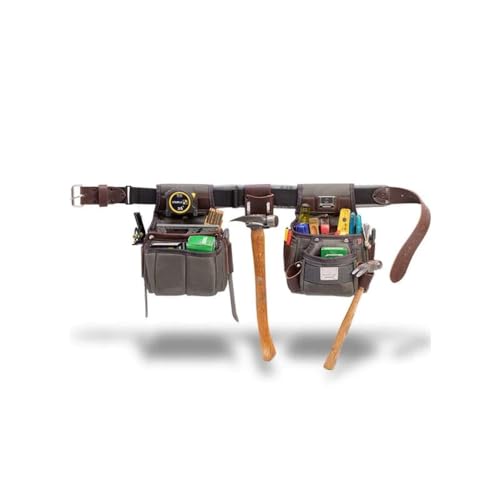
If you’re serious about your kit, the OX Pro leather rig is the benchmark for carpenter’s tool belts in the UK. The four-piece set includes a main pouch, a nail/fastener pouch, a hammer holder and a genuine oil-tanned leather belt, all built from top-grain leather with reinforced double stitching throughout. This isn’t a fashion accessory — it’s a workhorse.
The oil-tanned leather softens and moulds to your body over time, which you genuinely appreciate after a week on site. The belt itself is thick and sturdy, distributing weight well even when fully loaded, and the main pouch has a strong selection of pockets and loops, including a dedicated tape measure clip and multiple pencil slots — nothing bounces around.
Expect to pay between £80 and £120 depending on where you buy it, but this is a belt that will last years with proper care. OX Tools has a strong reputation as reliable UK trade kit, and this rig delivers on it. If you’re buying one belt to see you through a career, this is a strong contender.
Pros:
- Genuine oil-tanned top-grain leather — improves with age
- Excellent weight distribution across the hips
- Dedicated slots for tape, pencils and drill bits
- Durable steel hardware — clasps and D-rings built to last
Cons:
- Expensive — premium pricing that not everyone can justify
- Can feel bulky if you’re used to lighter setups

2. DeWalt DWST1-75651 Tool Belt — Best Budget Buy
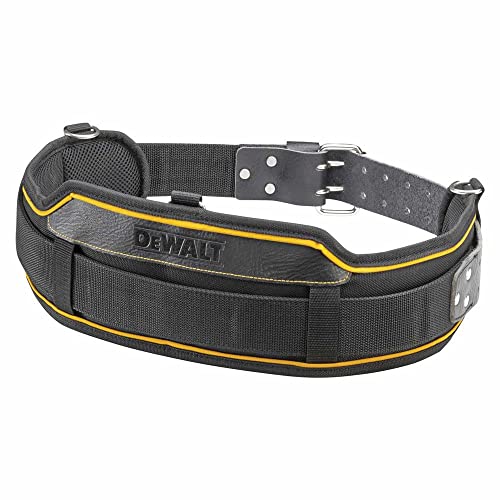
If you want a dependable belt without the leather price tag, the DeWalt DWST1-75651 is a sound budget pick. It’s a heavy-duty padded belt with a breathable mesh lining, which makes a real difference on hot days carrying a full load, plus a two-pin buckle and D-ring hangers so you can add or remove pouches as your kit changes.
It’s fully adjustable and built to work with DeWalt’s own pouch range, so it’s a sensible starting point if you’re building a modular setup over time rather than buying a fixed rig in one go. It won’t develop the character of a leather belt, and the components are plastic and nylon rather than steel and leather, but for the price it’s a genuinely useful piece of kit.
Pros:
- Low price point for a name-brand belt
- Breathable padded mesh — comfortable over a full shift
- Compatible with DeWalt’s modular pouch range
- Fully adjustable to fit most waist sizes
Cons:
- Plastic buckle and hardware, not steel
- Sold as a belt only — pouches are a separate purchase
3. Veto Pro Pac AX3631 Builders Belt — Premium Pick
Veto Pro Pac is a brand serious tradespeople know well, and the Builders Belt (AX3631) sits at the top end of the price range for good reason. It combines premium leather with heavy-duty nylon, and the padded waist support genuinely makes a difference on long days — this is a belt built for people who wear one for eight-plus hours, five days a week.
The modular design means you can configure pouches to match how you actually work, rather than accepting a fixed layout. It isn’t the right choice for everyone: if you’re only on the tools occasionally, or want something for lighter work, the price is hard to justify. But for full-time carpenters and joiners who live in their belt, it’s one of the best-built options on the UK market.
Pros:
- Exceptional build quality — leather and nylon hybrid
- Padded back support makes a real difference on long days
- Modular design — configure pouches to suit your trade
Cons:
- Premium pricing — a serious investment
- Overkill for occasional or light use
4. CLC Work Gear 1649 Tool Belt — Best Mid-Range
CLC (Custom LeatherCraft) is a long-established US brand that’s well regarded among UK tradespeople, and the 1649 is a solid mid-range pick. It’s a four-piece, 11-pocket combo rig built from heavy-duty polyester with reinforced stitching at the stress points, striking a sensible balance between price and genuine day-to-day usability.
The pocket layout is sensible rather than flashy: enough dedicated slots for fasteners, a tape measure and a hammer loop without piling on pockets you’ll never use. It won’t develop the character of a leather rig and the hardware is a step down from the premium options above, but as an everyday belt for general carpentry and site work, it earns its place in this list.
Pros:
- Good mid-range pricing — solid value for money
- Sensible 11-pocket layout without excess bulk
- Reinforced stitching at the pockets that take the most strain
Cons:
- Not as premium as leather — won’t last as long under daily heavy use
- Hardware feels lighter-duty than the Veto or OX Pro rigs

5. Stanley 1-96-181 Belt Bag — Best Compact, Single-Pouch Pick
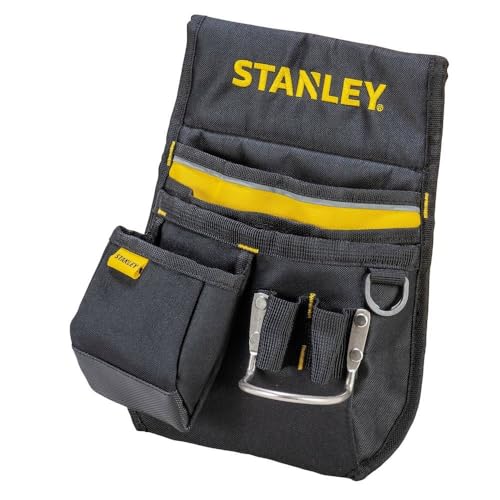
Not everyone needs a full rig. If you want one compact pouch you can clip onto a work belt or trousers without building out a whole system, the Stanley 1-96-181 is a straightforward, inexpensive option. It’s a single 600-denier nylon belt bag measuring roughly 33 x 23.5 x 7.5cm, with two nail pockets, a hammer holder and a dedicated tape measure pocket.
This is a pouch, not a rig — it doesn’t come with its own wide support belt or the pocket count of the other picks on this list, so it suits carpenters who already have a belt they like and just need extra storage, or anyone who wants to keep their kit minimal for quick jobs. For the price, it’s a handy, no-fuss addition to a toolbox rather than a main tool belt for full-time site use.
Pros:
- Low price for genuine Stanley kit
- Compact and easy to clip onto an existing belt
- Dedicated hammer holder and tape measure pocket
Cons:
- A single pouch, not a full multi-pocket rig
- No integrated support belt — needs your own belt or trousers to clip to
6. Bucket Boss Airlift 50100 Suspension Rig — Best Budget Option with Suspenders
If a loaded belt digging into your hips is your main complaint, the Bucket Boss Airlift 50100 takes a different approach: it’s a lightweight polyester rig with built-in suspenders that move the weight onto your shoulders and back instead of your waist alone. At this price point, that’s a genuinely useful feature most budget rigs don’t offer.
It comes with 12 pockets across the main pouches, fits up to a 52-inch waist, and the suspension design makes it noticeably more comfortable than a belt-only rig once you’re carrying a full day’s tools. The trade-off is durability: it’s polyester rather than leather, so the hardware and fabric won’t hold up to the same level of daily abuse as the premium picks on this list, but for the price and the comfort gain, it’s a smart budget choice.
Pros:
- Built-in suspenders shift weight off your hips and onto your shoulders
- 12 pockets across the main rig
- Fits up to a 52-inch waist — generous sizing
Cons:
- Polyester construction, not leather — won’t age or last like the OX Pro or Veto Pro Pac
- Hardware is lighter-duty than the premium picks

Buyer’s Guide — What to Look For in a Carpenter’s Tool Belt
Leather vs Nylon vs Polyester — Which Should You Choose?
The big debate in tool belts is leather versus synthetic. Leather wins on longevity — a quality oil-tanned leather rig will outlast several nylon or polyester belts and develops character as it breaks in, moulding to your body over months of use. It costs more upfront and needs occasional conditioning to stay supple.
Nylon and polyester belts are lighter, easier to clean and much cheaper. For most site work they do the job well, and modern reinforced stitching means the gap in day-to-day durability is smaller than it used to be. If you’re carrying tools eight hours a day, five days a week, leather earns its keep faster. For occasional use or a first belt, synthetic is the sensible starting point.
Pocket Layout and Organisation
Think carefully about what you actually carry every day. A carpenter typically needs a dedicated tape measure clip, a hammer loop, several pencil slots, and separate compartments for different fastener sizes so you’re not digging through one pocket to find a specific screw.
Don’t get seduced by sheer pocket count — lots of small pockets you’ll never use is less useful than fewer, well-positioned ones that match how you actually work.
Belt Width, Suspenders and Weight Distribution
A wider belt distributes weight more evenly across your hips and lower back. Once you’ve got a full load of tools on, the difference between a narrow and a wide belt is noticeable within an hour. If hip and lower-back strain is a recurring problem, a suspension-style rig with shoulder straps — like the Bucket Boss above — is worth considering instead of a belt-only design.
Fit and Adjustability
Most tool belts fit waists from roughly 28 to 46 inches, but check the specific size range before buying, particularly on suspension rigs and premium sets where sizing can vary more between brands. A belt that’s too loose will sag and swing as you move; one that’s too tight will dig in within an hour.
Build Quality Markers to Look For
Whatever your budget, look for reinforced rivets at stress points — where pouches meet the belt is where cheaper rigs fail first — double or triple stitching on load-bearing seams, and metal (rather than plastic) buckles and D-rings on anything you expect to use daily. On leather rigs, check whether the leather is described as top-grain or oil-tanned, both of which age and hold up better than lower-grade splits.
Frequently Asked Questions
Is a leather tool belt worth the money?
For full-time tradespeople on site every day, yes — the longevity and comfort improvement over time makes leather a better long-run investment despite the higher upfront cost. For occasional use, a well-made nylon or polyester belt will do the job for a fraction of the price.
How do I break in a new leather tool belt?
New leather is stiff — expect it to take a week or two of regular use before it properly softens. You can speed this up with a leather conditioner, but normal daily wear will get you there on its own.
Can I wash my tool belt?
Nylon and polyester belts can generally be wiped clean with a damp cloth, or hand-washed if needed — check the manufacturer’s care instructions first. Leather belts should never be machine washed; wipe them down and use a proper leather conditioner instead.
What’s the difference between a tool belt and a tool rig?
A tool belt typically refers to a belt with integrated pouches as a single unit. A tool rig (or carpenter’s rig) is a more modular system, often with a separate belt and multiple attachable pouches, or in the case of suspension rigs, a harness that takes some of the weight off your waist.
Final Verdict
For most UK carpenters, the OX Pro Oil-Tanned Leather 4-Piece Rig hits the sweet spot between quality and price — it’s a genuine long-term investment that earns its cost back in comfort and durability.
If you’re a full-time professional spending long days on site and want the best available comfort and ergonomics, the Veto Pro Pac AX3631 is worth the extra spend. If you’re starting out or working to a tighter budget, the DeWalt DWST1-75651 and the CLC 1649 both give you a genuinely usable belt without the premium price tag, and the Bucket Boss Airlift is worth a look specifically if hip strain from a loaded belt is your main problem.
Related reading