Our quick verdict
For most professional joiners the Makita PJ7000 is the sweet spot – around £230, beautifully made, easy to set and accurate enough for everyday joinery. It is the one we would hand a working chippy without a second thought, and it comes in 110V and 240V versions.
If you are on DeWalt batteries, the DCW682NT is the pick – a cordless brushless jointer with the rack-and-pinion fence that made DeWalt’s jointers a favourite for hardwood work. Makita LXT users should get the DPJ180. At the other end, the Einhell TC-BJ 900 at around £70 is the most-bought jointer on Amazon UK and will get an occasional user going, with the compromises you would expect.
How to choose a biscuit jointer
Fence quality and accuracy
The fence is the tool. A jointer that holds its fence dead parallel and square gives you flush, repeatable joints; one that flexes or drifts gives you steps and misalignment you then have to sand out. Pro tools like the Makita and DeWalt use cam-locked or rack-and-pinion fences that stay put. On cheaper tools the fence is the first thing to check – if it wobbles, walk away.
Depth settings and biscuit sizes
Most jointers take standard 0, 10 and 20 biscuits, with a rotary depth stop to switch between them. A good tool has positive, clearly marked detents so you set the right depth without thinking. Some also cut for smaller and specialist biscuits, which matters if you do thin material or face-frame work. Check the range covers what you actually build.
Corded or cordless
Biscuit jointing is quick, bursty work, which suits cordless well – grab it, plunge, done, no lead across a finished floor. Makita, DeWalt and Einhell all offer 18V models that run on batteries you likely already own. Corded tools are cheaper and never run flat, and since a jointer is not used continuously, either works. If you are on a battery platform already, cordless is a tidy addition.
Dust extraction
A jointer throws a surprising amount of fine chip. Most have a dust port that connects to a shop vac or extractor – use it, both for cleaner cuts and for your lungs. Some come with a bag, which is better than nothing but fills fast. If you are cutting MDF, connect an M-class extractor.
The best biscuit jointers at a glance
Prices are approximate Amazon UK prices for September 2026 and vary with kit and promotion.
Biscuit jointer | Type | Best for | Approx. price |
Makita PJ7000 | Corded 240V / 110V | Best overall / joiners | £230–£240 |
DeWalt DCW682NT | Cordless 18V XR | DeWalt users / hardwood | ~£280 bare |
Makita DPJ180ZJ | Cordless 18V LXT | Makita battery users | ~£260 bare |
Einhell TE-BJ 18 Li | Cordless 18V PXC | Budget cordless | ~£87 bare |
Einhell TC-BJ 900 | Corded 240V | Budget / occasional use | ~£70 |
Draper Storm Force 900W | Corded 240V | Cheapest entry point | ~£61 |
The picks in detail
1. Makita PJ7000 – best overall
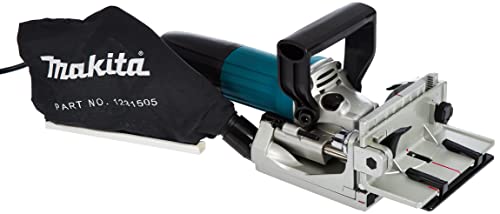
The PJ7000 is the biscuit jointer most working joiners end up recommending, and for good reason. It is well balanced, with a slim motor housing and barrel grip plus a flat-sided top handle for control. The fence locks with big, easy cam levers and stays where you put it, and six preset depth stops cover 0, 10, 20 and the other common biscuit sizes with one touch. The plunge action is smooth and predictable.
For everyday edge-joining, worktop and cabinet work it does everything a pro needs without fuss, and with nearly 1,000 reviews on the 110V version it is one of the best-rated jointers on Amazon UK. If you want one jointer and do not do fine cabinetry all day, buy this.
110V site version:
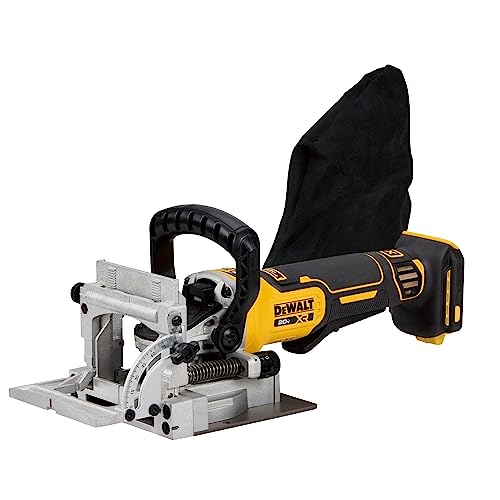
2. DeWalt DCW682NT 18V XR – best for DeWalt users and hardwood
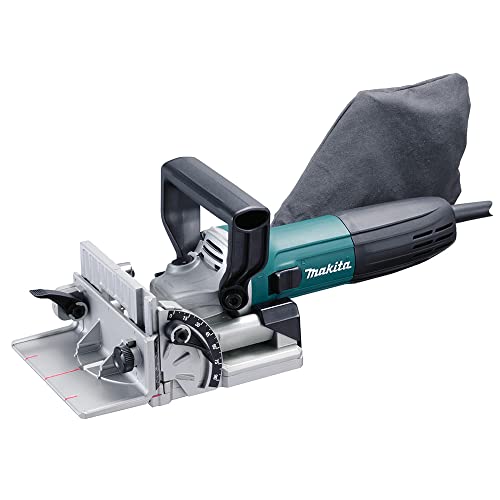
DeWalt’s corded DW682K was a trade favourite for years, largely thanks to its rack-and-pinion fence, and the cordless DCW682NT carries that system over to the 18V XR platform with a brushless motor. The rack-and-pinion control gives precise vertical adjustment and keeps the fence parallel to the blade, which shows in the accuracy of the slots – especially in hard, dense timber like oak.
Preset depths for 0, 10 and 20 biscuits come with a fine adjuster, anti-slide grippers stop it creeping on the work, and eight guide notches plus a fence window help you line up cuts. It is supplied bare in a T-STAK case, so it only makes sense if you already run DeWalt 18V batteries – but if you do, it is the best jointer on the platform.

3. Makita DPJ180 – best cordless for Makita users
If your van runs on Makita LXT, the DPJ180 gives you the freedom of no lead with the accuracy Makita is known for. It takes a single 18V battery, has six depth settings with fine adjustment screws, a fence that swivels to any angle from 0 to 90 degrees and locks with a single lever, and a rotating dust nozzle for easy extraction. For fitters moving room to room on a kitchen, losing the lead is worth real money.
The bare DPJ180Z is often out of stock on Amazon, so this is the DPJ180ZJ, which comes in a Makpac case. At around £260 bare it is not cheap, but you are not buying a platform – just add it to your batteries.

4. Einhell TE-BJ 18 Li – best budget cordless
If you want cordless jointing without paying Makita or DeWalt money, Einhell’s Power X-Change jointer is a surprisingly capable tool for under £90 bare. It has a solid aluminium angle guide, a six-stage quick depth adjustment and a slim, comfortable body, and it runs on the same batteries as the rest of Einhell’s big 18V range.
It will not have the fence precision of the pro tools, so check your first few cuts, but for DIY, landlords and light trade use it is a tidy, lead-free option with more than 400 reviews on Amazon UK.
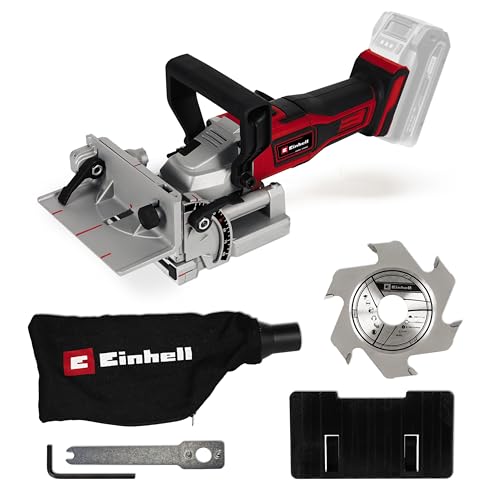
5. Einhell TC-BJ 900 – best budget corded
For an occasional user or a first jointer, the Einhell TC-BJ 900 is the most-bought biscuit jointer on Amazon UK, with more than 4,000 reviews. It is an 860W corded tool with a solid aluminium body, a 100mm cutter, infinitely adjustable height and angle, three quick depth settings and dust extraction – all for around £70.
It is fine for DIY and light trade use, but the fence and depth stops are not in the same league as a Makita. If you cut biscuits daily, spend the extra on a PJ7000 and save yourself the frustration.

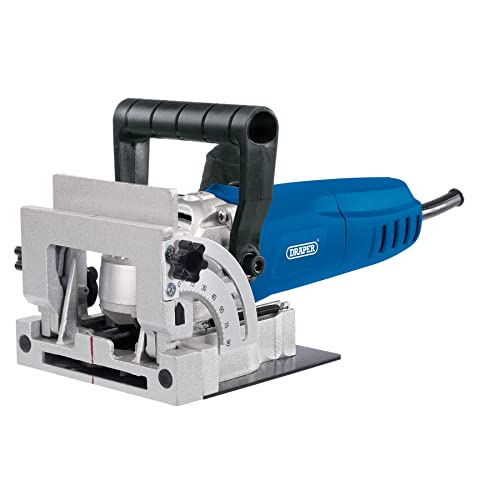
6. Draper Storm Force 900W – cheapest entry point
If you just need to cut a handful of biscuit joints for a single project, the Draper Storm Force is the cheapest decent jointer on Amazon UK at around £60. It has a 900W motor, a maximum cutting depth of 20mm to cover all standard biscuit sizes, and a spindle lock for easy blade changes, and it is well reviewed for the price.
Treat it as what it is: a budget tool for occasional work. It is noisy and the fence needs checking, but it gets you into biscuit joining for less than the price of a decent set of clamps.
What about Lamello?
Lamello invented the biscuit jointer, and the Classic X and Top 21 remain the benchmark for fence accuracy and repeatability – the Top 21 is also the gateway to Lamello’s P-System connectors. They are not sold on Amazon UK, and at £700 to £1,150-plus they only make sense for cabinet makers and bespoke shops where precision pays the bills. If that is you, buy from a specialist woodworking supplier.
Getting clean joints every time
A jointer is only as good as your setup. Always cut from a marked reference face so any tiny fence error is consistent across both boards and the joint still lines up. Keep the blade sharp – a dull blade tears the slot and strains the motor. Do not skimp on glue coverage or clamping; the biscuit aligns and reinforces, but the glue does the holding. Match biscuit size to material thickness, and let the joint cure properly before you work it. Get those basics right and even a budget jointer gives you flush, strong joints all day.
Frequently asked questions
Are biscuit joints strong enough for worktops and cabinets?
Yes – for alignment and edge-joining they are plenty strong, and they are widely used for worktops, carcasses and panel work. For heavy structural joints you might reach for dominoes or dowels, but for the vast majority of joinery, biscuits do the job.
Is a biscuit jointer worth it over a domino?
A Festool Domino is stronger and more versatile but costs several times as much. For most fitters and joiners a biscuit jointer does everything they need for a fraction of the price. If you build structural furniture daily, the domino earns its keep; if you mainly align and edge-join, a jointer is the smarter spend.
What biscuit size should I use?
Use the largest biscuit the material will take – a size 20 for anything 18mm and thicker, dropping to 10 or 0 for thinner stock and narrow rails. Bigger biscuits give more glue surface and stronger, better-aligned joints.
Do I need dust extraction?
Strongly recommended. A jointer throws fine chip and dust, so connect it to a shop vac or extractor for cleaner cuts and to protect your lungs – especially with MDF, where you should use an M-class extractor.