Kitd is reader-supported. If you buy through links on this page we may earn a commission from Amazon, at no extra cost to you.
Walk into any electrical wholesaler in the UK and the test kit wall is dominated by two names: Martindale and Kewtech. Both make the everyday instruments that electricians use to prove a circuit is dead, check a socket and confirm a tester is working before they trust it. Neither is the wrong choice, but they are not identical, and the differences are mostly about price, layout and what you get for your money.
This comparison looks at the like-for-like kit from each brand that you can buy on Amazon UK: voltage sticks, two-pole voltage testers, proving units and socket check plugs. Prices and review counts below were checked at the time of writing and will move, so treat them as a guide.
Quick Verdict
If you want the cheapest sensible route into branded test kit, Kewtech is hard to beat. The KEWSTICKDUO voltage stick at £25.99 and the KEWCHECK103 socket tester at £22.00 are both well reviewed and cost little. If you want the two-pole tester you will lean on every day, the Martindale VT12 at £33.48 has more than 1,400 reviews and is a proven, no-nonsense unit.
For proving units, the Martindale PD240 and Kewtech KEWPROVE3 do the same job. Choose on whether you need the higher 690V range of the Kewtech or the simpler 240V Martindale.
Martindale vs Kewtech at a Glance
| Product | Brand | Type | Price | Reviews |
| KEWSTICKDUO | Kewtech | Dual sensitivity voltage stick | £25.99 | 1,113 |
| VT12 | Martindale | Two-pole voltage and continuity tester | £33.48 | 1,408 |
| KT1780 | Kewtech | Two-pole tester with LED display and torch | £58.80 | 573 |
| VT25 | Martindale | Two-pole voltage and continuity tester | £60.00 | 235 |
| PD240 | Martindale | 240V proving unit | £77.94 | 125 |
| KEWPROVE3 | Kewtech | Proving unit up to 690V | £87.00 | 48 |
| KEWCHECK103 | Kewtech | Socket tester | £22.00 | 2,406 |
| CP501 | Martindale | Check plug socket tester | £16.48 | 703 |
How the Two Brands Compare
Build and Feel
Both brands make instruments aimed at working electricians rather than DIY, and the build reflects that. Martindale has a long history in UK test equipment and its testers tend to have a plain, functional layout that has barely changed over the years. Kewtech leans towards more modern touches such as LED displays, torches and dual-sensitivity sensing. Neither approach is better; it depends whether you value a familiar tool or extra features.
Price
At the entry level Kewtech is usually the cheaper of the two. A Kewtech voltage stick starts under £20 and the KEWSTICKDUO is under £26. Martindale costs a little more for the equivalent two-pole tester at the lower end, but the VT12 at £33.48 is still very reasonable for what is a safety-critical tool.
Ranges and Choice
Martindale has the wider range of straightforward two-pole testers and proving units, while Kewtech covers more of the lower-cost voltage detectors and socket testers. Between them you can build a complete personal safe-isolation kit from either brand, and plenty of electricians mix the two.
Voltage Sticks
Kewtech KEWSTICKDUO
The KEWSTICKDUO is a non-contact voltage detector with dual sensitivity and a CAT IV rating, according to the Amazon listing. At £25.99 with more than 1,100 reviews it is a popular choice for a quick check before you open up a fitting or a back box. Remember a voltage stick is an indication tool, not a replacement for proving dead with a two-pole tester.
Pros: Dual sensitivity, CAT IV rated, well reviewed, low price.
Cons: Non-contact only, so not suitable for proving dead.
Best for: Quick pre-checks before you start work.

- DUAL SENSITIVITY: On this Volt Pen, just press and hold the desensitising button and you can differentiate between live and earthed cables approximately 10mm apart
- SAFETY ASSURED: Cat IV rated volt finder with heartbeat safety feature - green LED indicates that the unit is on and working correctly
- EASY DETECTION: Red LED indicates presence of voltage, while audible tone also indicates the presence of voltage
- NON CONTACT: Clearly detects 90 - 600 volts AC without metal contact
- BUY WITH CONFIDENCE: The Kewtech brand has become synonymous with high quality, as we manufacture innovative, accurate and reliable test equipment specifically for the UK market
Two-Pole Voltage Testers
The two-pole tester is the one that matters. HSE guidance (GS38) is that you should prove dead with a two-pole voltage indicator, not a voltage stick or a multimeter with bare probes, and this is where both brands have strong products.
Martindale VT12
The VT12 is a two-pole voltage and continuity tester that has been a regular in electricians’ pockets for years. At £33.48 with more than 1,400 reviews, it is the most reviewed two-pole tester in this comparison. It is simple, quick to read and does what you need without fuss.
Pros: Proven design, great review record, affordable.
Cons: Basic indication, no display.
Best for: Daily safe isolation on a budget.

- Reliable Two-Pole Voltage and Continuity Tester for professional electrical safety
- Measures AC/DC voltages from 12V to 690V for comprehensive testing needs
- Includes continuity testing function for quick circuit verification
- GS38 compliant with probe tip caps for enhanced user protection
- Durable design trusted by electricians for accurate and safe performance

Kewtech KT1780
The KT1780 is Kewtech’s step up, a 2-pole voltage detector and continuity tester with an LED display and torch, rated to 690V. It costs £58.80, so you pay nearly twice the Martindale VT12 for the display and the light. If you work in dim plant rooms and meter cupboards, the torch earns its keep.
Pros: LED display, built-in torch, 690V rating.
Cons: Costs more than a basic two-pole tester.
Best for: Electricians who work in poor light.
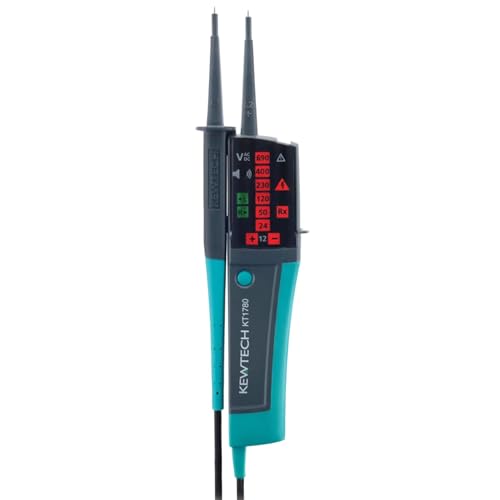
- ✔️ The KT1780 Voltage Tester measures AC and DC voltages up to 690, providing clear LED indication of the detected voltage level.
- ✔️ With GS38 compliant slender probe tips and designed to the new international standards IEC 61243-3, IEC 61010-1 and measurement category CAT IV 600V
- ✔️ Perform continuity, single pole phase, polarity and phase rotation testing as well as a self diagnostic test to ensure correct operation.
- ✔️ Slender UK specific probe tips that fit into recessed terminals such as RCBOs
- ✔️ The Kewtech brand has become synonymous with high quality, as we manufacture innovative, accurate and reliable test equipment specifically for the UK market.
Martindale VT25
The VT25 sits above the VT12 in the Martindale range and costs £60.00. It has more than 230 reviews and positions itself as the more capable two-pole option. It is a good choice if you want to stay with Martindale and want more than the entry model.
Pros: Step up from the VT12, trusted brand.
Cons: Fewer reviews than the VT12 and a higher price.
Best for: Martindale fans who want a more capable tester.
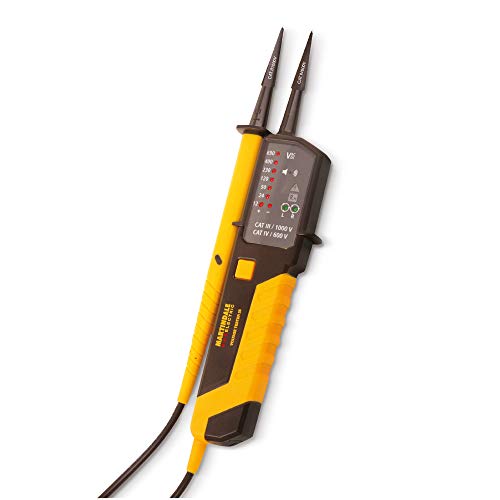
- Measures 12 - 690 V AC/DC
- Single pole phase test 90 - 690 V
- Phase rotation test 100 - 690 V
- Continuity - optical and acoustic indication
- Auto power off and white LED torch light
Proving Units
A proving unit lets you check that your two-pole tester works before and after you prove dead. They are not exciting, but they are part of doing safe isolation properly.
Martindale PD240
The PD240 is a 240V proving unit at £77.94 with over 120 reviews. It does one job well. If most of your work is domestic and light commercial single-phase work, 240V is all you need.
Pros: Simple, does the job, trusted brand.
Cons: 240V only.
Best for: Domestic and light commercial work.
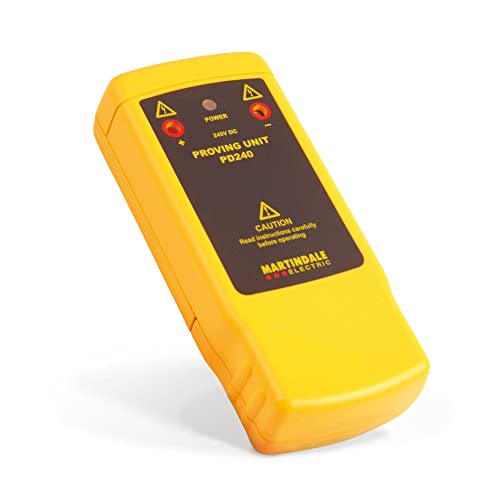
- Safely proves the operation of voltage testers and multimeters before and after use
- Provides a stable 240V DC output for reliable and accurate proving of electrical testers
- Compact and lightweight design with integrated belt clip for easy portability
- Essential tool for implementing safe isolation procedures in compliance with regulations
- Durable construction trusted by professionals for dependable electrical safety checks
Kewtech KEWPROVE3
The KEWPROVE3 is a proving unit that goes up to 690V, which makes it more useful if you also work on three-phase installations. At £87.00 it costs about £9 more than the PD240, and it has fewer reviews at 48.
Pros: Covers up to 690V, useful for three-phase work.
Cons: Costs more and has fewer reviews.
Best for: Electricians who also test three-phase supplies.

- High output will drive even the most high current voltage detector
- Instant ramp up and then step down will prove several voltage levels
Socket Testers
Both brands make a plug-in socket tester. They are no substitute for a multifunction tester, but they are quick and cheap. For a full comparison see our guide to the best socket testers.
Kewtech KEWCHECK103
At £22.00 with more than 2,400 reviews, the KEWCHECK103 is a proven everyday socket tester. It is simple to read and cheap enough to keep one in the van and one in the toolbag.
Pros: Very well reviewed, simple, low price.
Cons: Basic indication only.
Best for: Everyday socket checks.

- ✔️ SIMPLE TO USE: The Kewcheck 103 Socket Tester allows you to easily check if Live, Neutral and Earth wires are wired correctly on any UK plug socket. Simply plugs into the socket for results in seconds
- ✔️ DUAL RESPONSE: The LED lights integrated into this socket tester will then light up in a certain way depending on what's detected, and the product will either emit a continuous, warbling or no tone depending on what's detected
- ✔️ QUICK AND EASY: Designed to easily give quick and clear indication of the status of a socket's internal wiring without the need to remove the socket panel from the wall.
- ✔️ 14 WIRING CONDITIONS: All of the possible indications are displayed on the front of the Kewcheck103 to help with easily understanding the test results for each socket
- ✔️ BUY WITH CONFIDENCE: The Kewtech brand has become synonymous with high quality, as we manufacture innovative, accurate and reliable test equipment specifically for the UK market.
Martindale CP501
The CP501 is a classic check plug and costs £16.48. It has over 700 reviews. It is the cheaper of the two, and it is a straightforward design that does exactly what the name says.
Pros: Cheapest branded option, simple.
Cons: Basic checks only.
Best for: A low-cost check plug for the van.

- Quick and easy testing of 240V UK sockets to ensure correct wiring and safety compliance
- Detects 28 common wiring fault conditions for reliable electrical safety checks
- Three bright LEDs with clear fault codes for instant and accurate identification
- Compact and tough design with sculpted grip for easy removal from sockets
- Ideal for electricians and homeowners for fast socket verification before use
Which Should You Buy?
If you are building your first set of test kit, buy a two-pole tester first (the Martindale VT12 is the safe choice), then a proving unit, then a voltage stick and socket tester. Choose Kewtech where it is cheaper or has a feature you need, such as the KT1780’s torch or the KEWPROVE3’s 690V range. Choose Martindale where you want a proven, simple design.
Whichever you buy, look after it, check it before use and replace leads at the first sign of damage. Test kit is only worth having if you can trust it.
Buying Test Kit: Practical Tips
Buy for the Work You Do
Domestic and light commercial electricians can get by with a 240V proving unit and a two-pole tester. Anyone who works on three-phase supplies, industrial plant or higher voltages should check the rating on every instrument and buy accordingly. The listing should state the voltage and category rating, and the instrument itself will have it printed on the body.
Check Before Every Use
Test kit only protects you if it works. Inspect leads and probes for cracks and damage, prove the tester on a known source before and after you test, and replace anything that looks tired. Leads and probe tips are consumables, and a damaged lead is never worth the risk.
Calibration and Care
Voltage indicators and proving units are not calibrated in the same way as a multifunction tester, but they still need looking after. Keep them clean, keep them dry and store them in a pouch so the probes do not get bent in the toolbag. Test instruments such as multifunction testers do need regular calibration, and that is a separate cost to budget for.
Mixing Brands
There is no rule that says you must buy one brand. Many electricians run a Martindale two-pole tester with a Kewtech voltage stick and a Fluke multifunction tester. The important thing is that each instrument is suitable for the job and in good condition. What you should avoid is a tester and proving unit that are not compatible, so check that your proving unit is suitable for the type of tester you use.
FAQs
Is Kewtech or Martindale better?
Neither is better across the board. Both make trade-grade kit. Kewtech tends to be cheaper at entry level and adds features such as torches and displays, while Martindale offers simple, proven designs. Pick on the specific product.
Can I use a voltage stick to prove dead?
No. A non-contact voltage stick is an indication tool. Use an approved two-pole voltage indicator and a proving unit to prove dead.
Do I need a proving unit?
If you are following the proving, testing, proving routine for safe isolation, yes. It confirms your tester works before and after you test the circuit.
Are these testers suitable for three-phase work?
Check the voltage rating on the listing and the instrument itself. The Kewtech KT1780 and KEWPROVE3 are rated to 690V, while the Martindale PD240 is a 240V unit.
How often should I replace test leads?
Inspect them every time you use them and replace them at the first sign of cracking, damage or loose connections.
Final Thoughts
Martindale and Kewtech both earn their place in a sparky’s toolbag. Start with the Martindale VT12 and a proving unit, add a Kewtech voltage stick and socket tester, and you have a branded kit for well under £200. If you work in the dark or on three-phase, step up to the Kewtech KT1780 and KEWPROVE3.