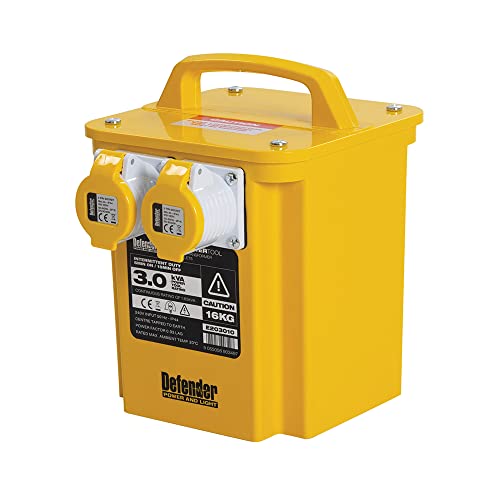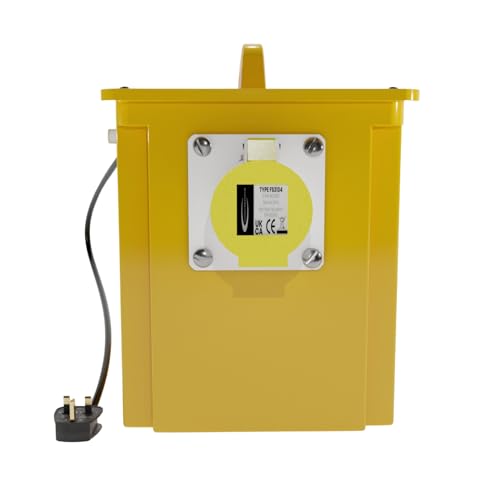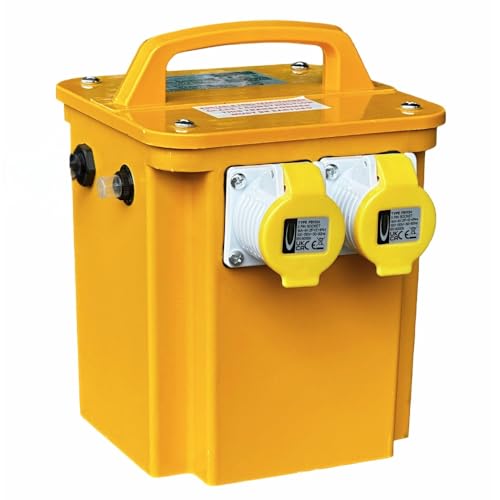
Walk onto almost any UK commercial or new-build site and the first thing the gate will ask about your tools is the voltage. 110V is the standard, it is what the site’s RCD-protected supply is built around, and a 240V lead through the fence will get you sent back to the van. That is where a site transformer comes in – a heavy yellow box that steps 230V mains down to safe centre-tapped 110V so your corded drills, breakers, saws and lights can run legally and safely on site.
The trouble is that transformers all look much the same, and the kVA figures on the label are easy to misread. Buy too small and it will trip or cook itself under a breaker; buy too big and you have hauled 20kg of copper around for no reason. This is a straight guide to the 110V site transformers worth buying in the UK right now, grouped by the job they suit, with the ratings explained in plain English so you get the right one first time.
Our quick verdict
For most tradespeople the Defender 3.3kVA step-down transformer is the one to buy. It gives you two 16A outlets, a genuinely tough case built to be kicked around a site, and enough continuous output to run a big corded drill, a grinder or a chop saw all day. It is the sensible default for a van.
If you want a complete plug-and-go kit, the Carroll & Meynell 3kVA distribution kit pairs a solid transformer with a 110V junction box and a long extension lead, so you are working the moment it comes out of the box. For sparks, decorators and anyone running lights and small tools only, a compact 1.5kVA tool transformer is lighter and cheaper. And if you run heavy plant – a big breaker or a 110V cement mixer – step up to a 5kVA or 10kVA unit with a 32A socket so you are not fighting the overload cut-out all day.
At a glance: 110V site transformers compared
Prices are inclusive of VAT and reflect typical UK retail at the time of writing. Transformers are heavy and their ratings matter more than the headline number, so always check the continuous rating and socket type against the tools you actually run before you buy.
| Model | Rating (int / cont) | Sockets | Approx price (inc VAT) | Best for |
| Defender 3.3kVA step-down | 3.3kVA / ~1.65kVA | 2 x 16A | ~£130-£160 | All-round van/site use |
| Carroll & Meynell 3kVA kit | 3kVA / ~1.5kVA | 16A + junction box + 14m lead | ~£200 | Complete plug-and-go kit |
| Compact 1.5kVA tool transformer | 1.5kVA / ~0.75kVA | 2 x 16A | ~£90-£120 | Lights & small tools |
| 5kVA / 10kVA transformer | 5-10kVA / ~2.5-5kVA | 16A + 32A | ~£300-£600+ | Breakers & heavy plant |
| Budget 3kVA tool transformer | 3kVA / ~1.5kVA | 2 x 16A | ~£110-£130 | Occasional site use |
The best 110V site transformers for UK trade in 2026
Defender 3.3kVA step-down transformer – the all-round best buy
The Defender 3.3kVA is the transformer most tradespeople should own. It steps 230V down to 110V, carries two recessed 16A outlets, and is wrapped in a tough moulded case with an integrated lifting handle, a cable tidy and a securing strap – the small details that stop it becoming a nuisance in the back of a van. It will happily run a corded SDS drill, an angle grinder, a jigsaw, a circular saw or a set of site lights, which covers the vast majority of trade jobs.
Its 3.3kVA intermittent rating gives you around 1.65kVA continuous, which is the figure that matters for sustained work. That is enough for a single heavy tool run flat out or a couple of lighter tools together. Defender’s build quality is well regarded on site, the sockets are properly weather-resistant, and it is priced sensibly for what you get. If you buy one transformer and want it to cope with almost anything short of heavy plant, this is it.
Carroll & Meynell 3kVA distribution kit – best complete kit
If you would rather buy a ready-to-work setup than piece it together, the Carroll & Meynell 3kVA distribution kit is the one. It bundles a 3kVA transformer with a separate 110V junction box and a 14m three-core extension lead, so you can park the transformer by the supply and run power to where you are actually working without buying leads separately. Screwfix buyers rate it highly – it sits around 4.7 out of 5 – and the general verdict is that it is a well-made bit of kit from a brand site electricians trust.
Carroll & Meynell have been making transformers in the UK for decades and the quality shows. The distribution kit format suits anyone working across a larger area – groundworkers, extension builds, garden rooms – where a transformer with only sockets on the box means dragging it around behind you. Buy this if you want the flexibility of a proper junction box and a long lead as standard.
Compact 1.5kVA tool transformer – best for lights and small tools
Not everyone needs to run a breaker. If your day is site lighting, a corded drill/driver, a small grinder or a jigsaw – the kind of load a sparky, a decorator or a plumber puts through – a compact 1.5kVA transformer is lighter, cheaper and easier to carry up a ladder or into a loft. These typically give around 750VA continuous through a pair of 16A sockets, which is plenty for lighting and intermittent light-tool use.
The trade-off is obvious: it will trip if you ask it to start a big inductive load like a breaker or a large mitre saw. Know your loads. If everything you plug in is lighting and hand-sized power tools, the weight and cost saving is worth having. If there is any chance of heavy plant, size up instead – a transformer that trips every time you pull the trigger is a false economy.
5kVA and 10kVA transformers – best for heavy plant
Running a proper 110V concrete breaker, a 110V cement mixer, a large dust extractor or several tools at once will overwhelm a 3kVA box. This is where a 5kVA or 10kVA transformer earns its keep. The bigger units carry a 32A outlet alongside 16A sockets, so you can plug in high-draw plant with the correct plug, and their continuous rating means they will feed a breaker all day without nuisance tripping.
They are heavier and pricier, and for a lot of trades they are overkill – but for demolition crews, groundworkers and anyone running multiple corded tools off one supply, the headroom is the point. Match the transformer to your heaviest regular load, not your lightest, and buy the 32A version if any of your plant uses a 32A plug.
Budget corded tool transformer – best occasional-use pick
If you only need 110V now and then – the odd site job, a hire tool that came without a transformer, a bit of lighting – a basic 3kVA twin-socket tool transformer from Screwfix or Toolstation does the job without spending big. These are built with tough GRP casing to survive weather and rough handling, carry two 16A outlets, and cover general corded tools and lighting perfectly well.
Treat it as an occasional-use box rather than an all-day workhorse. The build and cooling are not as generous as the premium Defender and Carroll & Meynell units, and the continuous rating is where the corners are cut. But for a landlord, a semi-pro or a trade that touches a site only occasionally, it is sensible money and it will keep you legal at the gate.
kVA ratings explained – the number that actually matters
The single most misunderstood thing about site transformers is the kVA rating, because every box quotes two figures and the big one on the front is not the one you should size by. Get this right and everything else falls into place.
Intermittent vs continuous rating
A transformer labelled 3.3kVA is quoting its intermittent rating – the load it can handle in short bursts, like the surge when a motor starts. Its continuous rating, the load it can carry all day without overheating, is roughly half that – around 1.65kVA. A 3kVA box is typically 1.5kVA continuous. Always size by the continuous figure, because that is what a tool run flat out for minutes at a time actually demands. Buying on the headline intermittent number is how people end up with a transformer that trips under load.
Matching the transformer to your tools
Work out the running wattage of your heaviest tool and make sure it sits comfortably under the continuous rating. A big corded SDS drill or a 2000W grinder wants a 3.3kVA (1.65kVA continuous) box as a minimum; site lighting and small tools are fine on 1.5kVA; a proper breaker or running several tools at once needs 5kVA or more. Remember that motors draw a big surge on start-up, so leave headroom rather than sizing right to the limit.
16A or 32A sockets
Most site tools use a 16A 110V plug (the yellow round three-pin), and most transformers give you two or four 16A outlets. Heavier plant – some breakers, mixers and larger extractors – uses a 32A plug, and for those you need a transformer with a 32A outlet, which generally means a 5kVA or 10kVA unit. Check the plugs on your tools before you buy so you are not stuck with the wrong socket on site.
Buyer’s guide: what else to look for
Case and build quality
A transformer lives a hard life – dropped off tailgates, left in the rain, kicked across a slab. A tough moulded or GRP case, recessed sockets that keep the muck out, and an integrated handle make a real difference to how long it lasts and how easy it is to move. The premium brands cost more here for a reason.
Portability and weight
Copper is heavy, and a bigger transformer weighs a lot more than a small one. If you carry it up scaffold or into lofts, a compact 1.5kVA unit is far kinder on your back; if it lives by the van and feeds a long lead, weight matters less than output. Be honest about how you will move it before chasing the biggest rating.
Distribution and leads
A transformer with only sockets on the box tethers you to wherever you set it down. A distribution kit or a junction box with a long 110V lead lets you place the transformer by the supply and take power to the work, which is far more practical on a larger job. Factor the cost of decent 110V extension leads into your budget either way.
FAQs
Why do UK sites use 110V instead of 240V?
It is a safety standard. Site transformers deliver centre-tapped 110V, which means the voltage to earth is only 55V – far less dangerous if a lead is cut or a tool fault occurs in wet, rough site conditions. Most UK construction sites require 110V tools and will not allow 240V through the gate, so a transformer is essential kit for site work.
What size transformer do I need for a breaker?
A light demolition hammer may run on a 3.3kVA (1.65kVA continuous) box, but a full-size 110V breaker really wants a 5kVA or larger transformer with the headroom to cope with its start-up surge and sustained draw. Check your breaker’s rated wattage and size the transformer by its continuous rating, not the headline intermittent figure.
Can I run two tools off one transformer?
Only if their combined running load stays under the continuous rating. Two light tools on a 3.3kVA box is usually fine; two heavy tools will trip it. Add up the running wattage of everything you want to run at once and keep it comfortably below the continuous figure, leaving room for start-up surges.
Step-down or step-up – which do I need?
For running 110V tools from a 230V mains supply, you need a step-down transformer (230V to 110V) – that is what almost every trade needs. A step-up transformer (110V to 230V) does the opposite, letting you run a 240V tool from a site’s 110V supply, which is a niche requirement. Make sure you buy the step-down version unless you specifically need to power 240V kit on a 110V site.
Prices and availability change quickly, so check the current price and confirm the continuous rating and socket type before you buy. Size by the continuous kVA figure, match the sockets to your plugs, and buy a case tough enough to survive site life – get those three right and a good transformer will outlast most of the tools you plug into it.