


Our quick verdict
For most tradespeople, the Bosch GMS 120-27 Professional is the one to buy. At around £90 it detects live cables, magnetic and non-magnetic metal, and timber studs, tells you which of those it has found, and is built to survive life in a tool bag. It is the sensible default for electricians, kitchen and bathroom fitters, joiners and anyone drilling into other people’s walls for a living.
If you only need to check a wall before the odd fixing, do not overspend — the Bosch Truvo at around £35, or the UniversalDetect at around £75, will keep you out of trouble on domestic work. And if you are a sparks who needs to trace a specific cable or find which breaker feeds a socket, that is a different tool altogether: a dedicated cable tracer like the Martindale CD1000, not a wall scanner.
At a glance: the cable detectors compared
Prices are inclusive of VAT and reflect typical Amazon UK pricing at the time of writing (September 2026). Detection depths are the manufacturer’s figures for ideal conditions — treat them as a best case, not a promise.
Detector | Type | Detects | Approx price | Best for |
Bosch GMS 120-27 Pro | Multi-mode wall scanner | Live cable, metal, wood | £90–£100 | All-round trade use |
Bosch UniversalDetect | Touchscreen wall scanner | Live cable, metal, wood | £75–£85 | Light trade & DIY |
Bosch Truvo 2nd gen | One-button detector | Live cable, metal | £35–£45 | Quick pre-drill checks |
Martindale CD1000 | Cable tracer (Tx/Rx) | Cable routes, breakers, breaks | ~£300 | Electricians tracing circuits |
Bosch D-tect 200 C | Radar wall scanner | Cable, pipe, metal, cavities | £640–£700 | Structural & pre-chase surveys |
The best cable detectors for UK trade in 2026
Bosch GMS 120-27 Professional — best all-round wall scanner
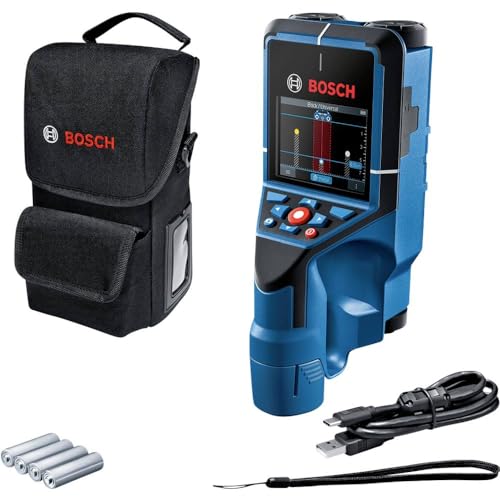
The GMS 120 is the detector you see clipped to more tool bags than any other, and the current GMS 120-27 version keeps it that way. It finds non-magnetic metal to 120mm, magnetic metal to 100mm, live cables to 50mm and timber to 30mm — and, crucially, it tells you which one it has found, so you know whether you are over a copper pipe, a steel joist hanger or a live cable. The LED ring around the marking hole goes red over an object and green when it is clear, and the centre indication makes it quick to mark the exact edge of a stud or the run of a cable.
It is built for site, with a shock-absorbing rubber casing and IP54 dust and water protection, and it comes with a pouch (and a marker pen on this listing). It is not radar and it will occasionally get confused by foil-backed plasterboard or dense masonry, but for everyday drilling and chasing it is accurate, fast and tough. At around £90 it is the value pick for anyone doing this for a living, and it has more than 800 reviews on Amazon UK.
Bosch UniversalDetect — best value for light trade and DIY
The UniversalDetect is the sensible step up from a bargain-bin stud finder without paying professional money. It flags wooden studs, live cables and metal at roughly 25mm, 50mm and 100mm respectively, with a 2.4-inch colour touchscreen that walks you through each scan step by step and a traffic-light LED around the marking hole that shows where it is safe to drill.
It is a green-line DIY tool rather than a site-hardened professional one, so it will not take the same abuse as a GMS 120-27 — and at around £75 it is now close enough in price that most trades should just buy the Professional unit. But for a kitchen fitter putting up the odd wall unit, or a landlord doing their own maintenance who wants the on-screen guidance, it is more than enough.

Bosch Truvo 2nd gen — best budget one-button detector
The Truvo strips detection back to a single button — no modes, no menus, no depth figures. Place it on the wall and it auto-calibrates, then sweep, and it flashes and beeps over live cables (up to 50mm) and metal (up to 70mm). The second-generation model has separate LEDs for metal and live wire, so you do know which you have found, and a “parking sensor” beep that gets faster as you close in.
That is genuinely all a lot of people need before hanging a shelf or a TV bracket. It will not find timber studs or tell you how deep something is, so it is a keep-you-safe tool rather than a diagnostic one, but at around £35 it is cheap insurance to keep in the van as a loaner or a backup. Buy one for the apprentice.
Martindale CD1000 — best cable tracer for electricians
This is the tool people mean when they say they need to ‘trace a cable’, and it is a completely different job to wall scanning. The CD1000 is a two-part transmitter-and-receiver kit from Martindale, one of the best-known UK test-equipment brands. You connect the transmitter to the cable, then sweep the receiver along the wall or floor to follow the route, find which fuse or breaker feeds a circuit, or locate a break or open circuit. It works on live and dead circuits, traces through walls and underground, and will also follow metallic water and heating pipes and electric underfloor heating mats.
It is overkill for putting up a shelf and it will not tell you where a random pipe is, but for a working electrician chasing faults or identifying circuits in an unmarked board it earns its keep. Around £300 for the kit.
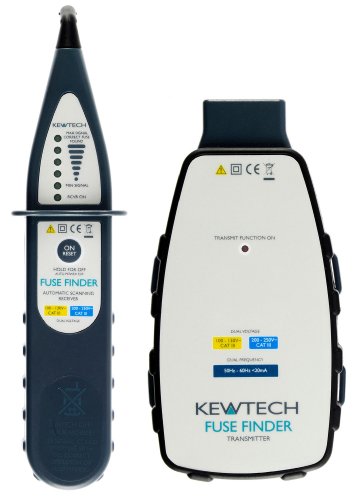
If all you need is to identify which fuse or MCB controls a circuit — not follow the cable route — a dedicated fuse finder is cheaper. The Kewtech FFINDER2 plugs into a socket (or connects to a lighting point), and its self-learning receiver pinpoints the right breaker at the board without switching anything off.
Bosch D-tect 200 C — best premium radar scanner
If you are drilling or coring into structural concrete, or you need to know what is buried before you chase out a wall on a commercial fit-out, a radar scanner is the honest answer. The D-tect 200 C uses radar rather than simple induction, so it finds live and dead cables, water-filled and empty plastic pipes, metal, timber and even cavities, with a proper display that shows what it has found. It can save screenshots of a scan to download over USB-C or micro SD, which is handy for documenting what was in a wall before you cut it.
It is heavy, it needs a bit of technique to read well — which shows in mixed reviews from buyers expecting a point-and-shoot tool — and at around £640 it is a serious purchase. But for the tradespeople who need it, nothing cheaper does the same job with the same confidence.
Wall scanner or cable tracer — which do you actually need?
These two tools get lumped together as ‘cable detectors’ and they answer completely different questions. A wall scanner like the GMS 120-27 tells you whether there is anything behind the plaster right here, before you drill. A cable tracer like the Martindale CD1000 tells you where one specific cable goes, or which breaker controls it. Buying the wrong one is the most common mistake people make.
If your worry is drilling into a live cable or a pipe when you hang, fix or chase, you want a wall scanner and the GMS 120-27 covers almost everyone. If you are a sparks trying to identify circuits, follow a route or find a fault, you want a tracer and a wall scanner will not help you at all. Plenty of electricians end up owning both, because they solve genuinely separate problems.
Buyer’s guide: what to look for
Detection modes
The cheapest detectors only flag live AC and metal. Better ones add a wood or stud mode and separate magnetic from non-magnetic metal, so you can tell a joist from a pipe from a cable. If you drill into varied walls all day, multi-mode detection saves you second-guessing what the beep actually means.
Depth readout
A simple detector tells you something is there; a better one tells you how deep. A depth figure matters when you are choosing fixing length or deciding whether a shallow cable is in the danger zone for the screw you are about to drive. Remember the quoted depths are best-case — knock a margin off for real walls.
Live cable detection
Induction detectors only see a live cable when it is actually carrying current, so a switched-off circuit can read as clear. That is exactly why you still isolate, and why a radar scanner or a proper tracer is safer around dead cables. Never treat a ‘nothing here’ reading as a guarantee on a circuit you have switched off.
Build and calibration
A professional detector auto-calibrates on start-up and shrugs off being dropped in a bag of tools; a DIY one needs careful handling and a steady sweep to read right. If it is going on site every day, spend the extra for the tougher unit — a detector that reads inconsistently is worse than none, because it breeds false confidence.
FAQs
Can a cable detector find cables through any wall?
No. Induction detectors read live cables and metal near the surface reliably in plasterboard and standard plaster, but foil-backed board, dense masonry and metal lath can block or confuse them. Radar scanners cope with far more, which is part of why they cost more. Always sweep slowly and cross-check from two directions.
Will it detect a cable that is switched off?
Not reliably, if it is a basic live-cable detector — those only sense current flow. Metal-mode detection will still pick up the copper conductor, and radar scanners see the cable itself regardless, but this is exactly why you isolate and prove dead before drilling near anything you cannot see.
Do I need a stud finder as well?
Usually not. The GMS 120-27, UniversalDetect and D-tect 200 C all find timber studs as well as cables and metal, so a separate stud finder is redundant. A dedicated stud finder only makes sense if all you ever do is hang things on timber-framed walls and you want the cheapest possible tool.
What is the difference between a cable detector and a CAT and Genny?
A wall detector is for the surface of a building — finding cables and pipes before you drill indoors. A CAT and Genny (cable avoidance tool) is a groundworks tool for locating buried services before you dig outside. They look related but are built for completely different jobs, so do not buy one expecting to do the other.
The bottom line
For the widest range of tradespeople, buy a Bosch GMS 120-27 Professional and keep it in the top of the bag — it tells you what is behind the plaster before you drill, and that is the question most people need answered. Keep a cheap Truvo as a loaner and a backup. If you are a working electrician who needs to trace circuits or chase faults, that is a Martindale CD1000, not a wall scanner — a different tool for a different job. And if you are coring structure or surveying before you chase, the D-tect 200 C is the radar-grade answer worth the money.
Related reading