Spraying has gone from a niche skill to a standard part of the working decorator’s kit. A sprayer that lays down a new-build hallway in an afternoon, or finishes a kitchen’s worth of doors without a single brush mark, pays for itself fast once you’re charging by the day. But the market is full of machines that look the part and clog within a fortnight, and the gap between a budget handheld and a serious airless rig is bigger than the price tag suggests.
Kitd earns from qualifying purchases through Amazon links on this page.
This guide is written for working decorators and painters in the UK, not weekend DIYers. We’ve split the picks the way the job actually splits: airless machines for walls, ceilings and large surface areas where speed matters, and handheld units for doors, skirting, furniture and fine finish work where control matters more than throughput. A serious decorator usually ends up owning one of each.
Our quick verdict
If you want a one-line answer: the Titan ControlMax 1700 HEA is the best all-round airless sprayer for UK decorators. It’s the machine most working painters end up on — enough power for emulsion on walls and ceilings, low-overspray HEA technology that keeps the masking sane, and a build that survives daily van life. Around £320-330 puts it within reach of a one-week return on investment.
For doors, skirting and furniture, skip the big airless entirely and get a Wagner FLEXiO handheld — it’s the right tool for fine work and a fraction of the cost. For whole-house and high-volume jobs, step up to a cart-mounted Graco Magnum.
The 6 best paint sprayers for UK decorators
Titan ControlMax 1700 HEA — Best all-round for decorators
Price: Around £320-330
The Titan ControlMax 1700 is the airless sprayer that’s quietly become the default for UK decorators who’ve moved past the entry-level machines. It uses Titan’s High Efficiency Airless (HEA) technology, which sprays at lower pressure than a traditional airless — the headline benefit is up to 55% less overspray, which on a real job means less masking, less fog drifting onto skirting you didn’t want painted, and a softer, more controllable spray fan.
It’ll handle unthinned emulsion straight from the tub, pulls paint directly from the bucket so you’re not constantly refilling a cup, and runs a long hose as standard so the machine can sit out of the way while you work the room. The pump components are rated for a serious annual volume — this is built for the painter doing it week in, week out, not the once-a-year DIYer.
- Pros: genuinely low overspray makes masking faster, sprays unthinned emulsion without complaint, pulls straight from the tub, properly serviceable pump with UK parts.
- Cons: heavier and bulkier than a handheld, cleaning down at the end of the day takes 10-15 minutes of discipline.

Wagner ControlPro 250R HEA — Second HEA airless option
The Wagner ControlPro 250R is Wagner’s current UK High Efficiency Airless machine — like the Titan, it quotes up to 55% less overspray versus conventional airless, so it shares the same big practical advantage of reduced masking and a controllable fan. It sprays unthinned wall paint and draws from the tub with a 9m hose.
- Pros: true HEA airless, low overspray, sprays unthinned emulsion, widely stocked in the UK.
- Cons: currently priced above the Titan rather than below it, so buy on features rather than assuming it’s the budget option; fewer tip options than the pro machines.
No products found.
Graco Magnum A30 ProPlus — Best for whole-house and high volume
For decorators taking on whole houses, new-build snagging contracts and large repaint jobs where the limiting factor is how fast you can move paint, step up to a cart-mounted Graco Magnum. It’s a traditional high-pressure airless rather than a low-pressure HEA unit, so it throws more material per minute and handles thicker coatings — the trade-off is more overspray, so you mask more and pick your moments to use it.
It comes on a stand with a flexible suction tube straight into the bucket and takes larger tips for heavier coatings. For a decorator whose work is dominated by large empty rooms before second fix, it earns its keep faster than anything else here.
- Pros: high output for fast coverage on big jobs, handles thicker coatings and larger tips, cart-mounted so it’s easy to move.
- Cons: more overspray than HEA machines means more masking, overkill for small rooms and trim, the most expensive airless here.


Wagner FLEXiO 575 — Best handheld for doors and trim
Not every job wants an airless. For doors, skirting, architrave, radiators, furniture and small areas where control and finish beat raw speed, a handheld HVLP is the right tool — and the Wagner FLEXiO 575 is the one most decorators can actually buy right now (the 590 is currently a pre-order on Amazon UK). It’s a self-contained gun with the turbine in the handle, and X-Boost-style adjustable air power so you can dial the material flow and pattern to the coating.
It sprays conventional materials including emulsion, woodstains, varnishes and many primers and topcoats, often unthinned. For a decorator who mostly needs to spray a kitchen’s worth of doors or a set of built-in wardrobes on site, it’s far more practical than dragging out an airless — quicker to set up, quicker to clean, and easy to control on vertical and horizontal surfaces.
- Pros: excellent for doors, trim and furniture, fast to set up and clean compared with an airless, light enough for overhead and awkward work, cheap enough to own alongside an airless.
- Cons: cup capacity means frequent refills on big areas, not the machine for walls and ceilings all day.

Graco TrueCoat 360 Variable Speed Handheld — Best for furniture and quick jobs
The TrueCoat 360 is a handheld airless for the decorator who wants genuine airless performance without wheeling out a full cart rig. It’s corded rather than battery-powered (Graco doesn’t currently sell a cordless ‘TC Pro’ model in the UK), with a variable speed dial and Graco’s FlexLiner system that lets you spray in any direction, including upside down.
It’s ideal for snagging lists, touch-ups, fences, sheds, garden furniture and any job where setting up a full airless is more faff than the work justifies. It’s not a whole-house machine, but for fast, mobile spray work on smaller items it’s genuinely useful.
- Pros: true airless performance in a compact handheld, FlexLiner disposable liner system speeds up cleaning, variable speed control.
- Cons: corded, not cordless as some US listings suggest, premium price for a handheld, overkill if you already own a corded airless and a handheld HVLP.

Fuji Q4 Platinum — Best for fine finish and spray-shop work
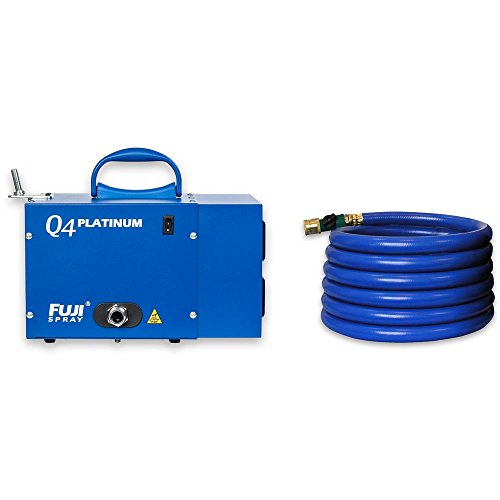
If your work leans towards high-end finishing — kitchen doors, bespoke joinery, furniture, lacquers and fine topcoats — a turbine HVLP system like the Fuji Q4 Platinum delivers a finish an airless struggles to match. It’s a four-stage turbine driving a separate gun on a hose, with fine atomisation control that’s made for thinner finishing materials rather than emulsion on walls.
This is a finishing tool, not a production wall sprayer. For a general decorator it’s a specialist purchase, but for anyone doing spray-shop work or on-site furniture and joinery finishing, the control and surface quality justify the outlay.
- Pros: outstanding finish quality on fine materials, excellent atomisation control, separate gun is comfortable for detailed work.
- Cons: expensive, slow and inefficient for walls and ceilings, a specialist buy rather than an all-rounder.
UK paint sprayers for decorators compared at a glance
Sprayer | Type | Best for | Approx price |
Titan ControlMax 1700 HEA | Airless (HEA) | All-round decorating | £320-330 |
Wagner ControlPro 250R | Airless (HEA) | Second HEA option, longer hose | £440-450 |
Graco Magnum A30 ProPlus | Airless (high pressure) | Whole-house, high volume | £590-600 |
Wagner FLEXiO 575 | Handheld HVLP | Doors, trim, furniture | £120-130 |
Graco TrueCoat 360 Handheld | Handheld airless | Furniture, snagging, quick jobs | £380-390 |
Fuji Q4 Platinum | Turbine HVLP | Fine finish, joinery | £1,050-1,100 |
How to choose a paint sprayer as a decorator
Airless vs HVLP — get this decision right first
The single most important choice is airless versus HVLP, and it comes down to what you spray most. Airless machines force paint through a small tip at high pressure and are made for moving a lot of material fast — walls, ceilings, fences, large flat surfaces. HVLP (high volume, low pressure) atomises paint with air and is made for control and fine finish — doors, trim, furniture, cabinets. A working decorator usually wants an airless for the big surfaces and a handheld HVLP for the joinery, because neither does the other job well.
HEA is worth paying for on an airless
High Efficiency Airless (the technology in the Titan ControlMax and Wagner ControlPro) sprays at lower pressure than traditional airless and cuts overspray by around half. On site that means less masking, less fog settling where you don’t want it, and a more forgiving spray fan that’s easier to control. Unless you genuinely need the raw throughput of a high-pressure machine like the Graco Magnum for whole-house work, an HEA airless is the easier machine to live with day to day.
Hose length and where the paint comes from
For walls and ceilings you want a machine that draws straight from the paint tub and runs a decent hose. Cup-fed handhelds are fine for doors and trim but become a refilling chore on large areas. Match the supply system to the surfaces you spray most.
Cleaning and maintenance is the real cost
Every sprayer here lives or dies on how well it’s cleaned down. An airless left with paint in the pump overnight is a repair bill waiting to happen. Budget 10-15 minutes at the end of each spray day for a proper flush, keep the recommended pump-protector fluid in the system over winter, and buy a machine with UK parts availability. A well-maintained airless lasts years; a neglected one clogs in weeks regardless of what you paid.
Tips and spares
Spray tips wear out and a worn tip ruins your fan pattern and wastes paint. Keep spare tips in the sizes you use most, and treat them as consumables. Stick with the manufacturer’s tip system where you can — Titan, Graco and Wagner all have their own, and mixing and matching causes more grief than it’s worth.
Frequently asked questions
What’s the best paint sprayer for a UK decorator overall?
For most working UK decorators the Titan ControlMax 1700 HEA is the best all-round choice. It has enough power for emulsion on walls and ceilings, low-overspray HEA technology that keeps masking manageable, and a build that stands up to daily use. Pair it with a Wagner FLEXiO handheld for doors and trim and you’ve covered the whole job.
Airless or HVLP — which should I buy first?
Buy whichever matches the work you do most. If your days are dominated by walls and ceilings, buy an airless first. If you mostly spray doors, kitchens, furniture and trim, buy a handheld HVLP first. Most decorators end up owning both because they genuinely do different jobs.
Can you spray emulsion straight from the tub without thinning?
With a proper airless like the Titan ControlMax or Graco Magnum, yes — they’re designed to spray standard trade emulsion unthinned and pull it straight from the tub. Smaller handheld HVLP units sometimes need light thinning on thicker emulsions. Always check the machine’s guidance for the specific paint.
How much overspray will I get?
It depends on the technology. High-pressure airless like the Graco Magnum throws the most overspray, so mask thoroughly. HEA airless machines like the Titan ControlMax and Wagner ControlPro cut that by roughly half. Handheld units sit in between on large surfaces but are very controllable on small ones. Whatever you use, proper masking and dust sheeting are part of the job — spraying is fast, but only if you’ve prepped the room.
Related reading