
Brands
Makita vs DeWalt
Year
2026
This is the debate that never dies. Walk onto any site in the UK and you’ll see teal and yellow everywhere — and the people holding those tools have opinions.
Here’s the thing: both Makita and DeWalt make excellent tools. Neither is objectively “better” than the other. What matters is which platform fits your work, your budget, and your existing kit.
This isn’t about crowning a winner. It’s about helping you make a decision you won’t regret in three years when you’re £2,000 deep into batteries and bare tools.
The Platform Decision Matters More Than the Tool
Before we get into the details, let’s be clear about what we’re really comparing here: battery ecosystems, not individual tools.
Once you buy three or four tools on one platform, you’re committed. Switching means replacing batteries, chargers, and potentially tools that still work fine. That’s expensive and wasteful.
So choose carefully. The drill you buy today determines which impact driver, multi-tool, SDS, and circular saw you buy tomorrow.
Both Makita LXT and DeWalt XR are mature, professional-grade systems. You won’t go wrong with either. But they have different strengths that suit different users.
The Platforms at a Glance
| Makita LXT (18V) | DeWalt XR (18V) | |
|---|---|---|
| Tools in range | 350+ | 250+ |
| Battery sizes | 2.0Ah – 6.0Ah | 1.5Ah – 5.0Ah |
| Higher voltage option | 40V XGT (separate platform) | 54V FlexVolt (backwards compatible) |
| Charge time (5.0Ah) | ~45 mins (Rapid Charger) | ~60-90 mins |
| Warranty | 1 year (3 with registration) | 1 year (3 with registration) |
| UK market share | ~35% | ~35% |
Tool Range
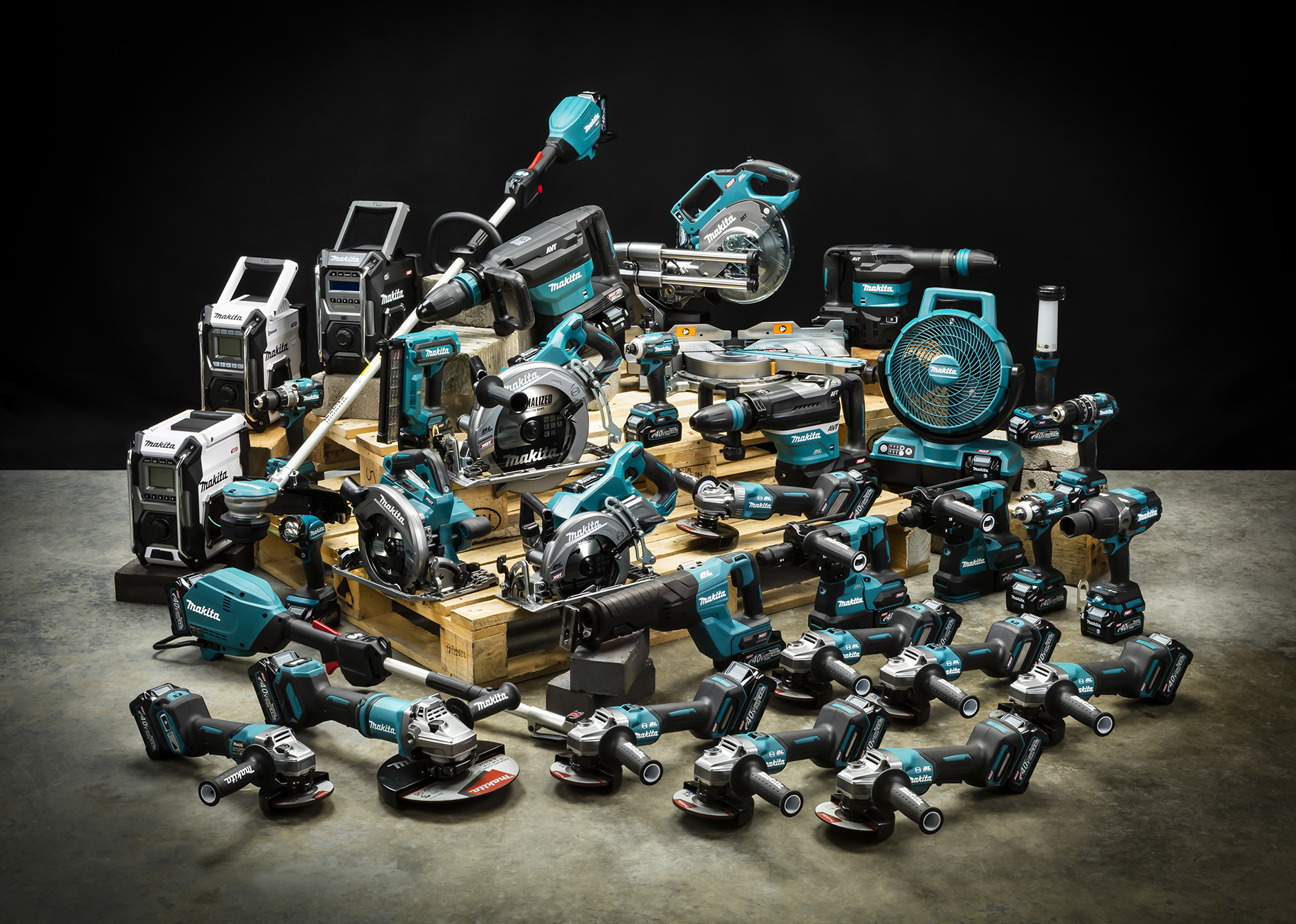
Makita wins on sheer numbers. With over 350 tools sharing 18V LXT batteries, it’s the largest compatible cordless system in the world. Whatever niche tool you need — vacuum pump, coffee maker, heated jacket — Makita probably has it.
DeWalt isn’t far behind with 250+ tools in the XR range. For most tradespeople, both platforms cover everything you’ll actually need. Drills, drivers, saws, grinders, multi-tools, SDS hammers, nailers — they’re all there in both camps.
Where Makita pulls ahead is in specialist and trade-specific tools. If you’re in a niche trade with unusual requirements, check both catalogues before committing.
Verdict: Makita has more options, but both cover mainstream needs comprehensively.
Battery Technology
This is where things get interesting.
Makita LXT runs on 18V lithium-ion batteries from 2.0Ah to 6.0Ah. The batteries are reliable, widely available, and competitively priced. Makita’s Rapid Optimum Charger is genuinely fast — a 5.0Ah pack charges in about 45 minutes, which is industry-leading.
The downside? Makita’s stuck with traditional cylindrical cells while competitors have moved to pouch cells. This means their batteries are slightly heavier and bulkier for the same capacity. It’s not a dealbreaker, but it’s worth noting.
DeWalt XR also runs on 18V (marketed as 20V Max in some regions — same thing, different measurement). Batteries range from 1.5Ah to 5.0Ah. DeWalt’s POWERSTACK batteries use pouch cells, offering better power delivery and longer life in a more compact package.
DeWalt’s big innovation is FlexVolt — batteries that automatically switch between 18V and 54V depending on the tool. This means you can use the same battery in your compact drill and your table saw. It’s genuinely clever engineering and gives DeWalt users access to corded-equivalent power without a separate battery platform.
The trade-off? DeWalt’s chargers are slower than Makita’s. Expect 60-90 minutes for a 5.0Ah pack.
Verdict: Makita charges faster. DeWalt offers better high-voltage flexibility with FlexVolt. For most users, it’s a wash.
Power and Performance
Let’s compare like-for-like flagship tools.
Combi Drills:
| Makita DHP486 | DeWalt DCD996 | |
|---|---|---|
| Max torque | 130Nm | 95Nm |
| No-load speed | 0-2,100 rpm | 0-2,000 rpm |
| Weight (bare) | 2.0kg | 2.0kg |
| Length | 178mm | 205mm |
| Price (body) | £145-175 | £140-165 |
Makita’s flagship has more torque on paper. DeWalt’s is slightly longer but otherwise comparable. In real-world use, both will handle anything you throw at them.
Impact Drivers:
| Makita DTD172 | DeWalt DCF887 | |
|---|---|---|
| Max torque | 180Nm | 205Nm |
| Impact rate | 0-4,000 ipm | 0-3,800 ipm |
| Weight (bare) | 1.1kg | 1.0kg |
| Price (body) | £130-150 | £90-110 |
DeWalt has a slight edge on torque; Makita on impact rate. Both are excellent. DeWalt’s often cheaper.
The Pattern: Makita tends to be slightly more refined and compact. DeWalt tends to offer marginally more power and often better value. Neither difference is dramatic.
Verdict: Performance is comparable. Pick based on ergonomics and price, not spec sheets.
Ergonomics and Build Quality
This is subjective, but patterns emerge from user feedback.
Makita tools are consistently praised for:
- Compact, lightweight designs
- Comfortable grips that reduce fatigue
- Smooth, refined operation
- Quieter motors
DeWalt tools are consistently praised for:
- Rugged, durable construction
- Solid, confidence-inspiring feel
- Good performance under heavy load
- Aggressive, powerful operation
The stereotype? Makita feels like precision engineering. DeWalt feels like industrial toughness. Neither is better — they’re different philosophies.
If you work in confined spaces or do a lot of overhead work, Makita’s compact designs might suit you better. If you’re on building sites doing heavy first-fix, DeWalt’s ruggedness might appeal.
Verdict: Try before you buy if possible. Ergonomic preference is personal.
Pricing
Let’s look at what you’d actually spend to get started.
Starter Kit (Drill + Impact + 2 batteries + charger + case):
| Makita | DeWalt | |
|---|---|---|
| Mid-range | DLX2131TJ — £280-320 | DCK266P2T — £280-320 |
| Premium | DLX2414TJ — £350-400 | DCK2050H2T — £320-370 |
Remarkably similar. Both brands offer entry-level, mid-range, and premium options at comparable price points.
Individual Batteries (5.0Ah):
| Makita BL1850B | DeWalt DCB184 | |
|---|---|---|
| Price | £55-70 | £45-60 |
DeWalt’s slightly cheaper on batteries. Makita’s slightly cheaper on some body-only tools. It evens out.
Verdict: Pricing is comparable. Neither is the “budget” option.
Availability and Support
Both brands are everywhere in the UK. Screwfix, Toolstation, ITS, Amazon, independent dealers — you won’t struggle to find either.
Spare parts, batteries, and accessories are readily available for both platforms. Both offer 3-year warranties when registered within 30 days of purchase.
DeWalt’s service network is arguably slightly more accessible through its partnership with retailers, but Makita has authorised service centres throughout the UK. Neither is difficult to deal with.
Verdict: Equal availability and support in the UK market.
Higher Voltage Options
What if you need more power than 18V delivers?
Makita’s approach: The 40V Max XGT platform is completely separate from LXT. Different batteries, different chargers, no compatibility. You can run both platforms, but you’re essentially maintaining two separate systems. Makita does offer an adapter to use LXT batteries in XGT tools, but it’s a compromise.
DeWalt’s approach: FlexVolt batteries work in both 18V XR tools and 54V FlexVolt tools. Buy a FlexVolt battery, and it powers everything from your compact drill to your mitre saw. One charger handles all of it.
This is DeWalt’s biggest advantage. If you anticipate needing high-power tools — large angle grinders, table saws, SDS-Max hammers — the FlexVolt compatibility is genuinely valuable.
Verdict: DeWalt wins convincingly on high-voltage flexibility.
Who Should Choose Makita?
Makita LXT suits you if:
- You value compact, lightweight tools
- Charging speed matters (you’re running one or two batteries hard)
- You prefer refined, precise operation
- You want the widest possible tool selection
- You’re in a trade with niche tool requirements
- Ergonomics and comfort are priorities
Trades that often favour Makita: Electricians, plumbers, kitchen fitters, maintenance engineers — trades where compactness and all-day comfort matter more than maximum power.
Who Should Choose DeWalt?
DeWalt XR suits you if:
- You need or might need high-power tools (FlexVolt)
- You prefer rugged, aggressive tools
- You want maximum power from 18V
- You value one battery system for everything
- You’re frequently in demanding conditions
Trades that often favour DeWalt: Builders, carpenters, roofers, general contractors — trades where power and durability are paramount.
The Real-World Answer
Here’s what actually happens on UK sites:
About 35% of tradespeople use Makita. About 35% use DeWalt. The rest split between Milwaukee, Bosch, and others. Both camps are happy. Neither is obviously wrong.
The decision often comes down to:
- What your colleagues use — borrowing a battery in a pinch is handy
- What your first tool was — many people stick with what they know
- Personal ergonomic preference — how it feels in your hand
- Specific tool availability — one brand might have exactly what you need
Don’t overthink it. Both platforms will serve you well for years.
What If You’re Starting Fresh?
If you have no existing investment and no strong preference, here’s my practical advice:
Go to a tool shop and hold both. Pick up a Makita drill and a DeWalt drill. Which feels better? That matters more than spec sheets.
Check your trade’s specific tools. Browse both catalogues for the specialist tools you might need. Does one brand have something the other doesn’t?
Consider FlexVolt. If there’s any chance you’ll need a mitre saw, table saw, or large grinder in the future, DeWalt’s FlexVolt compatibility is genuinely valuable.
Ask around. What do the tradespeople you respect use? What do they think of it after years of daily use?
What If You’re Already Invested?
If you’ve got four Makita batteries and a charger, buy more Makita. The cost of switching doesn’t make sense unless you’re deeply unhappy.
Same applies to DeWalt users.
The only exception: if you need a specific tool that only one brand makes, consider adding a small parallel system for that purpose. Some tradespeople run 18V in one brand and 12V in another, or have one brand for power tools and another for garden equipment.
It’s not ideal, but it’s practical.
The Honest Conclusion
There is no wrong choice here.
Makita LXT and DeWalt XR are both excellent professional-grade platforms backed by mature ecosystems, wide availability, and solid warranties. They’ve earned their dominant market positions.
Choose Makita if compact ergonomics, fast charging, and the widest tool selection matter most to you.
Choose DeWalt if FlexVolt compatibility, maximum power, and rugged construction matter most to you.
Then stop second-guessing and get to work. Your tools are meant to help you earn a living, not to be status symbols or tribal identities.
Buy what suits your trade, maintain it properly, and it’ll serve you for years. That’s true whether the tools are teal or yellow.
Kitd’s Take: Both platforms are excellent. For most UK tradespeople, the decision comes down to ergonomic preference and whether you need FlexVolt compatibility. Either way, you’re buying quality.