Cordless brad nailers have come a long way. The early models were heavy, slow and ate batteries for breakfast. The 2026 generation is a different beast — brushless motors, lighter bodies, faster cycle times and enough grunt to drive 50mm brads into oak architrave without breaking sweat. For second fix carpenters, kitchen fitters and shopfitters, the question isn’t whether to go cordless. It’s which one to back.
We’ve spent time with the main contenders on UK sites — first fix and second fix carpentry, MDF skirting, scotia, beading, panel mouldings and the odd bit of furniture work. Below are the brad nailers we’d actually buy with our own money in 2026, what each one is best at, and where they fall short.
All prices are approximate and based on UK retail at the time of writing — Screwfix, Toolstation, Amazon UK and Power Tool World. Battery platforms matter more than the tool itself if you’re already invested, so we’ve called that out for each pick.
Our quick verdict
If you want a one-line answer: the DeWalt DCN680 is still the most balanced 18-gauge cordless brad nailer for UK trade use in 2026. The Milwaukee M18 FUEL pips it on ergonomics if you’re already on the red platform. Makita’s DBN500 is the lightest of the three and a dream for overhead work. For DIY and lighter trade jobs, the Ryobi One+ AirStrike is the smart-money choice — and Bosch’s GNH 18V-64 is a quietly excellent option that often gets overlooked.


The 6 best cordless brad nailers UK tradespeople should consider in 2026
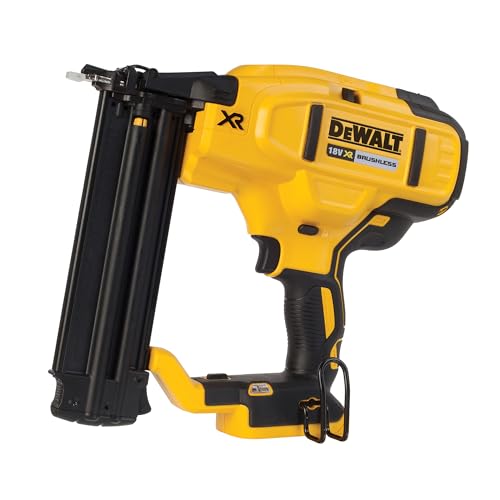
DeWalt DCN680N — Best overall for trade
Price: Around £280–£320 body only
The DCN680N has been the benchmark cordless 18-gauge brad nailer for years and the 2026 stocks haven’t changed that. Brushless motor, sequential and bump fire modes, depth-of-drive wheel that doesn’t slip mid-job, and a tool-free jam clear that actually works when you need it. It runs on the standard DeWalt 18V XR platform — so if you’ve already got DeWalt batteries, it’s a no-brainer.
Drives 18 gauge brads from 30mm up to 54mm. Fast cycle time, consistent countersinking, and the LED work light is genuinely useful in dim cupboards and lofts. It’s not the lightest of the bunch at around 2.5kg with battery, but the weight sits well in the hand.
Pros: balanced platform, excellent depth control, fast bump fire, parts and service network is everywhere in the UK.
Cons: not cheap if you’re starting from scratch, and it’s slightly heavier than the Makita.
- BRUSHLESS MOTOR: The advanced brushless motor technology delivers exceptional performance by maximising power output while minimising energy loss. This design not only extends the overall lifespan of the tool but also allows for a more compact and ergonomic build, making it easier to handle in tight spaces and reducing fatigue during prolonged use.
- ADJUSTABLE DRIVE DEPTH: The depth of drive can be conveniently adjusted using the thumb wheel depth adjuster. This facillitates precise nail placement and ensures optimal performance for various materials and applications.
- SEQUENTIAL MODE: Ideal for precision placement, this mode ensures accurate and controlled nailing for detailed work.
- BUMPING MODE: Designed for high-speed production, this mode enables a rapid firing rate of up to 4 nails per second, making it suitable for larger projects requiring efficiency.
- ERGONOMIC AND LIGHTWEIGHT: Engineered for user comfort and maneurability, this nail fixer was designed for extended use and demanding working conditions, ensuring continous performance and reduced fatigue.
Milwaukee M18 FUEL 2746 — Best for ergonomics
Price: Around £320–£360 body only
If you’re on the red platform, the M18 FUEL brad nailer is excellent. The grip and balance are noticeably better than the DeWalt — Milwaukee tends to win the ergonomics test on most cordless tools and this is no exception. Brushless motor, dry-fire lockout, tool-free depth adjustment and stall release in case of a jam.
Drives 18 gauge brads from 16mm up to 54mm. Bump fire is rapid and accurate, and the nose is slim enough to get into tight corners on architrave returns and beading.
Pros: best-in-class ergonomics, clean countersinking, brilliant if you already run M18 batteries.
Cons: priciest of the mainstream picks, slightly heavier than the DeWalt body-only.
Makita DBN500Z — Best for overhead and trim work
Price: Around £270–£310 body only
The Makita uses a built-in air compressor mechanism rather than a flywheel, which gives it a feel closer to a pneumatic nailer — a quieter shot, smoother recoil and very consistent depth on full-charge. It’s the lightest of the three big trade picks, which makes a real difference if you’re working overhead all day on cornicing or panelling.
Drives 18 gauge brads from 15mm to 50mm — a slightly shorter top length than the DeWalt and Milwaukee, so check your nail size before committing. Around 1,000 nails per 3.0Ah battery in our testing on softwood architrave.
Pros: lightest in class, near-pneumatic feel, slim nose for tight work, runs on the huge LXT range.
Cons: 50mm max nail length, the compressor mechanism takes a fraction longer to cycle than the DeWalt’s flywheel system.
- DBN500Z
- STAPLER
- DBN500Z
- Model Number : DBN500Z
- From : Makita

Bosch GNH 18V-64 Professional — Best for first fix crossover
Price: Around £250–£290 body only
The Bosch is the underrated pick. Brushless motor, very consistent depth, and Bosch’s anti-vibration grip is genuinely effective on long second-fix days. Drives 18 gauge brads up to 64mm — longer than the DeWalt or Makita — which makes it useful when you’re crossing over into lighter first-fix work like batten and lath.
Comes in at a slightly lower price than the DeWalt and Milwaukee body-only and runs on the Bosch ProCORE 18V platform, which is one of the better 18V batteries on the market.
Pros: longer 64mm capacity, smooth firing, well priced for a pro tool, ProCORE battery runtime is excellent.
Cons: smaller UK service network than DeWalt, fewer kit options on the shelf at Screwfix.
No products found.
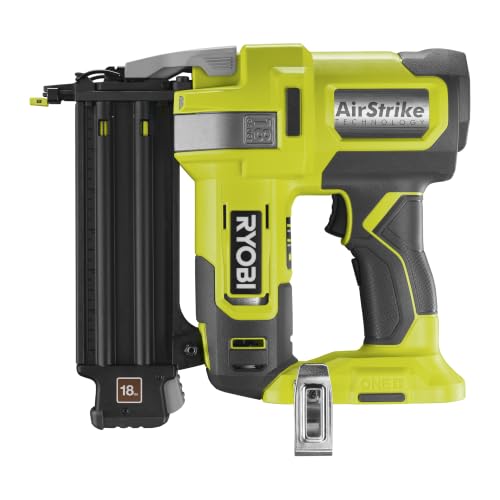
Ryobi R18N18G — Best on a budget
Price: Around £160–£200 body only
If you’re not nailing all day every day, this is the smart-money option. Ryobi’s AirStrike technology fires reliably and the battery life is surprisingly good — Ryobi quotes around 1,700 nails per 4.0Ah charge, and in real-world use we comfortably saw 1,200 plus on softwood with 30mm brads. Drives 18 gauge brads from 15mm to 50mm.
It’s not as fast as the trade picks, the bump fire isn’t as crisp, and the body is bulkier in the hand. But for a kitchen fitter doing the occasional second fix, a chippy on smaller jobs, or a serious DIYer, it’s hard to argue with the price.
Pros: huge value, decent battery life, slots into the One+ ecosystem if you’ve already got Ryobi gear.
Cons: heavier than the trade picks, depth control is fiddlier, sequential fire only feels properly accurate.
- Air Strike Technology provides cordless convenience, eliminating the need for a noisy compressor, bulky air hose or expensive gas cartridges
- Fires 18 G nails 1.2 mm from 15 to 50 mm long
- Tool less depth of drive adjustment helps protect the work surface and allows proper setting of nails and tool - less jam release for easy removal of accidentally jammed nails
- Grip-light technology engages LED by grasping the handle
- Belt hook mounts left or right for added convenience
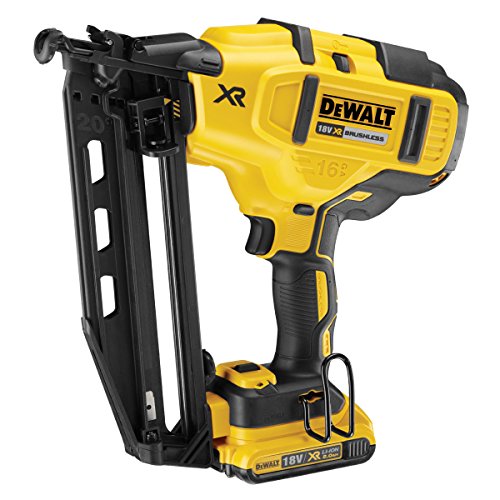
DeWalt DCN660 — Best for 16-gauge finishing work
Price: Around £320–£360 body only
Worth a mention if you’re crossing over between brad and finish nailing. The DCN660 is a 16-gauge straight finishing nailer rather than an 18-gauge brad nailer, but it lives on the same XR platform and is a sensible second tool for fitters who do skirting, architrave and door casings on heavier oak or hardwood. Drives nails up to 63mm.
Not a replacement for an 18-gauge for fine pin work — the heads are visibly larger — but for solid hardwood second fix where 18 gauge wouldn’t hold, this is the one.
Pros: powerful, brushless, handles hardwood without complaint.
Cons: 16-gauge is overkill for most brad nailer use cases, larger head means more filling.
- 18V XR Lithium Ion cordless brushless 16 gauge framing nailer
- The eagerly awaited successor to the DC618
- Brushless motor technology offers the power to fire a 63mm nail into soft wood and 50mm nail into hard wood
- Benefit from longer runtime, quicker readiness to fire and less recoil
- Durable magazine accepts 32 to 63mm 16Ga nails
Cordless brad nailers compared at a glance
| Model | Platform | Nail length | Approx price | Best for |
| DeWalt DCN680N | 18V XR | 30–54mm | £280–£320 | Trade all-rounder |
| Milwaukee M18 FUEL 2746 | M18 | 16–54mm | £320–£360 | Best ergonomics |
| Makita DBN500Z | 18V LXT | 15–50mm | £270–£310 | Overhead / trim |
| Bosch GNH 18V-64 | Bosch 18V | 32–64mm | £250–£290 | Longer brads |
| Ryobi R18N18G | 18V One+ | 15–50mm | £160–£200 | Budget / DIY |
| DeWalt DCN660 (16ga) | 18V XR | 32–63mm | £320–£360 | Hardwood finish |
What to look for in a cordless brad nailer
Battery platform
This is the single biggest decision. A brad nailer body alone is £250–£320, but a kit with battery and charger can be £400 plus. If you already run DeWalt 18V XR, Makita LXT or Milwaukee M18, stick with that platform. If you’re starting from scratch, DeWalt and Makita have the broadest UK trade adoption — second-hand batteries and chargers are easy to find, and Screwfix and Toolstation stock both.
Brushless motor
All the trade picks above are brushless. Brushed brad nailers still exist at the cheap end, and they’ll let you down. Brushless is more efficient, lasts longer between charges, and copes far better with high-cycle days. Anything you’re seriously using on site should be brushless.
Nail length range
18 gauge brads go from 15mm up to roughly 64mm depending on the tool. 30–50mm is the bread and butter of second fix work. If you regularly drive longer brads — into thicker architrave, casings or batten — the Bosch’s 64mm capacity is genuinely useful. Most of the time, anything that can do 50mm cleanly is enough.
Sequential vs bump fire
Sequential mode means you have to release the trigger between shots — safer, more accurate, better for visible work. Bump fire (or contact fire) lets you walk the nailer along and fire as you go — faster, but easier to misplace a shot. Every brad nailer in our list has both modes; the better tools switch between them quickly without fiddling.
Depth adjustment
Look for a tool-free wheel, not a hex key. Depth setting changes constantly during a job — softwood vs MDF vs hardwood — and you don’t want to be hunting for an Allen key every time. The DeWalt and Milwaukee are best in class here, the Makita is good, the Ryobi is fiddlier.
Weight and balance
Most cordless brad nailers come in between 2.2kg and 2.7kg with a 2.0Ah battery fitted. Doesn’t sound like much, but try holding one above shoulder height for an hour while you’re nailing cornicing. The Makita is lightest, the Milwaukee is best balanced, the Ryobi is heaviest of the picks here.
Suitability by trade
- Second fix carpenters and joiners — DeWalt DCN680 or Makita DBN500. Whichever battery platform you already run.
- Kitchen and bathroom fitters — Makita DBN500 for the lighter weight or DeWalt DCN680 for the speed. Both handle plinths, cornice and pelmets well.
- Shopfitters — Milwaukee M18 FUEL if you’re on the red platform, otherwise the DeWalt. The bump fire matters when you’re banging out fascia panels and beading at speed.
- General builders doing occasional second fix — Ryobi One+ AirStrike. You’re not using it daily, so the price-to-performance ratio wins.
- Heritage and joinery work in hardwood — DeWalt DCN660 (16-gauge) for skirting and architrave that needs to hold properly. Pair it with an 18-gauge for finer work.
Final verdict
For most UK tradespeople in 2026, the DeWalt DCN680N is still the brad nailer to beat. It’s not the cheapest and it’s not the lightest — but the combination of a huge UK service network, the 18V XR platform, a properly fast cycle time and consistent depth control makes it the safest pick if you don’t already have a battery platform locked in.
If you do — buy on platform. The Milwaukee M18 FUEL is the most comfortable to use; the Makita DBN500 is the lightest and best for overhead trim work; the Bosch GNH 18V-64 is the longest-firing of the lot and quietly the best value among the trade tools. The Ryobi is the right answer for anyone whose brad nailer doesn’t pay for itself by Wednesday.
Whatever you pick, get the brushless model, get a spare 4.0Ah battery, and don’t bother with the cheap pneumatic-cordless hybrids that need both gas cells and batteries. Modern brushless does the job, no gas needed.
Related reading