Kitd is reader-supported. If you buy through links on this page we may earn a commission from Amazon, at no extra cost to you.
Mixing plaster, tile adhesive, self-levelling compound or render by hand is slow, and it wrecks your wrists and shoulders. A mains paddle mixer fixes that, but the cable is a nuisance on a site with no power in the room you are working in, or when you are mixing in the van park or a back garden. A cordless paddle mixer takes away the lead and runs off batteries you probably already own.
Cordless mixers are still a niche corner of the market, so the choice is smaller than it is for drills and saws. We checked what is on sale at Amazon UK at the time of writing and picked three that are genuinely in stock, from named brands and with a decent pile of reviews behind them. All three are sold as bare tools, so the price on the page does not include a battery or a charger.
Quick Verdict
If you run Makita 18V LXT batteries, the Makita DUT130Z is the obvious pick: it uses twin 18V packs for power, it is a recognised trade tool and it has over a hundred reviews. If you are on the DeWalt FlexVolt system, the DeWalt DCD240N is the high-power choice for big batches of heavy material. If you want a cheaper way in and you are already on Einhell Power X-Change batteries, the Einhell Professional cordless mixer is the sensible budget option.
Best Cordless Paddle Mixers at a Glance
| Model | Battery system | Best for | Price at time of writing |
|---|---|---|---|
| Makita DUT130Z | Makita 18V LXT (twin) | Plaster, adhesive, screed | About £237 |
| DeWalt DCD240N | DeWalt FlexVolt 54V | Heavy, big-batch mixing | About £260 |
| Einhell Professional Cordless Mixer | Einhell Power X-Change 18V | Light-duty mixing on a budget | About £123 |
Buyer’s Guide: What to Look for in a Cordless Paddle Mixer
Battery Platform
This decides almost everything. A bare-tool mixer is only good value if the batteries are already in your van. Mixing is hard on a battery, so the lower-capacity packs that suit a drill will flatten quickly. Plan on 5Ah or bigger, and keep a second charged pack on the bench if you mix all day.
Power and Mixing Capacity
Paddle mixers are rated by the volume of material they will turn, not just by watts. A light-duty machine copes with a half bucket of plaster or adhesive. Dense materials such as sand and cement mortar, or a full bucket of self-levelling compound, need a much stronger motor and a lower gearing. Match the mixer to the stiffest thing you will actually mix.
Speed Control and Gearing
Variable speed matters more than top speed. Starting slowly stops dry powder blowing out of the bucket, and a gear change lets you drop to a low, high-torque setting for heavy mixes. A soft start is a bonus that spares your wrists when the paddle bites.
Handles and Ergonomics
A mixer is a two-handed tool, and a good side handle makes a big difference when the paddle is working through thick material. A reaction-torque grip stops the whole machine trying to twist out of your hands. Check the weight too: a twin-battery tool is heavy by the end of the day.
Paddle Type and Fitting
Most mixers take an M14 paddle, which is the standard thread on plastering and tiling paddles. Buy the right paddle for the job: a long, open paddle for thin mixes, and a compact, heavy-duty one for adhesive and mortar. A paddle that is too big will not circulate material properly.
The Best Cordless Paddle Mixers
Makita DUT130Z
The Makita DUT130Z is a brushless 18V LXT mixer that runs on two batteries to get the power it needs. It is sold at Amazon UK in a tool bag as a bare unit, so you supply the batteries and charger. It has over a hundred reviews on Amazon UK at the time of writing and a rating that is comfortably above four stars.
It is a sensible all-rounder for plasterers, tilers and general builders who already work on Makita. It will handle plaster, adhesive and most skim and basecoat mixes without any complaint, and the two-battery layout keeps the weight balanced. The cost of the tool is higher than the cheaper brands, but the build quality and dealer backing are what you are paying for.
Pros: Brushless motor; good for plaster, adhesive and screed; trade-standard Makita build; runs on batteries you may already own.
Cons: Needs two batteries to work; heavy when loaded with a big mix; batteries and charger not included.
Best for: Makita 18V users who mix daily.

- Suitable for mixer Paddles up to 165mm with a m14 thread
- Mixing Paddle not included; supplied separately
- Tool holder shank m14
- Maximum paddle diameter 165mm
- Not compatible with g-series batteries
DeWalt DCD240N FlexVolt Paddle Mixer
The DeWalt DCD240N is a 54V FlexVolt tool-only mixer. It is the strongest machine in this list and it is aimed at heavy, repeat mixing: sand and cement, self-levelling screed, and big buckets of tile adhesive. It has well over a hundred reviews on Amazon UK at the time of writing.
The price is high and the batteries are an additional cost if you are not already on FlexVolt, but the power is the reason to buy it. If you mix big batches throughout the day and want a cordless tool that does not feel underpowered, this is the one.
Pros: High power for heavy materials; brushless motor; part of the wide DeWalt FlexVolt range.
Cons: Most expensive here; FlexVolt batteries are costly if you do not own them; heavy.
Best for: DeWalt FlexVolt users who mix heavy materials.
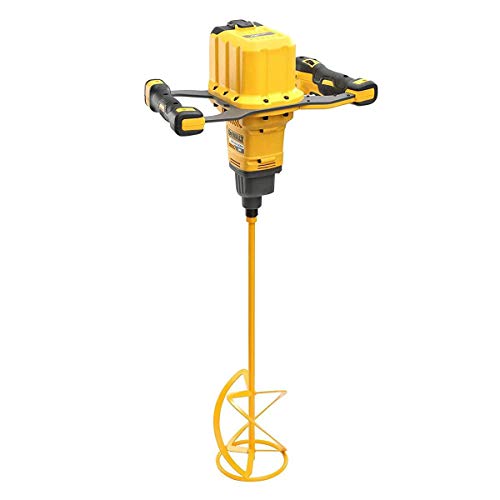
- Dual handle ergonomic with critical width and angle dimensions, reduces user fatigue
- All metal transmission for heavy duty cycle
- Safety lock off switch for minimizing accidental starts when on it's side or when inserting battery
- m14 threaded connector which is a standard fitment
Einhell Professional Cordless Mixer
The Einhell Professional cordless mixer is the budget choice in this guide. It is sold as a bare tool without a battery and runs on Einhell Power X-Change 18V packs, which are shared across a very large range of Einhell tools. It is priced well below the Makita and the DeWalt, and Amazon UK shows reviews from buyers who bought it for plaster, paint and light mortar.
This is a tool for light to moderate mixing and an occasional user. If you are mixing heavy batches all day, spend more on the Makita or DeWalt. For a handyman or a small contractor already on Einhell batteries, though, it gets the job done at a modest cost.
Pros: Much cheaper than the trade brands; shares batteries with other Einhell tools; light enough for frequent use.
Cons: Less power than the Makita and DeWalt; not for heavy daily mixing; battery and charger not included.
Best for: Occasional users and handymen on Einhell Power X-Change.

- EXPERIENCE CORDLESS FREEDOM - Annoying Power Cords Are A Thing Of The Past! The mounting of this battery-powered cordless paddle mixer is equipped with an M14 thread for use with the supplied stirrer (Ø 120 mm) and all common stirring tools
- ROBUST AND POWERFUL - A low-maintenance and powerful brushless motor ensures maximum performance with longer runtime compared to conventional brush motors
- GERMAN DESIGN EXCELLENCE - The 2-speed gearbox is suitable in 1st gear (high torque) for mixing tough materials such as mortar and in 2nd gear (high speed) for liquid material such as paint. Thanks to speed control and soft-start, it is possible to work without paint splashes, optimally adapted to any material such as paint or mortar
- ONE BATTERY FOR OVER 300 TOOLS - The same battery will power all of your Einhell PXC Power Tools and Garden Machines. Our intelligent ABS Battery Electronics and high-performance Li-Ion Cells makes our rechargeable battery system one of the safest in the industry and ensures efficiency, reliability and durability
- RECHARGEABLE PAINT AND MORTAR MIXER ONLY - This is the electric Mixer power tool only. It requires 1 x 18V Lithium-ion rechargeable battery and charger (Sold Separately)

Cordless or Mains: Which Should You Buy?
A mains paddle mixer is cheaper to buy, has more sustained power, and never runs out of charge. Where there is a socket, it is still the better choice for heavy daily mixing. A cordless mixer earns its keep where there is no power, where trailing leads are a trip hazard, and on small jobs where you want to mix one bucket and move on.
Think about where you will use it most. For a plasterer working through a house with the power off, a cordless machine can be a real time saver. For a renderer mixing sand and cement all day in a yard with a generator, mains is more practical.
Getting the Best Out of a Cordless Mixer
Add the powder to the water, not the other way round, so you do not get dry pockets at the bottom of the bucket. Start at low speed until the powder is wet, then build up. Keep the paddle moving through the bucket and avoid lifting it out while spinning, which throws material over you and the floor.
Clean the paddle straight after use. Dried plaster or adhesive on a paddle is hard to remove, and it will unbalance the tool next time you use it. A bucket of water and a stiff brush takes seconds while the material is still wet.
Rotate your batteries. A mixer will empty a pack faster than a drill, so charge spares between jobs. Avoid leaving batteries on a hot dashboard or in a cold van overnight if you can, since extreme temperatures shorten their life and reduce the power available.
FAQs
Can a cordless mixer handle sand and cement?
Only the stronger machines. The DeWalt FlexVolt is the one we would choose for heavy mortar, and the Makita copes with moderate batches. Light-duty cordless mixers will struggle and may overheat.
How many batteries do I need?
The Makita needs two 18V batteries to run. The DeWalt FlexVolt tool uses a 54V FlexVolt pack, and the Einhell uses a single Power X-Change pack. Larger-capacity packs last longer on a mixer.
Can I use a drill with a paddle instead?
For small amounts of paint or adhesive you can, but a standard drill has the wrong gearing and little reaction-torque control for thick mixes. A purpose-built mixer is safer and kinder to your wrists.
What paddle size should I buy?
Most mixers take a standard M14 thread. For plaster and thin mixes, use a longer, open paddle. For adhesive and mortar, a shorter, heavy-duty paddle works better.
Final Thoughts
The right cordless paddle mixer depends on the batteries in your van. Makita users should look at the DUT130Z, DeWalt FlexVolt users at the DCD240N, and anyone on Einhell at the Professional mixer. For heavy, all-day mixing with no power available, the DeWalt is the one with the muscle. For everything else, the Makita is a good balance of power and handling.