A petrol generator is still the right call for heavy, sustained loads – a site full of 110V tools running all day – but for a huge amount of van and light-site work, a battery power station does the job better. No fuel to carry, no fumes, no noise complaints on a residential job, and you can run it inside a van or even a client’s kitchen without a second thought.
This isn’t a generator replacement for heavy trade use. It’s the right tool for charging batteries, running a laptop and a site radio, powering low-draw lighting, or keeping a fridge or a small inverter drill topped up through a working day. Here’s what’s actually worth buying.
Quick Verdict
For most vans, the EcoFlow RIVER 3 Plus hits the sweet spot of capacity, size and price – enough power for a genuinely useful working day of charging and light tools without being too bulky to keep behind the seats. If you need serious capacity for a full day off-grid running more demanding kit, step up to the Jackery Explorer 1000 v2.
For the tightest budget and the smallest footprint, the Anker SOLIX C200 DC is a genuinely capable compact option, and the BLUETTI Elite 30 V2 sits neatly between the two on price and capacity if neither extreme suits you.
The Best Portable Power Stations for UK Trade
Best All-Round: EcoFlow RIVER 3 Plus
At 286Wh, the RIVER 3 Plus has enough capacity to run a laptop, charge phone and cordless tool batteries, and power small lighting or a site radio through a full working day, while staying compact enough to live behind the passenger seat without eating into load space. EcoFlow’s LFP (LiFePO4) battery chemistry is rated for a significantly longer cycle life than older lithium-ion power stations, which matters if this is going to get charged and drained most days for years.
It charges from empty to full via mains in well under an hour, which is the kind of turnaround that actually fits around a working day rather than needing an overnight charge. For most vans, this is the one to buy first.
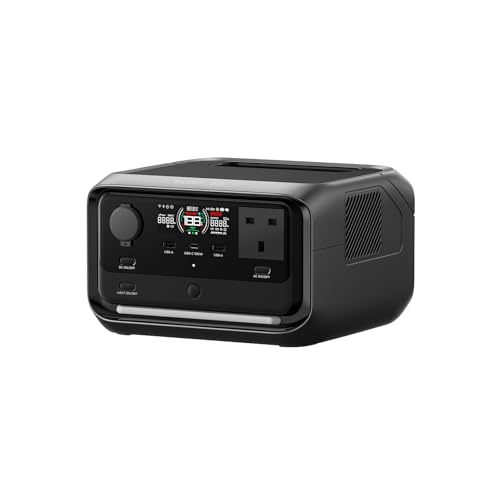
- High Power up to 1200W: RIVER 3 Plus powers appliances up to 1200W with X-Boost and provides 600W steady output. It features 7 outlets—3 UPS AC, 2 USB-A, USB-C, and car output—powering 90% of home devices. A built-in light ensures visibility anytime.
- Extra 16 hr Runtime & Ultra-Quiet: X-GaNPower boosts efficiency, delivering 16 hr runtime for <100W devices like lights and routers. Compact and ultra-quiet at 30 dB, it runs silently even at 0.5 m away.
- Expandable Power, Easy to Use: Expand capacity up to 858Wh with EB300 (286Wh) or EB600 (572Wh). Pogo Pin technology ensures seamless, wireless attachment. An extra battery adds a 140W USB-C port for more input/output options.
- Pro-grade UPS Protection: With a 10 ms auto-switch, RIVER 3 Plus secures sensitive devices from outages. LED, app, and software alerts keep you informed, while automatic data-saving protects PCs/NAS from low battery.
- Fast, Safe Charging Options: X-Stream tech recharges from 0-100% in 1 hr with no damage. Use 220W solar input for green, renewable energy in as fast as 1.5 hr, making it an efficient solar generator.
Best for Higher Capacity: Jackery Explorer 1000 v2
At 1070Wh, the Explorer 1000 v2 steps up into genuinely useful territory for running more demanding equipment – small power tools, a site fridge, multiple devices charging simultaneously – across a full day without needing a top-up. Jackery has one of the longest track records in this category and the build quality and app monitoring reflect that maturity.
It’s bulkier and heavier than the compact options here, so it suits a van that has the space to dedicate to it rather than being something you’d carry site to site on foot. For anyone regularly working off-grid for a full day, the extra capacity is worth the extra size.
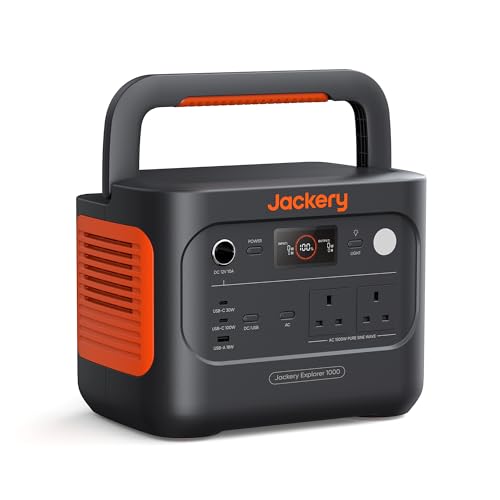
- Next-gen Power: Jackery’s new, upgraded Power Station features 50% increase in power output, to the old E1000 model, and 1,500W AC Output. It charges 7.5x faster, with impressive 1 hour fast charging - via App. The LiFePO4 battery has 4x longer lifespan, supporting 4,000 life cycles and retains over 70% capacity.
- Faster & Safer: The Jackery Explorer 1000 v2 delivers 1 hour fast charging - fully charged in 60 minutes with the App. Its ChargeShield 2.0 system, provides 62 types of safety protection, and is CE certified, combined with full fire and shock resistance - ensuring quality and maximum safety.
- Upgraded Performance: Boasting mega 1500W AC output and 3000W surge peak, it supports home appliances, from air conditioners to induction cookers. It features 100W PD Fast USB-C charging (input & output) for efficient recharging, with generous 1070Wh capacity, and comes in smaller size - saving space.
- Outdoor & Emergency Power Supply: Equipped with 6 charging ports (2 USB-C, 1 USB-A, 1 DC Car Port and 2 Pure Sine Wave AC Ports), Jackery’s Explorer 1000 V2 powers multiple devices simultaneously. Weighing 23.8 lbs with an ergonomic handle, it’s easy to carry on the go, with built-in LED lights, ideal for camping, hiking, and emergencies.
- Smart App Control: Easily monitor battery status via Wi-Fi or Bluetooth, and benefit from a range of charging modes with App. Tailored charging modes - lightning fast 1 hour super charging, 1.7 hour fast charging or 30 dB quiet mode (peaceful overnight charging). Modes extend battery life, optimising overall performance.
Best Compact and Budget: Anker SOLIX C200 DC
At 192Wh and under £180, this is the cheapest genuinely capable option here, small enough to fit in a bag rather than needing dedicated van space. It’s the right choice if your actual need is topping up phones, a laptop and small cordless tool batteries through the day rather than running anything power-hungry.
The trade-off for the compact size and price is capacity – it won’t run a fridge or charge multiple larger batteries across a full day. Know your actual power needs before buying on price alone, because upgrading later usually means buying a second, larger unit rather than being able to expand this one significantly.

- Massive Power Anywhere: This battery delivers 200W and includes one 140W two-way USB-C fast charging ports.
- 5 Device Charging Ports: Power all your tech with versatile ports, including 1× USB-C (100W), 1× USB-C (140W), 1× USB-C (15W), and 2× USB-A (12W).
- Travel-Friendly Design: 39% smaller than similar power stations, attach the strap (sold separately) to easily carry your power.
- 60W Solar Input: When your journey needs endless charging, do so seamlessly and sustainably with a 60W solar panel. This power station is not compatible with Anker SOLIX PS30 (or other 5V~3A USB-C panels), PS200, PS400.
- 3 Ways to Recharge: Fast Recharge to 80% in 1.3 hours with the PD 3.1 USB-C port. You can also use solar panels or your car.
Best Middle Ground: BLUETTI Elite 30 V2
At 288Wh with a 600W output, the Elite 30 V2 sits almost exactly between the EcoFlow and the Anker on capacity while adding a bit more sustained output power than either, which matters if you’re running something with a genuine power draw rather than just charging batteries and phones. BLUETTI has built a solid reputation in this space and the reviews reflect a reliable, well-built unit.
If you’ve compared the EcoFlow and Anker and neither quite fits – one too small, one you don’t need the bulk of the Jackery for – this is the sensible middle option.

- [288Wh On-the-Go Power] - Only 9.4 lbs lightweight, carry it anywhere during storms! 288Wh capacity meets daily & outdoor needs—camping, road trips, beach visits, or home emergencies. Extend your smart green energy life to every corner of your ideal lifestyle with this compact entry-level power station.
- [600W Continuous & 1500W Surge Power] - Get a full 600W output—twice as much as others. When you need serious power, activate Power Lifting Mode for 1500W power (vs. the typical 600W). It runs everything from essential camping lights, speakers, and car fridges to critical devices like laptops and CPAP machines and even a small kettle or toaster—ideal for stormy days at home or outdoor trips.
- [50% Lower Power Consumption] - Upgraded UltraCell tech & smart cooling system cut power consumption by 50%. Enhances overall energy efficiency, extends device runtime. Excellent durability & environmental adaptability for extreme outdoor climates and long-term operation.(Standby power only 4.5W, DC 5W, AC 8W)
- [8 Charging Modes & 380W Fast Wall Charge] - Supports AC wall charge (380W/200W adjustable), solar, car charging, etc. 0-80% in 45 mins, 0-100% in 70 mins (battery-safe). Match PV60L solar panel for on-the-go recharging. Flexible charging solutions for city, wilderness, daily or emergency scenarios.
- [Reliable UPS] - Never lose data or stop your devices during winter storms/blackouts! 10ms ultra-fast UPS switch protects CPAP, laptops, routers—critical for home emergencies when power cuts suddenly.
At a Glance – Portable Power Stations Compared
| Model | Capacity | Best for | Approx. price |
| EcoFlow RIVER 3 Plus | 286Wh | All-round van use, fast recharge | £219 |
| Jackery Explorer 1000 v2 | 1070Wh | Full-day off-grid, higher loads | £469 |
| Anker SOLIX C200 DC | 192Wh | Compact, budget, light charging | £179 |
| BLUETTI Elite 30 V2 | 288Wh | Middle ground capacity and output | £199 |
Buyer’s Guide – What Actually Matters
Work Out Your Actual Watt-Hour Need Before You Buy
Capacity is measured in watt-hours (Wh), and what you actually need depends entirely on what you’re running and for how long. A laptop draws roughly 50-65W, so a 286Wh unit gives you four to five hours of laptop use alone before anything else. Add up your realistic daily loads before choosing a capacity, rather than buying the biggest number available – it’s wasted money and wasted bulk if you never get near using it.
Output Power (W) Is Different From Capacity (Wh)
Capacity tells you how long something can run; output power tells you what it can run at all. A power station with a high Wh capacity but a low W output can still fail to start a tool with a demanding motor, because it can’t deliver the instantaneous power needed even though it has plenty of stored energy. Check both figures against what you actually intend to plug in, particularly for anything with a motor rather than a simple charger.
LFP Batteries Last Longer Than Older Lithium-Ion
LiFePO4 (LFP) battery chemistry, used in all four models here, is rated for several times more charge cycles than the older lithium-ion chemistry found in cheaper or older power stations – often 3,000+ cycles versus 500-800. For a tool that gets charged and drained most working days, that difference is the gap between the unit lasting a couple of years and lasting the better part of a decade.
Solar Charging Is a Genuine Bonus, Not a Core Feature
All four of these can be charged from a compatible solar panel as well as mains or a car socket, which is useful for topping up slowly across a long day on an off-grid site. Don’t buy based on solar charging alone unless you’re genuinely working somewhere without mains access regularly – for most vans, overnight mains charging covers it.
Weight and Size in the Van
The compact options here, the EcoFlow and the Anker, are light enough to carry in one hand and small enough to tuck into a door pocket or behind a seat without eating into load space. The Jackery Explorer 1000 v2 is a genuinely different proposition – closer to a small toolbox in size and weight, worth dedicating a permanent spot to rather than moving in and out of the van daily.
FAQs
Can a portable power station run a corded power tool?
It depends on the tool’s power draw and the unit’s output rating. Light-duty corded tools with a modest motor will generally run fine on any of the four here; anything with a high starting surge, like a large compressor or a heavy-duty saw, needs checking against the specific output rating before assuming it’ll work.
How long does a power station last before needing replacement?
With LFP battery chemistry rated for 3,000 or more charge cycles, daily use should realistically give you several years of reliable service before capacity noticeably degrades, assuming it isn’t regularly left fully drained or exposed to extreme heat.
Is a power station a replacement for a generator?
For heavy, sustained site power – running multiple 110V tools all day – no, a generator is still the right tool. For charging, lighting, laptops and light tool use, a power station is quieter, cleaner and genuinely more convenient, and the two aren’t really in competition for the same job.
Can I use one of these to jump-start a vehicle?
Some portable power stations include this feature and some don’t – none of the four reviewed here are marketed primarily as jump starters, so if that’s a specific need, check the exact model’s spec sheet or consider a dedicated jump starter alongside it.
How long does a full recharge take?
The smaller units here, like the EcoFlow RIVER 3 Plus and Anker SOLIX C200 DC, typically recharge from empty via mains in under an hour thanks to fast-charging tech. The larger Jackery Explorer 1000 v2 takes longer given its much bigger capacity, though still well within an overnight charge.
The Verdict
Buy the EcoFlow RIVER 3 Plus if you want the best balance of capacity, size and price for typical van use. Step up to the Jackery Explorer 1000 v2 if you regularly need to run higher loads for a full day off-grid. Choose the Anker SOLIX C200 DC if budget and compact size matter most, and the BLUETTI Elite 30 V2 if you want a genuine middle ground between the two extremes.
Prices correct at time of writing and vary between Amazon UK and the manufacturers’ own stores.