A tape measure needs two people or a wall to hook against, and it’s next to useless up a ladder, across an open room, or measuring a ceiling height on your own. A laser distance measure does the same job in a fraction of the time, on your own, accurate to a few millimetres over tens of metres – and once you’ve used one properly for a quoting or first-fix job, going back to a tape for anything over about three metres feels like a step backwards.
Prices here range from about £30 to £90 for the models actually worth buying, and the differences that matter are range, memory functions, and whether it can do area and volume calculations on the fly. Here’s what’s actually worth the money.
Quick Verdict
For most trades, the Bosch Professional GLM 40 is the benchmark – accurate, reliable, a genuinely huge number of satisfied users, and priced sensibly for what it does. If you want the tightest accuracy and don’t mind paying for a premium brand, the Leica DISTO D1 adds Bluetooth to a phone app, which is genuinely useful for quoting and floor plans.
If you’re already on a specific battery platform, the DEWALT and Makita options are solid, capable tools that do everything most trades need. And if you just want something reliable in the van for basic room and material measurements without spending much, the Stanley TLM40 covers it.
The Best Laser Distance Measures for UK Trade
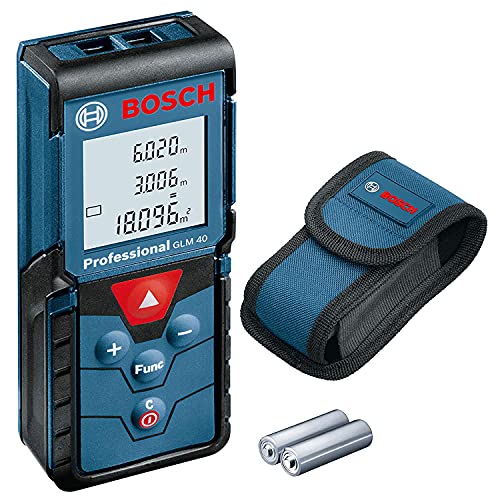
Best Overall: Bosch Professional GLM 40
The GLM 40 measures up to 40 metres with typical accuracy of around 1.5mm, which is tight enough for anything short of precision joinery. It has a memory function to store recent readings and can add or subtract measurements, which is handy for working out a room total across multiple walls without doing the maths in your head.
It runs on two AAA batteries rather than a proprietary rechargeable pack, which some people prefer because you can always find a spare set on site. It’s the single best-selling laser measure in this category for a reason – it just works, consistently, and the price reflects genuinely huge production volume rather than corner-cutting.
Best Premium Option: Leica DISTO D1
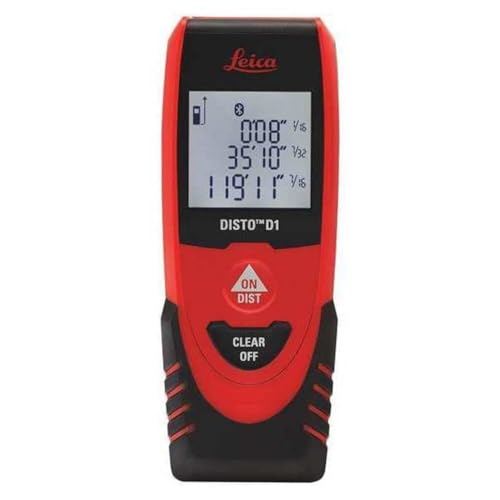
Leica built the original laser distance meter and the DISTO range is still treated as the reference point the rest of the market measures itself against. The D1 pairs over Bluetooth with Leica’s app, letting you build a sketch or floor plan directly from readings taken on site – genuinely useful for surveying and quoting work where you want a record beyond a number scribbled on a pad.
It costs more than the Bosch for a similar 40m range, and the premium is really about the app integration and the brand’s reputation for accuracy over years of hard use rather than a dramatically different core spec. If you quote jobs regularly and want a digital record, that premium is easy to justify.

Best for DeWalt Users: DEWALT DWHT77100-XJ
A straightforward 30m laser measure with claimed accuracy of ±3mm, which is perfectly adequate for general trade measuring – room sizes, material cutting lists, first-fix layout. It’s compact enough to live in a pocket rather than a case, which matters more day to day than an extra ten metres of range most trades rarely use.
There’s nothing flashy here – no app, no Bluetooth – just a tool that does the core job reliably at a fair price, which is exactly what most site measuring actually needs.

Best for Makita Users: Makita LD050P
Makita’s 50m-range option undercuts the Bosch on maximum distance on paper, useful if you’re regularly measuring long runs – driveways, large sheds, boundary fencing. It has the same core memory and add/subtract functions you’d expect at this price point, and the reviews reflect a tool that holds up to genuine daily site use.
If you’re already carrying Makita cordless kit and like keeping accessories within one ecosystem for familiarity’s sake, this is a sensible, capable choice without any real weaknesses.

Best Budget Pick: Stanley TLM40
A 12m-range pocket laser measure that costs roughly half the Bosch, the TLM40 is aimed squarely at basic room and material measurement rather than anything requiring long range or memory functions. For a lot of trades – especially anyone who mostly measures inside domestic properties – 12m covers the vast majority of what actually comes up.
It’s not the tool for surveying a warehouse or measuring a long driveway, but as a cheap, reliable backup to keep in the van or a second one for an apprentice, it does exactly what it needs to.

At a Glance – Laser Distance Measures Compared
Model | Range | Accuracy | Best for | Approx. price |
Bosch Professional GLM 40 | 40m | ~1.5mm | All-round best value | £73 |
Leica DISTO D1 | 40m | ~1mm, Bluetooth app | Quoting, digital floor plans | £90 |
DEWALT DWHT77100-XJ | 30m | ±3mm | General trade measuring | £52 |
Makita LD050P | 50m | ~2mm | Long-range measuring | £86 |
Stanley TLM40 | 12m | ~3mm | Budget, domestic work | £33 |
Buyer’s Guide – What Actually Matters
Range: Buy What You’ll Actually Use
Most domestic and light commercial trade work never needs more than 30-40 metres. Paying extra for a 100m-plus range only makes sense if you’re regularly surveying large open spaces, warehouses, or outdoor boundaries. Buying more range than you need is money spent on a spec sheet number, not a real benefit.
Memory and Add/Subtract Functions
Being able to store a reading and add or subtract the next one lets you work out a total room perimeter or a run of skirting without doing mental arithmetic under pressure. It’s a small feature that saves real mistakes on site, and every model above has it in some form.
Bluetooth and App Integration – Worth It or Not?
If you quote jobs from measurements taken on site, or you want a digital sketch to hand to a client or another trade, the Leica’s app integration genuinely pays for itself in saved admin time. If you’re just measuring a room to order flooring or plasterboard, it’s a feature you’ll rarely open.
IP Rating Matters More Than You’d Think
A laser measure that lives in a van and gets used in a half-finished, dusty or damp building benefits from at least basic dust and splash resistance. Check the spec before assuming – some budget models have none at all, and a laser measure with a cracked lens or a dead sensor from site grime is a false economy.
Keep It Calibrated and Look After the Lens
Laser measures can drift out of true accuracy after a hard knock or a fall, and most models have a simple self-check or calibration routine buried in the manual worth running every few months if the tool takes regular abuse in a tool bag. A scratched or dirty lens is the more common everyday problem – a soft cloth wipe before an important measurement takes seconds and avoids a misread that throws off an entire cutting list.
FAQs
How accurate are these compared to a tape measure?
For anything over about 3 metres, a decent laser measure is typically more accurate than a tape pulled by one person, because there’s no sag, no misread markings and no rounding to the nearest visible line. Under a metre, a tape is often still quicker and just as precise.
Do laser distance measures work outdoors in daylight?
Direct bright sunlight reduces the effective range because the laser dot becomes harder for the sensor to pick out against a reflective surface. All the models here still work outdoors, just with a shorter practical range than their quoted maximum on a bright day.
Can I measure area and volume, not just distance?
Yes – all five models here calculate area and volume automatically from two or three measurements, which is genuinely useful for ordering flooring, plaster or paint without doing the sums yourself.
What batteries do these use?
Most, including the Bosch, DeWalt and Stanley here, run on standard AAA batteries you can buy anywhere. The Leica DISTO D1 uses a rechargeable battery via USB, which is worth bearing in mind if you want to avoid carrying spares.
Is a laser measure worth it if I already have a tape measure?
For solo work, long distances, or awkward spaces like stairwells and high ceilings, yes – it pays for itself in time saved within the first few jobs. It’s a genuine addition to a tape rather than a replacement for short, precise cuts.
The Verdict
Buy the Bosch Professional GLM 40 if you want the safest, best-value all-rounder. Step up to the Leica DISTO D1 if you quote regularly and want app integration. Stick with the DEWALT or Makita if you’re already on that battery platform, and grab the Stanley TLM40 as a cheap, capable backup for domestic-scale work.
Prices correct at time of writing and vary between Amazon UK, Screwfix and Toolstation.