
Every sparks and plumber has done it with an angle grinder at some point. Two passes freehand, a bolster down the middle, and a room that looks like a cement works for the rest of the week. It works. It is also slow, the chase is never the same depth twice, and you are breathing the one thing on site that will genuinely shorten your life.
A wall chaser is a single-purpose machine that fixes all three problems: twin diamond blades on a fixed spacing, a plunge action with a depth stop, and an extraction port that is designed to pull the debris out at source rather than as an afterthought. This is a roundup of what is worth buying if you chase walls regularly, what you can get away with if you only do it a few times a year, and the depth and zone rules that decide whether the chase you just cut is compliant.
Quick Verdict
For most trades doing first fix in masonry, the Makita SG1251J is the machine to buy. Twin 125mm blades, a 1,400W motor, and depth and width both adjustable up to 30mm – which covers standard 25mm conduit and flat twin and earth with room to spare. Expect to pay somewhere in the £430 to £530 inc VAT band depending on retailer and whether you want 110V or 240V. It is the one you see on site most often, and the spares and blade availability reflect that.
If you need to go deeper or wider than 30mm – larger conduit, bunched cables, pipework – the Bosch GNF 35 CA is the better buy. The 150mm blades give a deeper cut and a wider maximum chase, and it sits at a similar or slightly lower price.
If you want a professional machine and the Makita money is not there, the Metabo MFE 40 does the same job for meaningfully less, typically around the £350 to £400 inc VAT mark.
If you chase a wall twice a year, do not buy any of them. A Screwfix own-brand chaser at around £100 to £150, run properly into a decent vacuum, will do the job. Buy the machine that matches how often you use it, and spend the difference on the extraction.
What a Wall Chaser Does That an Angle Grinder Does Not
Three things, and only one of them is speed.
Consistent depth. A chaser has a plunge base with a calibrated depth stop. You set 25mm, and every chase in the room is 25mm. Freehand with a grinder you are eyeballing it, and the cut wanders as your arm tires. That matters more than it sounds, because inconsistent depth is how you end up either too shallow to get the conduit in or deep enough to be into the wall’s structural third.
Parallel cuts in one pass. Twin blades on adjustable spacers cut both sides of the chase simultaneously, so the walls of the chase are parallel and the slug between them breaks out cleanly with a bolster. With a grinder you are making two independent cuts and hoping they stay parallel.
Extraction that actually works. This is the real argument. A grinder’s guard is designed to deflect sparks, not capture dust. A chaser’s hood shrouds the full cutting arc and ports it straight into a hose. The difference in airborne dust between the two is not marginal.
The Dust Is the Whole Problem
Chasing brick, block and sand-cement render releases respirable crystalline silica. The HSE workplace exposure limit for RCS is 0.1 mg/m³ averaged over eight hours, and dry-cutting masonry without extraction will blow past that in minutes, not hours. Silicosis and the associated lung disease are irreversible. This is not a box-ticking section.
Under COSHH the expectation is on-tool extraction as the primary control, with RPE on top – not instead. In practice that means:
An M-class vacuum, not a workshop vac. M-class filtration is the minimum for silica. An L-class or a household vac will pass the fine fraction straight back into the room, which is the fraction that does the damage. If you already own a dust extractor for a mitre saw, check the class marking before you assume it is fit for this.
Use the bag. Emptying a bagless vac full of silica fines undoes everything you just did. Fleece bags cost pennies by comparison.
Keep the hood flat on the wall. This is the single most common reason people conclude their chaser “doesn’t extract well”. The hood only seals when the whole base plate is flat against the surface. Tip it to start a plunge or ride it over a lump of old render and the seal breaks and the room fills. Plunge in with the base flat, and work top-down so blade rotation throws debris toward the port.
Watch for blockages. A flake of loose plaster or paint jams the extraction throat easily, and the first sign is usually the room going hazy. If dust suddenly appears, stop and clear the port rather than pushing on.
FFP3 on top. On-tool extraction reduces exposure, it does not eliminate it. An FFP3 mask, face-fit tested, is still the expectation.
How Deep and Where You Are Allowed to Chase
Two separate rule sets, and both catch people out.
Structural depth. UK masonry guidance limits vertical chases to no more than one third of the wall thickness, and horizontal chases to no more than one sixth. On a standard 100mm blockwork leaf that is roughly 33mm vertical and 16mm horizontal. Chases should not be cut back to back on opposite faces of the same leaf, and you should not chase a hollow block wall to a depth that breaks into the void. If in any doubt on a structural wall, ask – a chase is permanent, and remedial work on a cracked leaf is expensive.
Cable zones. BS 7671 permitted zones govern where buried cables may run: within 150mm of the top of a wall or of a corner, or in a vertical or horizontal zone running from an accessory. Cable outside a permitted zone and less than 50mm deep needs earthed mechanical protection or RCD protection to comply. The practical version is that you chase straight up or straight across from the accessory, not diagonally across the middle of a wall, because the next person through with a picture hook is relying on that convention.
Scan before you cut. Diamond blades go through cables and copper pipe without any warning at all. A cable detector takes thirty seconds and is cheaper than a callout.
At a Glance – Wall Chasers Compared
UK prices checked at the time of writing, inc VAT, and vary noticeably by retailer and voltage. Check before you buy.
| Model | Blades | Max chase | Power | Typical price | Best for |
| Makita SG1251J | 2 x 125mm | 30mm deep x 30mm wide | 1,400W | £430-£530 | Best overall – first fix electrics |
| Bosch GNF 35 CA | 2 x 150mm | 35mm deep x 39mm wide | 1,400W | £400-£480 | Deeper and wider chases, conduit |
| Metabo MFE 40 | 2 x 125mm | Around 30mm | 1,900W | £350-£400 | Best value professional machine |
| Screwfix own-brand | 2 x 125mm | Varies by model – check spec | 1,400-1,700W | £100-£150 | Occasional use, second machine |
The Best Wall Chasers for UK Trade
Makita SG1251J – Best Overall
The default trade choice, and for good reason. A 1,400W motor at 10,000rpm with soft start and constant-speed electronics, twin 125mm diamond blades, and both depth and width adjustable up to 30mm using the supplied spacers. It comes in a Makpac case, which stacks with everything else in the van if you are already in that system.
Thirty millimetres of depth sounds modest next to the Bosch, but for the work most people actually do – flat twin and earth, back boxes, 20mm and 25mm conduit in blockwork – it is enough, and it keeps you inside the one-third rule on a 100mm leaf without thinking about it. The extraction hood is well sealed and the machine tracks straight without fighting you.
The catch is price. It is the most expensive of the mainstream options and the gap is real, particularly if you want the 110V version for site. It is also worth knowing that the blades are a consumable you will replace – budget for a pair.

- SG1251J Wall Chaser 125mm 1400W 110V
Bosch GNF 35 CA – Best for Deep and Wide Chases
Where the Makita stops at 30mm, the GNF 35 CA runs to around 35mm deep and 39mm wide on 150mm blades. If you are burying 25mm conduit with a bit of cover over it, running bunched circuits, or chasing for small-bore pipe, that extra capacity is the difference between one pass and a lot of bolster work.
It is a 1,400W machine at around 9,300rpm, and the larger blades mean it feels a little more planted in the cut. The trade-off is weight and bulk, and the larger blades cost more to replace than 125mm. It also asks more of your extraction – a bigger chase produces more spoil, and a vac that coped with the Makita may struggle here.
Worth noting the wider maximum chase is a capability, not an instruction. A 39mm-wide chase in a 100mm block wall is still bound by the same structural limits as a narrow one.
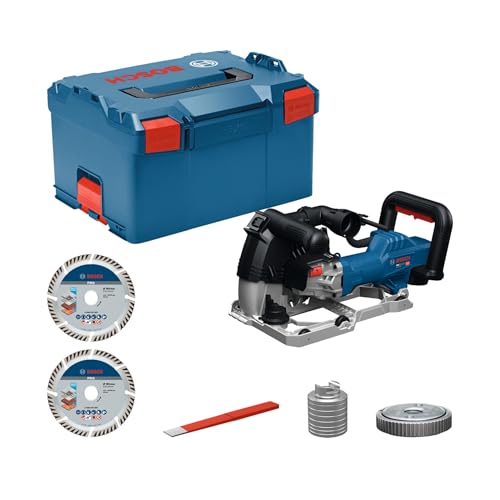
- HEAVY-DUTY POWER IN YOUR HANDS: Thanks to the 2000 W brushless motor
- BUILT TO LAST: The PRO GNF20-40 delivers high durability in demanding working conditions
- Smooth cuts up to 40 mm deep through masonry, sandstone and concrete with two diamond cutting discs
- Work comfortably in any position or direction with the ergonomic handle arrangement
- ITEMS INCLUDED: GNF20-40, 2x Diamond cutting blade 150mm, L-BOXX 238
Metabo MFE 40 – Best Value Professional Machine
Typically £350 to £400 inc VAT, which undercuts the Makita, often by a hundred pounds or more for a machine that is doing the same job in the same size class. Metabo’s 1,900W motor is the headline – it has more grunt than either of the above on paper, which shows up in hard engineering brick where the others slow down.
It is the pragmatic buy: professional build, professional warranty once registered, without the brand premium. The reason it is not the top pick is simply availability and familiarity. If your local factor stocks Makita and Bosch blades off the shelf and Metabo is a next-day order, that matters more on a Friday afternoon than the saving did on the day you bought it.
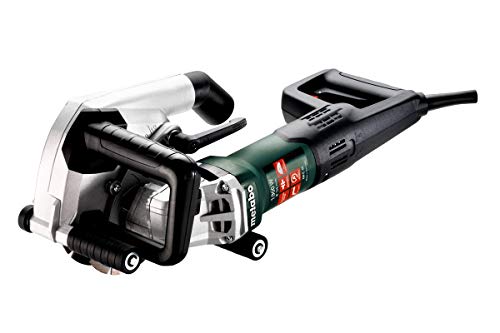
- Ideal for electric installations to lay cables and pipework under plaster with cutting depths up to 40 mm
- Robust aluminium die-cast hood with rubber rollers and optimal handle position for comfortable guidance of the machine
- Push cut for optimal view of the marking line
- Channel width and cutting depth can be set
- Metabo Marathon motor with patented dust protection for long service life

Screwfix Own-Brand – Best Budget and Best Second Machine
Around £100 to £150 and, by consistent trade report, perfectly usable. Paired with a decent vacuum and a bag, dust control is genuinely good – the recurring caveat from people using them is the one that applies to every chaser: the hood only works when the machine is flat on the wall, and it is less forgiving about that than the premium machines.
What you give up is refinement and longevity. The depth adjustment is cruder, the motor will not enjoy a full day in engineering brick, and the blades supplied are not the ones you want to keep using. But if you chase walls occasionally, or you want a knockabout second machine that lives in the van for the one job a month, it is an easy call. Spending £400 on a tool you use four times a year is how tool sheds fill up.
Hiring Instead of Buying
Worth saying plainly: for a single kitchen or a one-off rewire, hire. A day’s hire on a professional chaser plus an M-class vac is a fraction of the purchase price, and you get a machine with fresh blades. On a professional machine the maths only flips to buying at roughly six to eight days of use a year, and that is before you account for storage, servicing and the blades you will be replacing yourself.
What Else to Budget For
The machine is not the whole cost.
Diamond blades. They are consumables. Segmented blades for masonry, and a pair at a time – running mismatched blades on a twin-blade machine gives you an uneven chase. Blades rated for abrasive materials cost more and last considerably longer in sand-cement render.
The vacuum. If you do not already own M-class extraction, that is £200 to £500 on top and it is not optional. It is also the part of the setup that will still be useful when the chaser is worn out.
Bags and filters. Consumables again, and the bit people skip. A clogged filter kills suction, and poor suction is what makes the room fill.
RPE. FFP3, face-fit tested. Beards and face-fit do not mix, which is worth knowing before you buy rather than after.
FAQs
Can I use an angle grinder instead of a wall chaser?
You can, and plenty do. You will get an inconsistent chase, far more airborne silica, and a slower job. For occasional use with proper extraction and RPE it is defensible. For regular first fix it is not, and the HSE’s position on dry-cutting masonry without on-tool extraction is unambiguous.
How deep can I chase a wall?
As a working rule, no more than one third of the wall thickness vertically and one sixth horizontally, and never back to back on opposite faces of the same leaf. On a 100mm block leaf that is about 33mm vertical and 16mm horizontal. Check the specifics on structural walls rather than assuming.
Do I need an M-class vacuum, or will a workshop vac do?
M-class, for silica. A standard workshop vac will capture the visible debris and pass the respirable fraction straight through the filter into the room – which is the fraction that causes harm. Check the class marking on the machine, and use a fleece bag.
Why is my wall chaser still producing loads of dust?
Almost always one of two things: the base is not flat against the wall so the hood cannot seal, or the extraction port is blocked with a flake of plaster. Plunge in with the base flat, work top-down, and stop and clear the port the moment the air goes hazy.
110V or 240V?
If you work commercial or new-build sites, 110V, because a 240V machine will not be allowed on. If you are domestic-only, 240V saves you carrying a transformer. If you do both and can only buy one, 110V plus a transformer covers every job.
The Bottom Line
Buy for the depth you actually need and the frequency you actually work at. For most first-fix electrical work in masonry the Makita SG1251J is the safe answer and 30mm is plenty. If you need more capacity, the Bosch GNF 35 CA gives it for similar money. If the budget is tight but the use is regular, the Metabo MFE 40 is the sensible professional buy, and for a few jobs a year a Screwfix own-brand chaser run into a good vac will not let you down.
Whichever you land on, the extraction matters more than the machine. A £500 chaser plugged into a household vac is worse for you than a £120 chaser plugged into an M-class with a bag in it. Get that part right first.