A battery chainsaw used to be the thing you kept in the van for cutting the odd fence post while the proper saw sat at home. That is no longer true. On 36V and 54V platforms the current crop will cut fence posts, sleepers, roof timbers and storm-damaged limbs all day, and the reason most trades end up buying one has nothing to do with power – it is that you can pull it out of the van, cut for eleven seconds, and put it back without mixing fuel, priming a bulb or pulling a cord twelve times in the rain.
That is the honest case for cordless. Battery still does not beat petrol on raw cutting speed at the top end. But a battery saw gets used, and a petrol saw in the back of a van gets left there until the fuel goes stale and it will not start. Prices below are indicative UK trade prices excluding VAT, body-only unless stated.
Quick Verdict
For most trades the Makita DUC353Z is the saw to own. A 35cm bar running off two 18V LXT packs gets you genuine 36V performance without a new battery platform, it is available everywhere from Toolstation to Amazon UK, and at roughly £230 ex VAT body-only it is the cheapest route into a saw that is actually fit for site work.
If you are already on DeWalt and you cut bigger timber, the DCM575N FlexVolt is the stronger tool. The 40cm bar and 54V motor pull through sleepers and green hardwood in a way the 35cm saws will not, and it runs on the same batteries as your breaker and circular saw.
If you are on Milwaukee, the M18 FCHS is the obvious pick and there is no sensible argument for adding a second platform just for a chainsaw.
If you cut timber every single day – fencing gangs, tree work, arb-adjacent contractors – buy the Stihl MSA 220 C-B and stop trying to make a construction-platform saw do a forestry job. It costs roughly double and it earns it in chain brake quality, bar wear and dealer backup.
Battery or Petrol? Be Honest About the Work
The split is cleaner than most people admit. Battery wins on everything short and frequent: fence posts, decking, sleepers, roots, pallets, small limbs, cutting-in around groundwork. Petrol still wins on everything long and continuous: felling, milling, big section hardwood, a full day of clearance work where you are cutting more than you are walking.
The number that decides it is not voltage, it is how many minutes a day the chain is actually moving. Under about twenty minutes of real cutting, a pair of 5.0Ah packs will see you through and cordless is comfortably the better buy. Over an hour of continuous cutting and you are either carrying six batteries or you are buying petrol. Add to that the noise and emissions rules on urban sites – a battery saw is sometimes the only saw you are allowed to run.
What the Numbers Actually Mean
Bar length is the headline figure and the most misleading. A 30cm bar handles timber up to roughly 25cm across in a single pass, a 35cm bar around 30cm, and a 40cm bar around 35cm. You should never be cutting to the full bar length routinely – if you are, the saw is too small and you are stressing the motor, the chain and yourself.
Chain speed matters more than voltage for how a saw feels. Anything around 20m/sec cuts cleanly. Below about 12m/sec it still gets through timber but it feels like chewing rather than cutting, which is the giveaway at the cheap DIY end of the market.
Runtime claims are close to meaningless – manufacturers quote them against softwood in ideal conditions. A realistic working figure on a 36V saw with two 5.0Ah packs is 40 to 60 cuts through 100mm softwood, or 25 to 35 minutes of intermittent trade use. Weight is where cordless quietly loses: 5.5kg plus two packs is heavier than a comparable 40cc petrol saw, and it all sits behind your hands.
At a Glance – Cordless Chainsaws Compared
Indicative UK trade prices excluding VAT, body-only unless stated. Battery platforms noted because the platform, not the saw, is usually the real decision.
| Model | Platform | Bar | Weight (bare) | Approx. price ex VAT |
| Makita DUC353Z | 2 x 18V LXT | 35cm | c.5.5kg | £230-£250 |
| DeWalt DCM575N | 54V FlexVolt | 40cm | c.4.7kg | £230-£280 |
| Milwaukee M18 FCHS-0 | 18V M18 Fuel | 40cm | c.4.6kg | £250-£300 |
| Stihl MSA 220 C-B | 36V AP | 30/35cm | c.3.9kg | £470-£520 |
| Makita UC013G | 40V XGT | 40cm | c.5.6kg | £380-£430 |
| EGO CS1610E | 56V EGO | 40cm | c.4.8kg | £180-£220 |
The Best Cordless Chainsaws for UK Trade
Makita DUC353Z – Best Overall
The DUC353Z is the sensible default and has been for a while. It runs two 18V LXT packs in series for 36V, which means anyone already carrying Makita batteries gets a capable saw for the price of the bare tool and nothing else. At around £280 including VAT at Toolstation body-only, it is the cheapest credible entry into a trade-grade battery saw in the UK.
It earns its place on detail: toolless chain tensioning that works with gloves on, a metal spike bumper that lets you pivot into a cut rather than push, adjustable auto chain oiling, and an electric brake. The 3/8 inch chain at 0.043 gauge is a thin-kerf setup, which is part of why it cuts well on 36V.
Where it falls short: 5.5kg bare, and well over 6.5kg with two 5.0Ah packs. It is a ground-level saw. It also eats two batteries, so if you only own two you have no spares fitted anywhere else on site.
Buy it if: you are on Makita LXT, you cut timber weekly rather than daily, and you want the lowest cost per capable saw on the market.
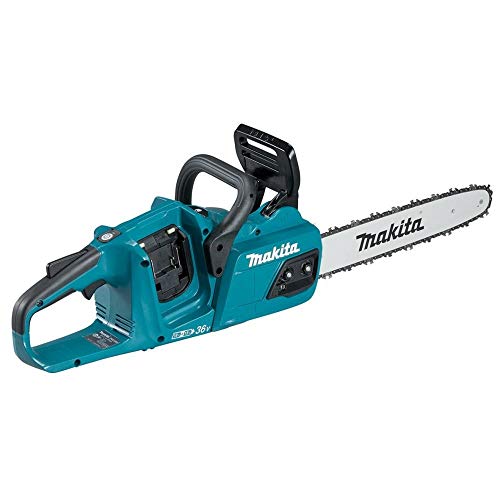
- Makita DUC355Z Twin 18v 36v Cordless Chainsaw 35cm Bar Body Only
- product type: CHAINSAW
- Brand: Makita
DeWalt DCM575N FlexVolt – Best for Bigger Timber
The DCM575N is the saw to reach for when 35cm stops being enough. A 40cm bar on a 54V FlexVolt motor is a meaningful step up, and it shows most on green hardwood, sleepers and anything over about 250mm where the 36V saws start to labour and heat the chain.
It is lighter bare than the Makita at around 4.7kg, though a 9.0Ah FlexVolt pack claws a chunk of that back. Auto chain oiling with a sight glass, a proper inertia-activated brake, and Oregon bar and chain so replacements are on every counter in the country.
Where it falls short: the FlexVolt battery is the whole proposition. If you do not already own 54V packs, a pack and charger will add well over £200 to the headline bare-unit price of around £260.
Buy it if: you are on DeWalt XR or FlexVolt, and your timber work is fencing, sleepers or structural rather than tidying.

- Innovative, brushless motor technology - higher efficiency, compact dimensions and longer service life
- Efficient and wireless like comparable petrol devices - at low noise and no exhaust exhaust
- Maximum safety: chain brake - stops the chain not only after the hand protection is triggered, but also when the gas switch is no longer pressed
- Automatic chain lubrication reduces maintenance work. Napinanie łańcucha bez użycia narzędzi – łatwa wymiana łańcucha/miecza i szybkie napinanie bez długich przerw
- Zakres dostawy: 1 x akumulatorowa piła łańcuchowa, długość ostrza 40 cm, łańcuch do piły 40 cm, 1 x osłona łańcucha, bez akumulatora i ładowarki
Milwaukee M18 FCHS – Best if You Are Already on M18
Milwaukee’s M18 Fuel chainsaw is quick, and the reason is torque – it holds chain speed under load better than most 18V saws have any right to. On repeated cuts through 150mm to 200mm timber it will keep pace with the 36V competition, which is impressive for a single-battery tool.
The trade-off is battery appetite. You want a High Output 12.0Ah pack on it; anything smaller than 8.0Ah leaves you swapping constantly and running the pack hot. Bare-unit pricing around £255 is competitive, but the pack that makes it work properly is not cheap.
Where it falls short: it is a single-battery saw doing a two-battery job and it shows on runtime, and 40cm is a big bar for an 18V platform. Buy it if you are on M18 and adding a platform makes no sense – but do not switch to Milwaukee for this saw alone.

- Kit includes: 2x M18 FB12 12.0Ah FORGE battery packs 1x M12-18 FC fast charger 76cc oil, chain tool, bar cover No kitbox or bag supplied
Stihl MSA 220 C-B – Best Pro-Grade
Everyone else on this list builds construction tools and makes a chainsaw. Stihl builds chainsaws. The MSA 220 C-B on the AP system is a different class of tool: lighter in the hands at around 3.9kg bare, better balanced, and fitted with a quick chain tensioner and a chain brake that behaves like a forestry saw’s because it is one.
The 1/4 inch Picco chain is the quiet advantage – thinner kerf, faster chain speed, less power needed per cut, which is why a 36V Stihl embarrasses saws with more voltage on paper. Add dealer support and resale value and the price starts making sense.
Where it falls short: cost, and the AP battery platform, which does nothing else in your van. A pack and charger will add roughly £250 to £350 on top of the bare tool.
Buy it if: you cut timber daily, you hold a CS30 or equivalent, or you want a saw that will still be good in eight years.

Makita UC013G XGT – Best 40V Alternative
If you have already gone XGT for the breaker or the cut-off saw, the UC013G is a single-battery 40cm saw with serious output – closer to a 45cc petrol saw than anything else here, and it runs one 40V pack rather than a pair of 18V packs.
Where it falls short: XGT is an expensive platform to enter for one tool, and at around £400 ex VAT body-only this is not a casual purchase. If you are on LXT and not XGT, the DUC353Z gets you most of the saw for a lot less. Buy it if you are already committed to XGT.
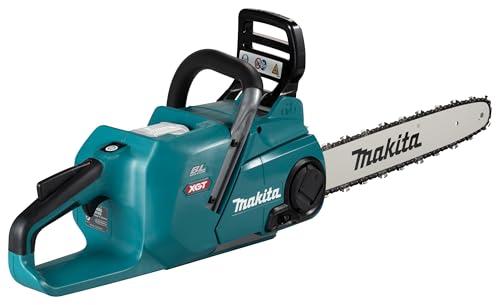
- Designed for high operating efficiency similar to that of an engine chainsaw and optimal performance in continuous, heavy duty applications
- Ideal for the smooth felling of trees with a trunk capacity of approximately 300mm diameter
- Chain type 80TXL, pitch 0.325”, gauge 0.043”
- 400mm sprocket nose bar
- Main power switch with auto power-off function
EGO CS1610E – Best Value Outside a Trade Platform
EGO are a garden-machinery brand, not a site brand, and that shows in the plastics. It does not show in the cutting. The 56V system is genuinely powerful, the CS1610E takes a 40cm bar, and kit prices with battery and charger regularly undercut the bare-tool price of the trade saws.
Where it falls short: the battery does nothing else you own, warranty runs through garden dealers rather than tool counters, and the build will not take being thrown in a van every day for five years. Buy it if the saw lives in a workshop or on a trailer and you have no interest in battery commonality.
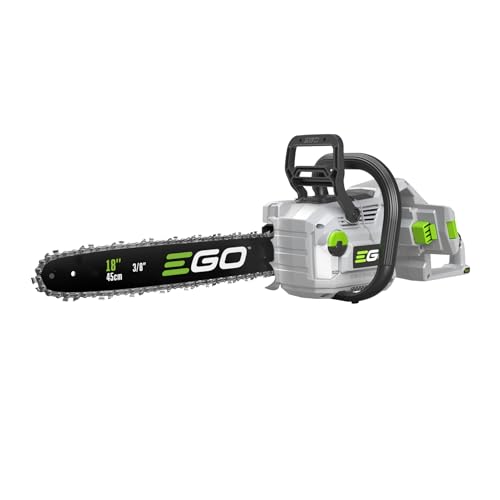
- 50cc gas equivalent, 2500W high efficiency brushless motor delivers chain speeds of up to 22m/s
- Up to 330 cuts on a 4x4 vehicle with a recommended 56V 6.0Ah ARC lithium battery (sold separately); compatible with all EGO 56V ARC lithium batteries (sold separately)
- Digital display with cutting speed controls, battery charge status, LED work light and safety brake indicator
- 18 inch bar and chain; 3/8 inch low profile, 1/2 inch gauge chain with 62 drive links
- Adjustable LED work light illuminates your cut when working at dusk or in emergencies without access to lights
PPE, Training and the Bit That Gets People Hurt
A cordless chainsaw is a chainsaw. The chain does not know it is running off a battery, and the quiet is actively dangerous because it removes the noise that normally makes people stand back.
Minimum kit: Class 1 chainsaw trousers to EN 381-5 or the newer EN ISO 11393, chainsaw boots with cut protection, gloves with saw protection on the back of the left hand, and a forestry helmet with mesh visor and ear defenders. Expect £250 to £400 for a full set worth wearing.
On training the position is simple. There is no licence, but under the Provision and Use of Work Equipment Regulations 1998 an employer must ensure anyone using a chainsaw at work is competent, and HSE guidance is explicit that this means recognised training. On a commercial site you will be asked for a City and Guilds NPTC or Lantra unit – typically CS30 or CS31 – and sent home without one. Insurance follows the same line.
One thing specific to battery saws: they start instantly and silently. Take the battery out before you touch the chain, every time. There is no idling engine to warn you.
Chains, Bars and Running Costs
The saw is the cheap part. Budget a spare chain from day one and a second within the first year – £15 to £30 each for genuine Oregon or Stihl at these bar lengths. Learn to sharpen with a file and a guide, because a blunt chain forces you to push, and pushing is how kickback happens.
Bar and chain oil is not optional and not interchangeable with engine oil. A five-litre drum is £15 to £25 and lasts most trades a season. Battery saws throttle their oil pump to preserve runtime, so check the level more often than you think you need to. All in, expect £50 to £90 a year in consumables on a saw in regular use.
FAQs
Is a cordless chainsaw powerful enough for fence posts?
Comfortably. A 35cm 36V saw goes through a 100mm treated post like it is not there, and through 150mm sleepers without complaint. Posts are exactly the job cordless does best – short cuts, lots of moving between them.
How long does a battery chainsaw last on one charge?
On a 36V saw with two 5.0Ah packs, realistically 25 to 35 minutes of intermittent trade cutting, or roughly 40 to 60 cuts through 100mm softwood. Hardwood roughly halves it. Continuous cutting drains packs far faster than the same total time spread across a day.
Do I need a licence to use a chainsaw in the UK?
Not a licence, but at work you need to be competent, and in practice that means NPTC or Lantra certification. On commercial sites it is checked. On your own land it is not legally required, though your insurer may take a different view.
Can I put a longer bar on a cordless chainsaw?
Only up to the manufacturer’s stated maximum. Fitting a longer bar than the motor is rated for overloads it, kills runtime, and voids the warranty. If you need more bar, you need a bigger saw.
Top handle or rear handle?
Rear handle for everything on the ground. Top-handle saws are designed for one-handed use in a tree by qualified climbers and are legitimately dangerous in untrained hands. If you are not CS38-qualified, buy rear handle.
The Bottom Line
Buy the Makita DUC353Z if you are on LXT and want the best value trade saw in the UK – the right answer for most people reading this. Buy the DeWalt DCM575N if you are on FlexVolt and cut heavier timber. Buy the Milwaukee M18 FCHS if you are on M18, paired with a High Output pack. Buy the Stihl MSA 220 C-B if timber is your trade rather than a task within it.
Whichever you land on, spend the PPE money before the battery money. A second 5.0Ah pack saves you ten minutes. Class 1 trousers save you a leg.
Prices correct at the time of writing and quoted excluding VAT unless stated. Cordless pricing moves quickly and battery-and-charger bundles are common through autumn – check current pricing at Screwfix, Toolstation and Amazon UK before you buy.