Best Extension Lead & Cable Reel UK 2026

Every trade runs on it and nobody thinks about it until it lets you down. A cheap extension reel that trips the moment you plug a 110V breaker in, melts its own drum on a hot day, or has cable so thin your grinder bogs down at the far end of a 50m run – that is a bad day’s work waiting to happen. Get the reel right and you never think about it again; it just delivers clean power wherever you drag it.

This guide cuts through the marketing and covers what actually matters for site and workshop use: 110V versus 240V, cable gauge, why a wound reel is a fire risk, and which specific reels and leads are worth your money in the UK right now. Prices below are typical high-street figures from Screwfix, Toolstation and Amazon UK at the time of writing – always check the current price before you buy.

Quick Verdict

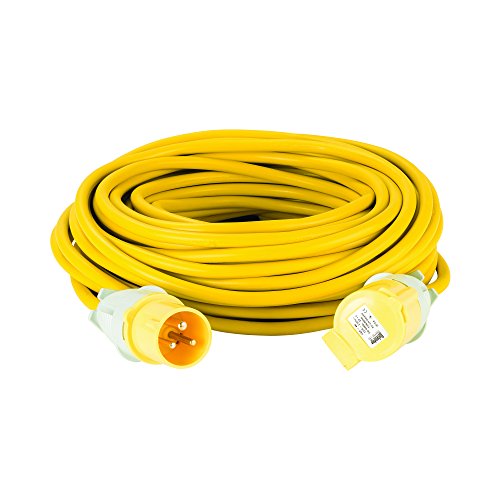
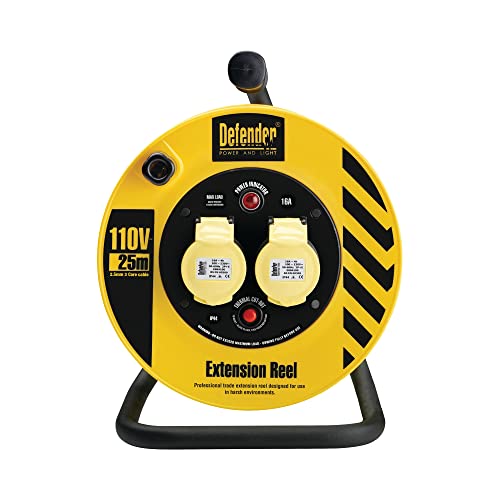
If you work on commercial or CDM sites, you need 110V. Buy the Faithfull 110V 25m site reel or the Defender 2-gang 110V reel – both are built for daily site abuse and take a 16A breaker without complaint. For a straight lead rather than a drum, the Defender Yellow 110V 25m in 2.5mm² is the one to grab.

For domestic, renovation, workshop and garden trades running off a normal socket, get a 240V heavy-duty reel with four sockets and thermal cut-out – the Masterplug and Sealey 50m drums are the workhorses. If you only need a short run, a 25m 4-socket reel for under £35 is all most first-fix and second-fix jobs demand.

110V or 240V – Get This Right First

This is the decision that dictates everything else, and getting it wrong is expensive. On most UK commercial and construction sites, mains-voltage 240V tools are banned. Site rules and CDM practice require 110V centre-tapped supply (55V to earth), which is why site tools, transformers and leads are all yellow. If you plug a blue 240V reel into a site setup you cannot, and you will be sent to the van to fetch the right kit.

110V yellow leads and reels run from a site transformer or a 110V generator. If you are buying your first site reel, pair it with a decent transformer – see our separate guide on that. Blue 240V reels are for domestic work, workshops, garages and gardens where you are plugging into a standard 13A socket. Plenty of tradespeople carry both: a yellow 110V reel for site days and a blue 240V drum for private domestic jobs.

Cable Gauge – Why 2.5mm² Beats 1.5mm²

The number that separates a good reel from a frustrating one is the cross-sectional area of the conductor. Budget leads use 1.5mm² cable; the better ones use 2.5mm². Thicker copper carries more current with less voltage drop, which matters enormously over a long run. Feed a 110V grinder or breaker through 50m of thin cable and the voltage sag at the tool end can leave it gutless and hot. 2.5mm² keeps the volts up and the tool working as it should.

As a rule: anything over about 15m, or anything driving a heavy inductive load like a grinder, transformer or breaker, wants 2.5mm². Save the 1.5mm² leads for lighting and low-draw kit. It is worth the few extra pounds every time.

The Wound-Reel Trap – Read the Two Ratings

Look at any cable reel and you will see two current ratings: one for fully unwound, one for wound. That is not marketing padding – it is a genuine safety limit. A tightly wound drum of cable carrying a heavy load builds up heat with nowhere to go, and coiled cable acts like an inductor. Run a high-wattage tool with the reel still coiled and you can cook the cable inside the drum and melt the reel from the inside out.

A typical 240V reel might be rated 13A (about 3kW) fully unwound but only 6A (around 1.3kW) wound. The rule is simple: always unwind the reel fully before you draw serious current, even if you only need three metres of it. The messy loop of spare cable on the floor is cheap insurance against a burnt-out drum.

Thermal Cut-Out and IP Rating

Every reel worth buying has a thermal cut-out – a resettable breaker that trips if the drum overheats or you overload it. It is your last line of defence against the wound-reel problem above. Test it works when the reel is new; the button should pop and reset cleanly. Avoid any reel that does not clearly state it has one.

For outdoor and site use, check the IP rating on the sockets. A splash-proof rating (IP44 and up) with sprung socket covers keeps water and site muck out of the contacts. Arctic-grade cable is worth looking for too – the sheath stays flexible in the cold instead of going stiff and cracking, which is exactly what a winter site throws at it. If the reel lives in an unheated van year-round, arctic cable earns its keep.

At a Glance – Extension Reels & Leads Compared

The table below covers the pick of the current UK range across both voltages. Prices are typical and move with promotions – confirm before buying.

ModelVoltageLengthSocketsApprox. price
Defender Yellow 110V Extension Lead (2.5mm²)110V25m1£40–£50
Faithfull 110V Site Cable Reel (FPPCR25MSEL)110V25m2£55–£65
Defender E86450 2-Gang Cable Reel110V25m2£65–£75
Masterplug 4-Socket Heavy-Duty Reel240V50m4£60–£75
Sealey 4-Socket Heavy-Duty Reel240V50m4£65–£80
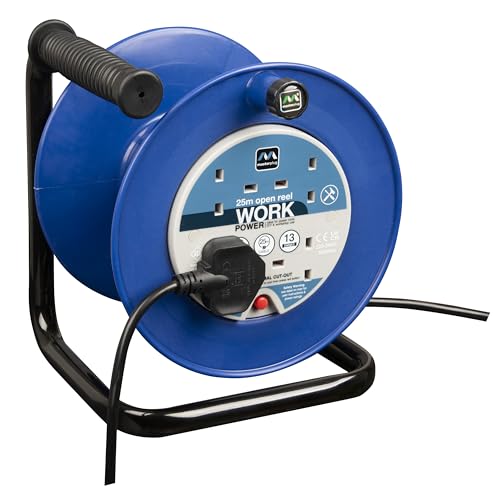
Masterplug/SLx Thermal Cut-out Reel240V25m4£25–£35

The Best Extension Reels and Leads for 2026

Best 110V Site Reel: Faithfull 110V 25m Cable Reel

For daily site use this is the sensible buy. A 16A 110V reel on a tough drum, rated 16A (around 1,760W) fully unwound and 6A wound, with a thermal cut-out and two yellow site sockets. 25m is the sweet spot for most site runs, and Faithfull build to survive being chucked in and out of a van. Pair it with a 3.3kVA or larger transformer and it will run drills, breakers and lights without complaint. Around £55–£65.

Best 110V Lead: Defender Yellow 110V 25m x 2.5mm²

When you want a straight lead rather than a drum – to reach round a corner or up a scaffold without the bulk of a reel – the Defender Yellow 25m in 2.5mm² is the trade default. Available in 16A and 20A versions from Screwfix, tough yellow arctic-grade sheath, and priced sensibly at roughly £40–£50. Buy the 2.5mm² over the cheaper 1.5mm² for anything that draws real current.

Best Heavy-Duty 240V Reel: Masterplug or Sealey 50m 4-Socket

For domestic, renovation and workshop work off a 13A socket, a 50m four-socket heavy-duty drum is the do-everything choice. Both Masterplug and Sealey offer near-identical units: impact-resistant drum, four switched-and-covered sockets, thermal cut-out, typically 13A unwound. 50m covers the length of most houses and gardens. Expect £60–£80. Just remember the wound rating and unwind it fully under load.

Best Budget 240V Reel: 25m 4-Socket Thermal Cut-Out

Not every job needs 50m. For second-fix, kitchen and bathroom work where you are never far from a socket, a 25m four-socket reel from Masterplug or SLx does the job for £25–£35. Make sure it still has the thermal cut-out and, ideally, 2.5mm² cable. A cheap short reel that trips constantly is a false economy, so buy a known brand even at the budget end.

Buyer’s Guide – What to Check Before You Buy

Voltage first: 110V yellow for site, 240V blue for domestic and workshop. Then cable gauge – 2.5mm² for anything over 15m or any heavy tool. Confirm there is a thermal cut-out and note the wound versus unwound rating so you know its real limit. For outdoor use, look for an IP44-or-better splash rating and covered sockets, plus arctic-grade cable if the reel lives in the van through winter.

Finally, match the length to the work. Buying 50m when you only ever need 25m means more weight, more cable to unwind, and more to trip over. Two shorter reels are often more useful on site than one long one, because you can power two ends of a job at once.

FAQs

Can I use a 240V extension reel on a construction site?

Generally no. Most UK commercial and CDM sites require 110V centre-tapped supply for hand tools, which is why site kit is yellow. A blue 240V reel will not fit the 110V setup and will fail a site inspection. Use a 110V yellow reel run from a transformer or 110V generator.

Why does my reel have two different amp ratings?

One is for the reel fully unwound, the other for it wound. Coiled cable under heavy load overheats, so the wound rating is much lower – often half. Always fully unwind the reel before drawing serious current, even for a short run.

Is 1.5mm² or 2.5mm² cable better?

2.5mm² carries more current with less voltage drop, which matters over long runs and with heavy tools. Use 2.5mm² for anything over about 15m or for grinders, breakers and transformers. 1.5mm² is fine for lighting and low-draw kit on short runs.

Do I need a thermal cut-out?

Yes. It is a resettable breaker that trips before an overloaded or overheating reel becomes a fire risk. Every reel worth buying has one – test it works when new and never buy a reel without one.

The Bottom Line

Decide voltage first and the rest follows. Site trades: a Faithfull or Defender 110V 25m reel plus a 2.5mm² yellow lead covers you. Domestic and workshop trades: a Masterplug or Sealey 50m 240V heavy-duty drum, backed up by a cheap 25m reel for short jobs. Buy 2.5mm² cable, insist on a thermal cut-out, and always unwind the reel fully under load. Do that and your extension reel becomes the one bit of kit you never have to think about again.

More Reviews Here..