Our quick verdict
For most UK trades, the Altrad Belle Minimix 150 is still the mixer to buy. It is the default on British sites for good reason: a drum that mixes a full barrow of concrete or mortar for steady brick-and-block work, barrow-height tipping, genuine portability, and a parts-and-spares network that means it can be kept running for years.
If you work on 110V sites, the JCB 134L 110V mixer is the one to get, with a bigger drum and a welded one-piece chassis. If you work where there is no power at all — fresh plots, fields, remote groundwork — the JCB petrol mixer with a Honda GX160 engine will go anywhere. For a bigger drum at a sensible price, the Scheppach MIX160 is strong value, and if you are watching every penny for occasional work, the Charles Bentley 125L is the budget pick. For screed, plaster and other stiff mixes, a heavy-duty paddle mixer like the Belle Promix 1600E does a job a drum mixer cannot.
How to choose a cement mixer
Drum size and batch volume
Mixer capacity is quoted as the total drum volume, but the usable mix is always less — roughly 60 to 75 per cent of the drum — because the load has to tumble. A Minimix-sized drum gives you a practical mix of around a barrow’s worth per batch, which suits one or two people laying brick and block at a steady pace. Step up to a 130–160 litre drum if you have a bigger gang or you are pouring footings and oversite, and drop to a smaller drum only for light DIY or pointing-mortar work. Bigger is not automatically better — a large drum you only half-fill is just heavier to move.
Electric vs petrol
Electric is the default for most trade use: quiet, no fumes so you can run it in a garage or extension, low maintenance and cheaper to buy. The catch is you need power, and you need to decide between 240V for domestic supply and 110V for sites running on a transformer. Petrol buys you total independence for plots and groundwork with no mains, at the cost of noise, fuel, servicing and not being able to run it indoors.
Tip-up design, stand and stability
Almost every trade mixer is a tip-up design — the drum tilts so you can pour straight into a barrow and tip it forward to empty and clean out. What varies is the working height and stability. A good working height saves your back when loading sand and cement, and a wide, stable chassis stops the thing walking across the slab as it runs. Cheaper mixers often sit lower and feel less stable when the drum is full and spinning, which matters more than it sounds when you are loading it all day.
Drum mixer vs paddle or pan mixer
This is the choice that catches people out. A traditional tumbling drum mixer is right for concrete and bricklaying mortar, where the aggregate helps the mix tumble and combine. But it struggles with sand-and-cement screed, plaster, adhesives and other stiff or fine mixes that just slump in the bottom of a drum. For those, you need something that forces the material to combine — a heavy-duty paddle mixer in a tub for smaller batches, or a forced-action pan mixer for large screed pours (usually bought or hired from a specialist supplier).
The best cement mixers at a glance
Mixer | Drum | Power | Best for | Approx. price |
Belle Minimix 150 | Barrow-load drum | 240V electric | All-round trade use | ~£610 |
JCB 134L 110V | 134 L (100 L mix) | 110V electric | Sites on a transformer | ~£545 |
JCB 134L Petrol | 134 L (100 L mix) | Honda GX160 petrol | No-power sites & groundwork | ~£950 |
Scheppach MIX160 | 160 L | 240V electric | Big drum on a budget | ~£350 |
Charles Bentley 125L | 125 L (113 L mix) | 240V electric | Light DIY / occasional use | ~£240 |
Belle Promix 1600E | Paddle mixer | 240V or 110V | Screed, plaster, stiff mixes | ~£500 |
The picks in detail
1. Belle Minimix 150 (240V) — best overall
The Minimix 150 is the mixer you see on more UK sites than any other, and it earns that position. It mixes a full barrow of concrete or mortar per batch, tips at barrow height, and its balanced design keeps it under control when you tip a full drum. The whole machine is light enough for one person to move and load into a van.
The real long-term advantage is parts: drums, gearboxes, belts and motors are all readily available — Amazon alone lists dozens of Minimix spares — so a Minimix can be kept running for years rather than thrown away when something wears. One thing to know: the Amazon price is noticeably higher than trade-counter pricing, so it is worth comparing before you buy. For most trades this is simply the right mixer.

2. JCB 134L Electric Mixer (110V) — best for 110V sites
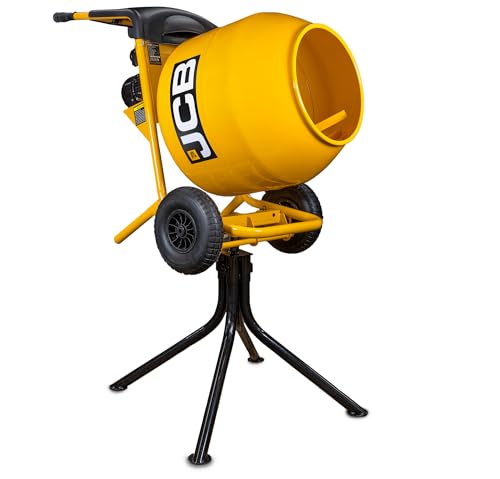
If you are on commercial or new-build sites running off a transformer, you need a 110V mixer, and the JCB is the one to get. It has a 134-litre seam-welded drum with a 100-litre working capacity — more than the Minimix — plus two welded “fast-mix” paddles and a robotically welded one-piece chassis built for all-day site use.
It is a bigger, heavier machine than the Minimix, so it is less of a one-person lift into the van, and as a newer model it has fewer reviews and a less established spares network than the Belle. But for a brick gang on a 110V site who want bigger batches, it is a strong pick.
3. JCB 134L Petrol Mixer (Honda GX160) — best for no-power sites
When you are first on a bare plot, doing groundwork in a field, or working anywhere there is no mains, a petrol mixer is the answer. JCB’s petrol version uses the same 134-litre seam-welded drum and one-piece chassis as the electric model, driven by a Honda GX160 engine — the reliable, easy-starting workhorse that powers half the kit on British sites.
You pay for the freedom with a higher purchase price, ongoing fuel and servicing, more noise, and the fact you cannot run it in an enclosed space. But for anyone whose work regularly starts before the power does, that independence is worth every penny.
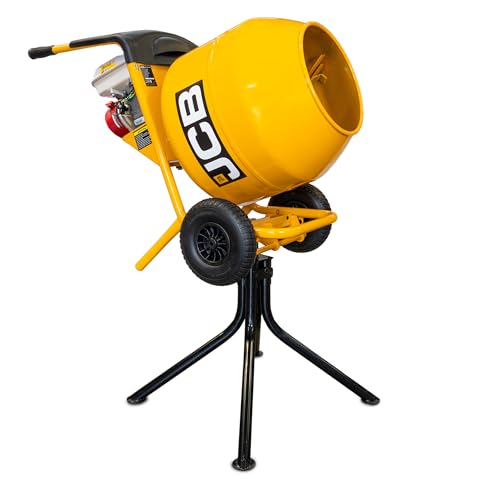

4. Scheppach MIX160 — best big drum on a budget
If you want a bigger drum without paying Belle or JCB money, the Scheppach MIX160 is strong value. It has a 160-litre drum with a welded base for stability, a 650W motor, a large opening for easy pouring, and a cast-iron transmission with a labyrinth housing that keeps splashes away from the motor. Built-in wheels make it easy enough to move around site.
It is 240V only and it will not have the decades-long parts support of a Belle, but it is one of the best-reviewed mixers on Amazon UK and a sensible choice for landscapers and builders pouring bigger batches on domestic jobs.
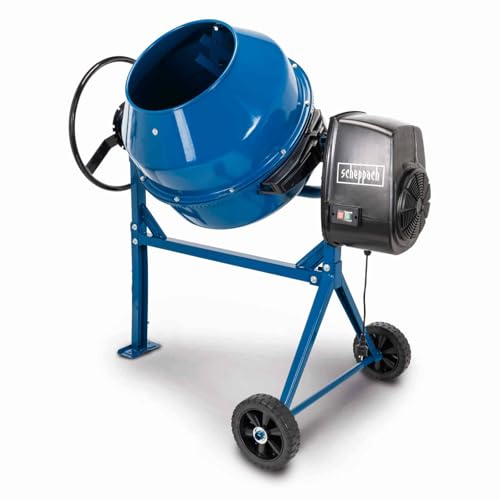
5. Charles Bentley 125L — best budget mixer
If your needs are occasional — a bit of DIY, a small wall, the odd batch of mortar — the Charles Bentley 125L will get the job done for around £240. It has a 125-litre drum with a 113-litre mix capacity, a 550W motor and two wheels for moving it about, and it is well reviewed on Amazon UK with over 100 ratings.
What you do not get is the build quality, stability or parts support of a Belle, so it is not the tool for daily trade abuse. Buy it knowing exactly what it is: a solid machine for light, occasional work, not a site mixer.
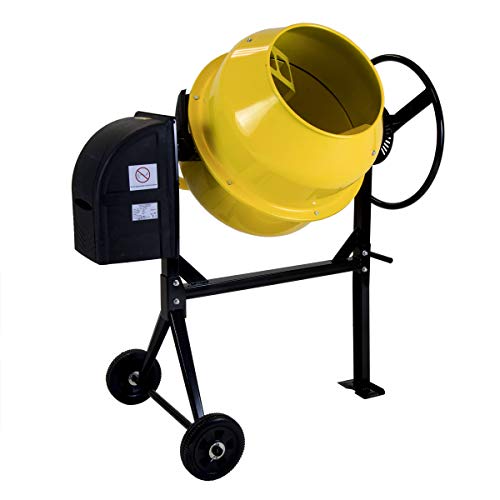
6. Belle Promix 1600E — best for screed and stiff mixes
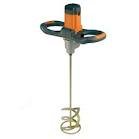
If you mix sand-and-cement screed, plaster, adhesives or any stiff or fine material, a tumbling drum mixer will let you down. For smaller batches, a heavy-duty paddle mixer used in a tub is the practical answer, and the Belle Promix 1600E is the trade standard. It has a 1600W motor with two speed ranges, handles up to around 227 litres of mix, and forces a consistent, even blend that a drum simply cannot achieve with stiff materials.
It is not a forced-action pan mixer — for large floor-screed pours you will still want one of those from a specialist supplier or hire shop — but for screeding a bathroom or extension, plastering or tiling prep, it is the machine the job demands. It comes in 240V and 110V versions; both usually take a week or more to dispatch on Amazon.
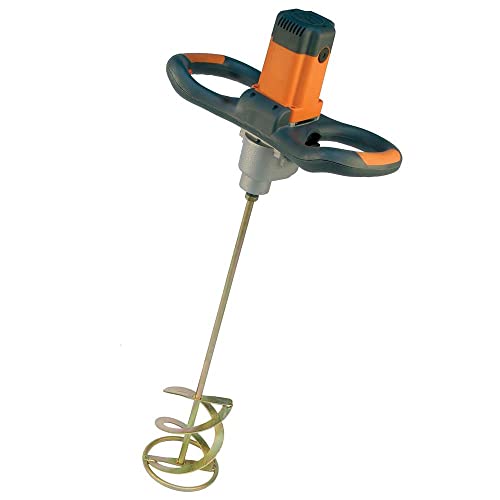
110V version:
Looking after your mixer
A mixer lives or dies on how you clean it. The single biggest killer is leaving mortar or concrete to set inside the drum and around the rim, which builds up, throws the balance off and eventually wrecks the drum. Clean it out at the end of every use — a few shovels of gravel and water spun in the drum knocks most of it loose, then a hose and a scrape finishes the job. Keep the gear ring and pinion clean and lightly greased, check the belt tension on belt-driven machines, and on petrol models keep up with the engine servicing. Treated properly, a good mixer will give you a decade of work; neglected, even the best mixer becomes a seized, unbalanced lump within a season.
Frequently asked questions
What size cement mixer do I need?
For most bricklaying and general building, a Minimix-sized drum is the sweet spot — a barrow-load per batch without being a chore to move. Go bigger, to 130–160 litres, only if you have a larger gang or are pouring footings; go smaller only for light DIY. Remember the usable mix is around 60–75 per cent of the drum, not the full quoted figure.
Electric or petrol — which should I buy?
Buy electric if you usually have power on site: it is quieter, cheaper, lower-maintenance and can run indoors. Buy petrol if you regularly work where there is no mains — bare plots and groundwork — and accept the extra cost, fuel and noise in exchange for going anywhere. If you are on transformer sites, get a 110V electric mixer rather than 240V.
Can I mix floor screed in a normal drum mixer?
Not well. Stiff sand-and-cement screed tends to slump and ball in a tumbling drum rather than combining evenly. For smaller screed jobs, a heavy-duty paddle mixer like the Belle Promix in a tub works well; for large pours you want a forced-action pan mixer. A drum mixer is the right tool for concrete and bricklaying mortar, not for screed.
Are cordless cement mixers any good?
Cordless drum mixers exist but are still rare and expensive in the UK, and battery life limits continuous high-volume mixing. For most trades, mains or petrol still makes more sense. Cheap cordless paddle mixers are widely available, but they are for small tubs of plaster or adhesive, not concrete.