
Ask any UK carpenter what they actually use day in, day out, and the cordless drill is somewhere in the top three. First fix, second fix, kitchen installs, decking, stud work — the drill goes everywhere the lad does, gets dropped, gets battery-swapped on the floor, and gets judged hard.
We’ve worked through the drills UK carpenters reach for in 2026 — from compact second-fix machines that sit on a tool belt all day, to combi drills that’ll run a 65mm forstner through 4×2 without complaining. The picks below are based on what’s stocked at Screwfix, Toolstation, Amazon UK and the trade counters, with battery platforms that have a future and spares you can actually buy.
All prices are approximate and reflect UK retail at the time of writing — usually a fair bit cheaper if you catch a Screwfix promo or buy bare body and pair with a battery you already own.
Our quick verdict
If you want the one-line answer: the Makita DHP486 LXT brushless combi is still the best all-round cordless drill for UK carpenters in 2026 — sensible weight, plenty of platform support, and the LXT battery range you can actually share with the rest of your kit. If your money’s on Milwaukee, the M18 FUEL Gen 4 is a clear step up in raw torque and the more comfortable choice if you’re stud-bashing all day. For tight second-fix work and kitchen fitters, the Festool TXS 18 or the DeWalt DCD800 sub-compact are the ones to look at.
The 6 best cordless drills for UK carpenters in 2026




Makita DHP489Z LXT Brushless Combi — Best all-round carpenter pick
Price: Around £150–£190 bare; £230–£290 with batteries and charger
The DHP489 is the carpenter’s default for good reason. Brushless motor, two-speed gearbox, hammer mode for the occasional masonry job, and the LXT 18V platform — which by 2026 is genuinely massive in the UK trade scene. Battery sharing across a circular saw, jigsaw, multi-tool and impact driver is what makes this drill make financial sense, not the drill itself.
Weight is sensible at around 2.0kg with a 5.0Ah pack. Chuck is a 13mm keyless that grips properly even after a year of being thrown in the back of the van. Torque is plenty for 95% of carpentry work — Forstner bits, holesaws, structural screws, decking screws, you’ll only feel the limits if you’re trying to do constant heavy stud work.
Pros: Brushless, sensible weight, the LXT platform you’ll already be on, well stocked at Screwfix and Toolstation, parts and spares are easy to source.
Cons: Not the most aggressive on heavy holesaw work, the older non-LXT batteries don’t fit, the body has more plastic than the Milwaukee.
- Suitable for a wide range of drilling and fastening applications
- 13mm maximum capacity in steel, 51mm maximum capacity in wood
- 21 torque settings
- Mechanical 2 speeds
- Twin LED job light with pre-glow and afterglow functions
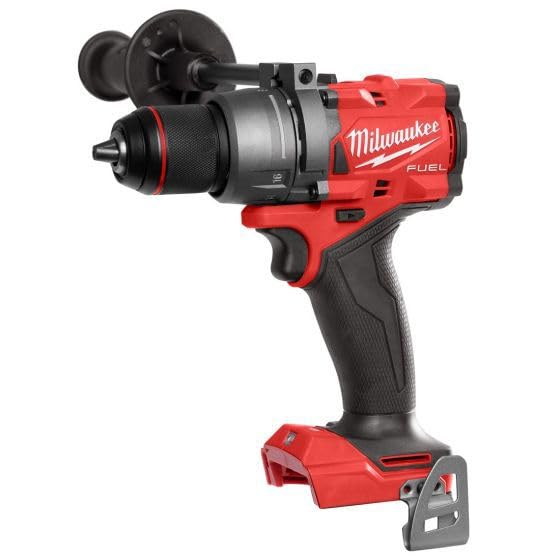
Milwaukee M18 FUEL Gen 4 (M18 FPD3) — Best premium / heavy use
Price: Around £190–£240 bare; £310–£380 with batteries and charger
Milwaukee’s FUEL combi is the drill you buy if you’re routinely punishing the tool — heavy holesaws through joists, big structural screws, kitchen install drilling through hardwood worktops. The Gen 4 brushless motor genuinely shifts and the auto-stop kickback control is a real-world safety feature that’s saved more than one wrist on a holesaw bind-up.
The M18 platform is the other UK trade default, and battery sharing across a track saw, multi-tool and impact wrench is what keeps Milwaukee buyers loyal. If you’re already on Makita LXT, switching is expensive — but new buyers building a kit from scratch in 2026 should weight Milwaukee seriously.
Pros: Strongest sensible-weight combi in the line-up, kickback control, the M18 platform is excellent in 2026, build quality is the best of the bunch.
Cons: Pricier than the Makita, slightly heavier, the higher torque is overkill for pure second-fix work.
- GEN-4 POWERSTATE Brushless Motor delivers 158 Nm of Max Torque with 2,100 RPM and 33,000 BPM
- Re-designed trigger mechanism with improved fitment and smoother acceleration provides the ultimate trigger control
- Offers an enhanced safety control mode, AUTOSTOP, preventing over-rotations in bind-up situations
- New M-Clutch design enables the tool to handle a wider range of torque settings with improved drilling and fastening performance

DeWalt DCD800 18V XR Brushless Sub-Compact — Best for second-fix
Price: Around £110–£150 bare; £200–£260 with batteries and charger
The DCD800 is the sub-compact 18V drill DeWalt should have built years ago. It’s noticeably shorter than a full combi (no hammer mode), brushless, and weighs in around 1.1kg bare. For second-fix carpenters, kitchen fitters and bathroom fitters who spend the day on doors, hinges, drawer runners and units, this is the drill that lives on the tool belt.
The 18V XR platform is well-stocked in the UK and battery sharing with the rest of the DeWalt range is genuinely useful. If you don’t need hammer mode — and most second-fix carpenters don’t — losing it for a much shorter, lighter body is a fair trade.
Pros: Compact and light enough to stay on a tool belt all day, brushless, full XR platform support, well-distributed in the UK.
Cons: No hammer mode, not the right tool for first-fix structural work, the keyless chuck is decent but not best-in-class.
- Brushless Motor Technology for excellent efficiency
- powerful 18V XR Brushless XRP Drill Driver with Compact Design
- 3-Mode Foot LED light with Pivoting Feature for working better in low visibility area
- 15 position adjustable torque control for consistent screw driving into a variety of materials
- Steel belt hook and magnetic bit holder ensures strong storage solutions
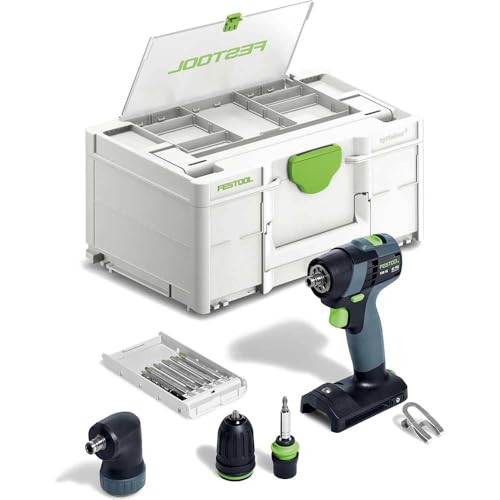
Festool TXS 18 — Best for kitchen fitters and high-end joinery
Price: Around £230–£290 bare; £370–£440 with batteries and charger
The TXS 18 is the small Festool drill that sits on the tool belt of every kitchen fitter and bespoke joiner who can justify the spend. It’s tiny, well balanced, and the right-angle and offset chuck attachments turn it into a genuinely different tool when you’re working into the back of a base unit.
It’s not a heavy-use drill — there are far better picks for first fix — but for fine joinery, kitchen install, furniture making and any work where access matters more than torque, nothing else in the UK trade market does what the TXS does. The Festool platform is small but the support and warranty are class-leading.
Pros: Outstanding for tight access work, swappable chuck attachments, very well balanced, premium fit and finish, three-year warranty.
Cons: Expensive, the Festool battery platform is small in the UK so battery sharing is limited, not the right pick for first-fix carpentry.
- Product type : POWER_TOOL_SET
- Brand : Festool
- The aim of is to offer many high quality products to customers and satisfy the needs of all customers.
Bosch Professional GSB 18V-90 C — Best Bosch Pro carpenter pick
Price: Around £160–£210 bare; £270–£340 with batteries and charger
Bosch’s blue Pro range is the underrated option in the UK trade scene. The GSB 18V-90 C is a brushless combi with proper torque, a metal chuck, and Bluetooth connectivity for the firmware updates and tool tracking that come with the Pro 360 platform. It’s not as common on UK sites as Makita and DeWalt, but the build quality is excellent.
Battery sharing is limited to the Bosch Professional 18V range, which is decent but smaller than LXT or M18. If you’re already in the Bosch ecosystem — track saw, multi-tool, planer — this is the drill to buy.
Pros: Brushless, strong torque, metal chuck, build quality is up there with Milwaukee, three-year Bosch Pro warranty.
Cons: Less common on UK sites, smaller battery ecosystem than the big two, the Bluetooth side is a marketing gimmick for most carpenters.
- Powerful brushless motor delivers high power with 64 Nm and 2,100 rpm maximising your efficiency on the job site
- 13-mm metal chuck ensures increased robustness and great torque transfer for every job
- Switchable Kickback Control and switchable Precision Clutch ensure perfect control and high protection for user and tool
- AMPShare: Batteries and chargers are fully compatible with the Bosch Professional 18V System as well as many other tools from brands in the AMPShare battery partnership
- Items included: GSB 18V-90 C, 2x GBA 4.0Ah Batteries, Charger GAL 18V-40, Inlay, L-BOXX
Ryobi One+ HP RPD18X — Best budget pick
Price: Around £80–£120 bare; £140–£200 with batteries and charger
The Ryobi One+ HP RPD18X is the obvious budget brushless combi for carpenters who don’t want to spend trade money — second jobbers, apprentices building a first kit, or anyone who wants a backup drill that lives in the second toolbox. The One+ platform is huge, including a track saw, planer and biscuit jointer aimed at the carpentry side, which is more than you’d expect at this price.
Don’t expect Makita-level torque or build quality. It will, however, drive most decking screws, run reasonable holesaws, and last longer than a non-brushless drill at the same price. The chuck is plastic-bodied and the bit grip isn’t as confident as the trade brands.
Pros: Brushless at a sensible price, huge One+ platform with proper carpentry tools, easy to find at B&Q and Amazon UK, fine for occasional and apprentice use.
Cons: Build quality is a step below trade brands, plastic chuck body, batteries are heavier than equivalent LXT or M18 packs.
- Model Pblhm101B
- RYOBI ONE HP 18V Brushless Cordless 1 2 in. Hammer Drill Tool Only PBLHM101B
- Product type: DRILL
- Yellow
UK carpenter cordless drills compared at a glance
|
Model |
Brushless |
Approx Price |
Best for |
|
Makita DHP486 LXT Combi |
Yes |
£150–£190 bare |
All-round UK carpenter |
|
Milwaukee M18 FUEL FPD3 |
Yes |
£190–£240 bare |
Heavy-use first fix |
|
DeWalt DCD800 Sub-Compact |
Yes |
£110–£150 bare |
Second-fix and kitchen fit |
|
Festool TXS 18 |
Yes |
£230–£290 bare |
Kitchen fit and joinery |
|
Bosch Professional GSB 18V-90 C |
Yes |
£160–£210 bare |
Bosch Pro ecosystem buyers |
|
Ryobi One+ HP RPD18X |
Yes |
£80–£120 bare |
Budget / apprentice / backup |
What to look for in a carpenter’s cordless drill
Brushless or bust
Buying a non-brushless drill in 2026 is hard to justify. Brushless motors run cooler, last longer, and are now standard at every sensible price point. The only reason to buy brushed is if you’ve found a stupid clearance deal.
Battery platform
The drill you buy is largely a decision about what battery you’ll own for the next decade. Makita LXT and Milwaukee M18 are the safe trade defaults. DeWalt 18V XR is also fine. Festool, Bosch Pro and Ryobi each have a place but think about what other tools you’ll add.
Combi vs drill driver
First fix carpenters and anyone doing the odd masonry job want a combi drill (with hammer mode). Second-fix carpenters and kitchen fitters who do almost no masonry are often better off with a sub-compact drill driver.
Chuck quality
A 13mm metal-bodied chuck that grips bits properly for years is worth a chunk of money over the life of the drill. Cheap plastic chucks slip on holesaws and large bits.
Weight on the belt
If the drill lives on your tool belt, every 200g matters. The DCD800 sub-compact and Festool TXS are the picks for belt-life. The Milwaukee FUEL is brilliant but heavier.
Final verdict
For most UK carpenters in 2026 the answer is still a Makita DHP486 LXT combi paired with the LXT batteries you already own — it’s the path of least resistance and it does the job. If you’re starting from scratch and prepared to spend trade money, the Milwaukee M18 FUEL is the better all-round build. If you’re a kitchen fitter or fine joiner with deep pockets, the Festool TXS 18 will earn its keep on access and balance.
Whatever you go with, buy at least two batteries, sit them on the charger in the van, and don’t cheap out on the chuck. The drill you carry every day is worth getting right.